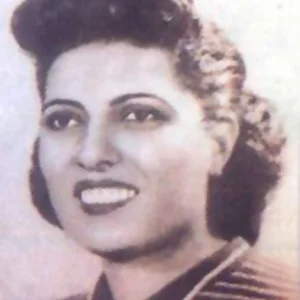

Samira Moussa (1917-1952) was an Egyptian nuclear physicist and a pioneer of atomic research in the Arab world. She worked to make the medical uses of nuclear energy accessible to all and died prematurely under circumstances that remain mysterious.
Sameera Moussa(1917 — 1952)
Samira Moussa
Égypte
6 min read
Frequently asked questions
Key Facts
- Born in 1917 in Gharbia (Egypt), she became one of the first women to graduate in science from Cairo University
- First woman to earn a doctorate in atomic radiation and to teach at Cairo University
- Campaigned for affordable medical applications of nuclear energy to treat cancer
- Earned a scholarship to study in the United States (University of California) in 1951
- Died in 1952 in a car accident in California, under circumstances that were never explained
Works & Achievements
Graduating top of her class at Cairo University, she immediately established herself as an exceptional student in radiation physics.
She broke a gender barrier by becoming the first Egyptian woman to teach at the faculty of sciences, paving the way for women in science.
A pioneer in the Arab world, she earned a doctorate devoted to atomic radiation, a field that was then brand new.
She devoted her work to making radiotherapy effective and affordable, in the hope of treating cancer for as many people as possible.
She organized a scientific gathering to champion the peaceful and medical uses of the atom, anticipating the debates of the postwar era.
Selected to study at American nuclear centers, she represented Egypt there before her untimely death.
Anecdotes
Cancer took Samira Moussa's mother when she was still young. Devastated, she vowed to put science at the service of the sick and made the fight against this disease the driving force of her entire career as a physicist.
Graduating top of her class in radiology in 1939, she became the first woman to teach at the Faculty of Science of Cairo University. Her professor, the great physicist Mostafa Mosharafa, saw her as an exceptional scientist and encouraged her to take up atomic research.
Convinced that nuclear medicine could save lives, she is said to have declared that she wanted to make nuclear treatment “as accessible and cheap as aspirin.” She organized a conference to promote the peaceful and medical use of atomic energy.
A Fulbright scholar in the United States, she visited several American atomic research centers. She was reportedly offered American citizenship to stay, but she refused, determined to return and put her knowledge at the service of Egypt.
On August 5, 1952, in California, the car taking her to a visit plunged into a ravine. The driver, who is said to have jumped out in time, was never found. Her death at 35 remains shrouded in mystery and still fuels many theories today.
Primary Sources
“I will make the nuclear treatment of cancer as available and as cheap as aspirin.”
She called for atomic energy to be placed at the service of health and peace rather than war, and worked to give Egypt and the Arab world access to this emerging science.
Key Places
Village in the Nile Delta where Samira Moussa was born in 1917. Her family later moved to Cairo for her education.
Egyptian capital where she grew up, studied and built her career. The country's intellectual and political center in her time.
Institution where she earned her degree in radiology and then became the first woman to teach science there. The place of her training and her early years as a researcher.
American atomic research center she attended thanks to a Fulbright scholarship. A major milestone of her scientific stay in the United States.
Region where she died on August 5, 1952 in a car accident that was never explained. The driver vanished without a trace.
Typical Objects

Instrument that detects and measures radioactivity, emitting a characteristic clicking sound. A basic tool for every nuclear physicist of the era.

Device producing X-rays used for radiography and radiotherapy. At the heart of Moussa's research into the medical applications of radiation.

A small quantity of radioactive radium kept in a lead-lined case, used to irradiate tumors. A precious and dangerous material from the early days of nuclear medicine.

A fog chamber that makes the paths of charged particles visible. It allowed scientists to observe the disintegration of atoms firsthand.

A white smock protecting clothing and limiting contamination. A symbol of the woman of science in a still largely male-dominated field.

Surface on which equations and atomic diagrams were written during lectures and demonstrations. A daily tool for the teacher she was.
School Curriculum
Vocabulary & Tags
Key Vocabulary
Tags
Daily Life
Morning
In the morning, Samira Moussa would leave the family home in Cairo to head to the university. She prepared her lectures and laboratory experiments, in a schedule shaped by the rhythm of teaching and research.
Afternoon
The afternoon was spent in the laboratory, among the instruments for measuring radiation, or in the library reading European and American scientific publications. She also mentored students, a rare thing for a woman of her time.
Evening
In the evening, she often continued her reading and her correspondence with other researchers, preparing lectures and projects. Cairo's intellectual life offered debates and encounters with the country's scholarly elite.
Food
Her diet reflected urban Egyptian cuisine: flatbread (aish), foul (fava beans), vegetables, rice and fruit from the Nile Delta, accompanied by tea. Meals were taken with the family according to the customs of the Cairo bourgeoisie.
Clothing
A modern, educated woman, she wore Western-style city clothes, understated and suited to scientific work, as well as the white coat in the laboratory. Her attire conveyed the image of an Egypt that was modernizing.
Housing
She lived in Cairo in housing typical of the educated middle class, close to the university institutions. At the time, the city blended modern buildings, old neighborhoods and intellectual ferment.
Historical Timeline
Period Vocabulary
Liens externes & ressources
Références
Œuvres
Licence de radiologie (major de promotion)
1939
Première femme enseignante en sciences à l'Université du Caire
vers 1939-1940
Doctorat en radiation atomique
années 1940
Recherches sur l'usage médical des rayonnements
années 1940-1950
Conférence pour l'énergie atomique au service de la paix
vers 1951
Séjour de recherche aux États-Unis (bourse Fulbright)
1951-1952