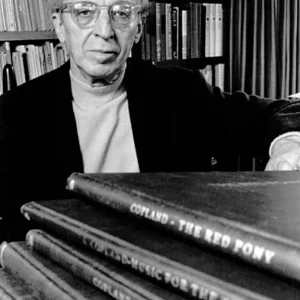

American composer (1900–1990) and a defining figure of 20th-century classical music. He sought to forge a distinctly American musical style by weaving together elements of jazz, folk music, and popular traditions.
Aaron Copland(1900 — 1990)
Aaron Copland
États-Unis
8 min read
Frequently asked questions
Famous Quotes
« The music I love best is the music that surprises me.»
Key Facts
- Born on November 14, 1900, in Brooklyn, New York, to Jewish parents who had immigrated from Russia.
- Studied composition in Paris under Nadia Boulanger during the 1920s.
- Composed Appalachian Spring (1944), a ballet written for Martha Graham, which earned him the Pulitzer Prize in 1945.
- Author of Billy the Kid (1938) and Rodeo (1942), iconic ballets celebrating the American West.
- Awarded the Presidential Medal of Freedom in 1964; died on December 2, 1990.
Works & Achievements
An orchestral work inspired by a popular Mexican dance hall and Mexican folk themes. It marks a turning point toward an accessible style rooted in the popular music of the Americas.
A ballet commissioned by the Ballet Caravan, telling the story of the famous outlaw of the American West. Copland incorporates authentic cowboy melodies, launching his great 'Americanist' cycle.
A short fanfare for brass and percussion commissioned during World War II to celebrate the ordinary American. Later incorporated by Leonard Bernstein into his Third Symphony, it has become a musical symbol of the United States.
A ballet choreographed by Agnes de Mille, whose four orchestral excerpts — most notably *Hoe-Down* — rank among the most frequently performed pieces in the American repertoire. It draws on cowboy dances and songs of the West.
A work for narrator and orchestra that weaves excerpts from Abraham Lincoln's speeches together with popular American musical themes. Removed from Eisenhower's inaugural concert in 1953 for political reasons, it became a symbol of freedom of expression.
Copland's masterpiece, composed for choreographer Martha Graham, depicting the life of a young pioneer couple in the Appalachians in the nineteenth century. It won the **Pulitzer Prize** for Music in **1945** and remains the most iconic work in twentieth-century American music.
Commissioned by the Koussevitzky Foundation, this monumental symphony — which incorporates the *Fanfare for the Common Man* in its finale — is regarded by many musicologists as the great American symphony of the twentieth century.
Anecdotes
Aaron Copland grew up in Brooklyn in a family of Russian Jewish immigrants who ran a department store. Nothing in his childhood suggested he would become the greatest American composer of his era: his parents had little interest in classical music, and it was through self-teaching, then private lessons, that he discovered his calling.
In 1920, Copland went to study in Paris under the legendary teacher Nadia Boulanger, the first woman to conduct major American orchestras. Their intellectual relationship was pivotal: it was she who encouraged him to draw from American popular music — jazz, blues, folk songs — to forge an authentically American style.
In January 1953, at the height of the McCarthyite witch hunt, the organizers of President Eisenhower's inaugural concert removed Copland's Lincoln Portrait from the program, on the grounds that the composer had associated with circles deemed 'subversive.' A few weeks later, Copland was called before McCarthy's Senate subcommittee, but no charges were brought against him.
When conductor Eugene Goossens commissioned several American composers to write fanfares for the 1942–1943 season, to boost the morale of a nation at war, Copland composed Fanfare for the Common Man in just a few days. Originally performed as a simple concert prelude, this piece of under four minutes is now one of the best-known American orchestral works in the world.
Appalachian Spring, composed in 1944 for choreographer Martha Graham, is built around the Shaker melody Simple Gifts. Copland had never heard the tune before discovering it in a folk song anthology — proof that his 'Americanism' was as much the product of scholarly research as of spontaneous inspiration. The work earned him the Pulitzer Prize for Music in 1945.
Primary Sources
The whole problem can be stated quite simply by asking, 'Is there a meaning to music?' My answer to that would be, 'Yes.' And 'Can you state in so many words what the meaning is?' My answer to that would be, 'No.'
The gifted composer… has always two choices before him : he may turn his back on the contemporary scene, or he may attempt to find a language that is peculiarly his own — one that reflects the life and times in which he lives.
I am seeking to write music that is recognizably American without being mistaken for raw folklore. It is not simple, but it is the only path that seems honest to me.
Jazz is the result of the energy stored up in America… it is the savage, restless, rhythmically acute expression of a people who know how to take life as they find it.
Key Places
Copland's home neighborhood, where he grew up in an immigrant family and taught himself music. The sounds and cosmopolitan energy of New York would nourish his musical imagination throughout his life.
Copland studied here from 1920 to 1924 at the American Conservatory in Fontainebleau, then with Nadia Boulanger in Paris. This formative stay gave him the technical and intellectual tools to develop a sophisticated American musical language.
Copland was one of the central figures of the Berkshire Music Center (now the Tanglewood Music Center), where he taught composition for decades and trained several generations of American composers.
Copland visited Mexico in the 1930s and struck up a friendship with composer Carlos Chávez. The festive atmosphere of the *Salón México*, a popular dance hall in Mexico City, directly inspired one of his most celebrated works.
The world premiere of *Appalachian Spring* took place at the Library of Congress in Washington in October 1944, and the federal capital was the setting for several key moments in Copland's career, from official honors to political hearings.
Typical Objects

Copland was himself a pianist and composed at the piano. He gave numerous recitals to champion contemporary American music, and the piano remained the central instrument in his creative process.

Copland wrote out his compositions by hand in a careful, legible script. His manuscripts, held at the Library of Congress in Washington, bear witness to a rigorous process of orchestration and revision.

Like many composers of his era, Copland used the phonograph to study the folk and jazz music he wanted to incorporate into his works, collecting recordings of traditional American and Mexican songs.

From the 1930s onward, Copland regularly conducted major American and European orchestras. As a respected conductor, he helped bring contemporary American music to concert halls around the world.

Copland drew on anthologies of Shaker melodies, spirituals, and cowboy songs to find authentic themes. It was in one such collection that he discovered the melody Simple Gifts, which lies at the heart of *Appalachian Spring*.

A prolific writer, Copland authored several books and essays on music aimed at general audiences. His typewriter served him in drafting lecture texts, articles, and educational works that did as much for his reputation as his compositions.
School Curriculum
Vocabulary & Tags
Key Vocabulary
Tags
Daily Life
Morning
Copland devoted his mornings to composition, working at the piano in the quiet of his country home in Westchester County, New York. He wrote his ideas directly onto manuscript paper, reserving the first hours of the day — intellectually the freshest — for pure creative work.
Afternoon
Afternoons were dedicated to revising scores, corresponding with colleagues (Leonard Bernstein, Marc Blitzstein, Carlos Chávez) and, during teaching sessions at Tanglewood, to composition classes and rehearsals. He also read widely, particularly literary and philosophical essays.
Evening
In the evenings, Copland was a willing fixture at concerts, theaters, and New York intellectual gatherings. A deeply curious music lover, he attended premieres by his contemporaries and maintained a broad network of friendships across the worlds of art, dance, and literature.
Food
Copland ate simply, in the manner of a cultured middle-class New Yorker of his era: light breakfasts, lunches often taken in the city with fellow musicians or publishers, and dinners cooked at home or in Manhattan restaurants. He had no particular indulgences and appreciated the Central European cooking he inherited from his Ashkenazi Jewish family background.
Clothing
Copland dressed with quiet, bourgeois elegance — suits and ties for concerts and formal events, and more relaxed attire (a sweater and flannel trousers) when composing or teaching in the country. His appearance reflected the seriousness of a mid-twentieth-century American intellectual.
Housing
Copland lived in New York for many years, but spent his most creatively productive years at his house in Rock Hill, in Cortlandt Manor, Westchester County, an hour from Manhattan. This country home with its large garden gave him the stillness his composition required, far from the urban noise he nonetheless loved deeply.