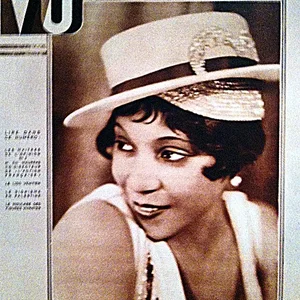

Adelaide Hall was an American jazz singer, later a naturalized British citizen, with an exceptionally long career. A pioneer of wordless singing, she rose to prominence in 1927 alongside **Duke Ellington** before becoming a star of the European stage.
Adelaide Hall(1901 — 1993)
Adelaide Hall
États-Unis
6 min read
Frequently asked questions
Key Facts
- Born on **20 October 1901** in Brooklyn (New York), died on **7 November 1993** in London.
- In **1927** she recorded the famous *Creole Love Call* with **Duke Ellington**, in which her wordless voice is used like an instrument.
- Performed in the Harlem revues, notably at the **Cotton Club**, during the **Harlem Renaissance**.
- Settled in Europe in the 1930s, opening a club in Paris (*La Grosse Pomme*) before establishing herself in London.
- Holds a record for longevity, with a recording career spanning more than seven decades.
Works & Achievements
Pioneering African-American Broadway musical, in which the young Adelaide Hall made her debut.
Recording in which her wordless vocalise caused a sensation and established her as a pioneer of the voice-as-instrument style.
Hugely successful revue in which she notably performed “I Can't Give You Anything But Love” and “Diga Diga Doo.”
Parisian sessions with the famous guitarist, emblematic of the transatlantic jazz of the interwar years.
During the war, she sang on the radio and for the soldiers, becoming a familiar figure to the British public.
Triumphant return to one of the world's most prestigious stages, crowning an exceptionally long career.
Anecdotes
In 1927, while on tour with Duke Ellington's orchestra, Adelaide Hall began improvising a wordless melody from the wings, turning her voice into a true instrument. Ellington was so captivated that he recorded it on the spot: this “Creole Love Call” made her a pioneer of wordless singing, a technique later taken up by countless jazz singers.
Adelaide Hall's career is one of the longest in the history of music: she sang professionally from the 1920s until the 1990s. The Guinness Book of Records honored her for a recording career spanning more than seventy years.
In the 1930s, Adelaide Hall settled in Paris for a while and opened a cabaret in Montmartre called “La Grosse Pomme,” a nickname for New York. The French capital, wild about jazz, was then welcoming many African American artists, such as Josephine Baker.
Settled in London, Hall and her husband Bert Hicks ran a hugely popular club. During the Blitz, the German bombing raids of 1940, the venue was destroyed. Far from giving up, the singer kept performing to lift the spirits of the British public and the troops.
In 1988, at the age of 86, Adelaide Hall returned to the stage of New York's prestigious Carnegie Hall. There, the audience was moved to discover an artist whose voice had spanned nearly the entire 20th century.
Primary Sources
On this record, Adelaide Hall's voice utters no words: she vocalizes and soars like an instrument above the orchestra, pioneering a new way of singing jazz.
“I can't give you anything but love, baby / That's the only thing I've got plenty of, baby.” Adelaide Hall popularized this standard from the very premiere of the revue on Broadway.
In Paris, Adelaide Hall recorded several tracks backed by guitarist Django Reinhardt, a testament to the transatlantic jazz exchanges between America and Europe.
Adelaide Hall is recognized there for a recording career spanning more than seven decades, from the 1920s to the 1990s.
Key Places
New York neighborhood where Adelaide Hall was born in 1901.
Heart of the Harlem Renaissance, where she performed in revues and recorded with Duke Ellington.
Parisian neighborhood where she opened her cabaret “La Grosse Pomme” in the 1930s.
Her adopted city from 1938 on: there she ran a club, sang on the BBC, and died in 1993.
Prestigious venue where she made a triumphant comeback in 1988, at over 80 years old.