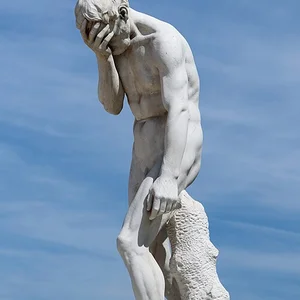

Abel is the second son of Adam and Eve in Genesis. A devout shepherd, he offers God the finest of his flock. Slain by his brother Cain, he becomes the first murder victim in the Abrahamic tradition.
Abel
Abel
9 min read
Frequently asked questions
Key Facts
- Second son of Adam and Eve according to Genesis (chapter 4)
- His animal offering is accepted by God, unlike Cain's
- Killed by his brother Cain, the first murder in human history according to the Bible
- A figure present in all three Abrahamic religions (Judaism, Christianity, Islam)
- His name is linked in Hebrew (הֶבֶל, Hevel) to fleeting breath and vanity
Works & Achievements
The foundational text of the Cain and Abel narrative, told in sixteen verses. This passage is the primary source for the entire Abrahamic tradition regarding Abel and has influenced millennia of Western theology, ethics, and art.
The Quranic version of the fratricide story, enriched by the episode of the raven teaching Cain how to bury his brother. In the Islamic tradition, this passage illustrates the themes of jealousy, repentance, and the absolute sanctity of human life.
The Jewish historian recounts the story of Abel from a historiographical and moral perspective. His account is one of the earliest 'biographies' of Abel outside the strictly biblical text, enriched with rabbinical interpretive elements.
A monumental depiction of Abel's sacrifice on the ceiling of the Sistine Chapel. This landmark work of the Renaissance helped fix the iconography of Abel in Western visual culture for centuries to come.
Medieval mystery plays staged the story of Cain and Abel before cathedral congregations. These popular productions spread the biblical narrative to wide audiences and embedded its moral symbols in the collective imagination.
Baudelaire turns Abel and Cain into emblems of two opposing humanities: the privileged, blessed by fate, set against the wretched of the earth. This two-part poem subverts the biblical tradition by reinterpreting the two brothers as figures of class struggle.
Anecdotes
The Hebrew name of Abel, 'Hevel' (הֶבֶל), literally means 'breath' or 'vapor.' This choice of name in the biblical text symbolically foreshadows the brevity of his life, cut short before it could ever fully unfold. The Book of Ecclesiastes uses this same word to denote the vanity and fragility of all human things.
According to Genesis, God accepts Abel's offering — the firstborn of his flock and their fat — but rejects Cain's. Theologians have long debated the reasons: the majority holds that Abel offers the very best of what he has with a sincere heart, while Cain brings only 'fruits of the ground' without any particular care.
In Islamic tradition, the story of Cain and Abel (known as Qābīl and Hābīl) is told in Surah Al-Ma'ida (5:27-31). It is there that the episode of the raven teaching Cain how to bury his brother appears — a passage absent from the Hebrew Bible but found in ancient rabbinic literature, illustrating how narratives circulated across traditions.
Abel's blood 'cries out from the ground' to God after the murder (Genesis 4:10). This poetic image became, in Christian tradition, the symbol of every innocent victim crying out for justice. The Epistle to the Hebrews (12:24) compares this blood to that of Christ, declaring that it 'speaks a better word than the blood of Abel.'
Abel is regarded in Christian tradition as one of the first saints and martyrs. In the ancient Catholic liturgy, the Roman Canon explicitly mentions 'the offering of your servant Abel the Just' as the prototype of the perfect sacrifice, making this prehistoric shepherd a central figure in Christian theology.
Primary Sources
Abel kept flocks, and Cain worked the soil. In the course of time Cain brought some of the fruits of the soil as an offering to the Lord. And Abel also brought an offering — fat portions from some of the firstborn of his flock. The Lord looked with favor on Abel and his offering, but on Cain and his offering he did not look with favor.
Recite to them in truth the story of the two sons of Adam. When they both offered a sacrifice, it was accepted from one of them and not from the other. The latter said: 'I will surely kill you!' The other replied: 'Allah only accepts from those who are righteous. If you raise your hand to kill me, I will not raise mine to kill you.'
By faith Abel brought God a better offering than Cain did. By faith he was commended as righteous, when God spoke well of his offerings. And by faith Abel still speaks, even though he is dead.
Abel, the younger, was virtuous and believed that God was present in all his actions; he practiced justice and strove in all his ways to avoid evil. Cain, by contrast, was corrupt by nature and thought only of gain.
What did they quarrel about? One said: 'The Temple will be built on my portion!' And the other: 'On my portion!' It was over this that Cain rose up against his brother Abel and killed him.
Key Places
The original place from which Adam and Eve, Abel's parents, came. Biblical tradition places it at the confluence of four rivers, including the Tigris and the Euphrates, in the region of Mesopotamia.
It is "in the fields" that Cain leads Abel and kills him, according to Genesis. This unnamed location has become the symbol of all fratricidal violence committed far from any human witness.
The territory east of Eden where Cain is condemned to wander after murdering his brother. Its Hebrew name (נוֹד) means "wandering" and symbolically represents the condition of the guilty, cast out from the presence of God.
The cradle of the first human civilizations and the likely geographical setting of the Genesis narratives. It was in this fertile crescent that the oral traditions surrounding the story of Abel took shape and were eventually committed to writing.
Some medieval Christian traditions place the murder of Abel southwest of Damascus. This site reflects the desire of believers to give the biblical narratives a geographical anchor, grounding them in physical reality.
Typical Objects

Abel chose the firstborn of his flock to offer to God, selecting the purest and finest animals. This sacrificial lamb becomes a symbol of his sincere devotion and, in the Christian tradition, prefigures the sacrifice of Christ, known as the 'Lamb of God.'

An iconic tool of pastoral life, the shepherd's staff accompanied Abel in his daily work, helping him guide and protect his flocks. It symbolizes both the gentleness and the responsibility of the shepherd toward his animals.

In the biblical tradition, offerings were placed on altars made of uncut stones, built in the open air. Abel raised such an altar to present his sacrifice to God — an act of piety and gratitude toward the Creator.

Abel offered not only the firstborn of his flock but also their fat, which in the Hebrew tradition was considered the most precious part of the animal. Offering the fat to God meant giving Him the very best before keeping anything for oneself.

After Abel's murder, his blood spilled onto the ground and 'cried out' to God, according to the biblical text. This image of earth stained by innocent blood has become a universal symbol of fratricidal violence and inescapable divine justice.

The nomadic shelter of the earliest herders, the shepherd's tent represents Abel's mobile way of life, following his flocks through the seasons. It stands in symbolic contrast to the settled existence of Cain, a farmer bound to his plot of land.
School Curriculum
Vocabulary & Tags
Key Vocabulary
Tags
Daily Life
Morning
At the break of dawn, Abel leaves his makeshift shelter to gather his flock, which has scattered during the night. He watches over the ewes in labor, makes sure the weakest animals are protected from predators, and guides his herd toward the greenest morning pastures.
Afternoon
Under the Mesopotamian sun, Abel leads his flock to watering holes. He carefully selects the most vigorous firstborns, setting them aside for the divine offering. His day is shaped by watchfulness and silent meditation beneath the vast open sky.
Evening
At sunset, Abel gathers his flock and prepares a stone altar for his offering. He lights a fire and places the meat and fat of the chosen animals on the altar in a gesture of gratitude toward God, before settling down to sleep under the stars.
Food
Abel's diet consists mainly of products from his flock: fermented ewe's milk, goat cheese, and occasionally meat from sacrifices — a portion of which traditionally goes back to the offerer. Wild fruits and vegetables gathered along the way round out his nomadic diet.
Clothing
Abel wears simple garments made from animal skins and raw wool spun by hand, in keeping with the tradition of nomadic shepherds across the ancient Near East. His practical attire is weather-resistant and suited to long treks across rocky hillsides.
Housing
Abel lives under a rudimentary tent of animal hides stretched over wooden stakes, moved along with the flock's seasonal migrations. This nomadic existence sets him in symbolic contrast to his brother Cain, a settled farmer bound to his plot of cultivated land.
Historical Timeline
Period Vocabulary
Visual Style
Enluminure médiévale et mosaïque byzantine : Abel jeune berger auréolé de sainteté, sur fond de collines dorées et d'autel de pierre fumant, dans une palette de terres chaudes, d'ivoire et d'or sacré.
Sound Ambience
Un paysage sonore pastoral et sacré : bêlements d'agneaux, vent tiède sur les collines arides, crépitement d'un feu d'autel sous un ciel immense — le silence solennel des origines du monde.
Liens externes & ressources
Références
Œuvres
Genèse, chapitre 4 (Bible hébraïque / Pentateuque)
VIIIe-VIe siècle av. J.-C.
Sourate Al-Mā'ida, versets 27-31 (Coran)
VIIe siècle apr. J.-C.
Antiquités judaïques, Livre I (Flavius Josèphe)
93 apr. J.-C.
Abel et Caïn, fresque de la chapelle Sixtine (Michel-Ange)
1508-1512
Mystères médiévaux — jeux du sacrifice d'Abel (théâtre religieux)
XIIe-XIVe siècle
« Abel et Caïn », Les Fleurs du Mal (Charles Baudelaire)
1857