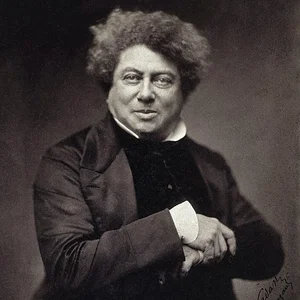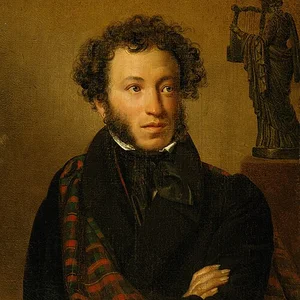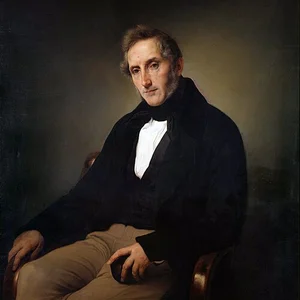

Alessandro Manzoni (1785–1873) was the greatest Italian novelist of the 19th century and a central figure of Romanticism. His historical novel *I Promessi Sposi* (*The Betrothed*, 1827) is regarded as the first modern novel written in Italian and played a decisive role in the linguistic unification of Italy.
Alessandro Manzoni(1785 — 1873)
Alessandro Manzoni
Saint-Empire romain germanique, empire d'Autriche, royaume d'Italie
8 min read
Frequently asked questions
Famous Quotes
« Il coraggio, uno non se lo può dare. (Courage is not something you can give yourself.) — *I Promessi Sposi*»
« *Adelchi*: Entra nel regno dei morti con la fronte del vincitore. (Enter the kingdom of the dead with the brow of a conqueror.)»
Key Facts
- **1785**: Born in Milan, grandson of **Cesare Beccaria**
- **1827**: Publication of *I Promessi Sposi*, the first great historical novel in modern Italian
- **1840**: Definitive revision of the novel, which established the Tuscan dialect as the national language standard
- **1860**: Appointed senator of the Kingdom of Italy following unification
- **1874**: **Giuseppe Verdi** dedicated his *Requiem* to him — one of the greatest works in the choral repertoire
Works & Achievements
The masterpiece of Italian literature and the first great historical novel written in Italian. The story of Renzo and Lucia, two young betrothed separated by a tyrannical nobleman in 17th-century Lombardy, has become a symbol of popular resistance and national unity.
A lyrical ode composed upon the death of Napoleon, translated into German by Goethe. This poem is one of the most celebrated works of 19th-century Italian poetry and is still studied in every Italian school.
A collection of five religious poems inspired by the major Christian feast days, bearing witness to Manzoni's conversion and his search for a spiritual poetry accessible to the widest possible audience.
A historical tragedy in verse that earned Manzoni the admiration of Goethe. In it, he defends creative freedom in drama against the classical rules of the three unities.
A tragedy about the fall of the Lombard kingdom in the 8th century, with clear political and national dimensions. Its lyrical choruses are considered among the high points of Italian Romantic poetry.
A foundational essay in which Manzoni argues for the adoption of living Florentine as the national language of Italy. This text directly influenced the linguistic policy of the newly unified Italian state.
Anecdotes
Alessandro Manzoni was the grandson of Cesare Beccaria, the renowned jurist and author of 'On Crimes and Punishments'. This distinguished lineage meant he was raised in an exceptional intellectual environment, steeped in Enlightenment ideas. Yet Manzoni went in a very different direction, turning toward the Catholic faith and Romanticism.
In 1810, while he was in Paris during the feast of Saint-Roch, Manzoni became separated from the crowd and stepped into a church to calm himself. This experience is said to have triggered his sudden conversion to Catholicism. From that moment on, the Catholic faith permeated all of his literary work.
After the first version of The Betrothed was published in 1827, Manzoni was dissatisfied with the language he had used, which was too heavily influenced by Milanese dialect. He decided to rewrite the novel entirely in Florentine Tuscan, declaring that one needed to “rinse one’s laundry in the Arno” (risciacquare i panni in Arno). The definitive version, published between 1840 and 1842, became a model of the Italian language.
When Napoleon died on Saint Helena on May 5, 1821, Manzoni composed the ode Il Cinque Maggio (The Fifth of May) within a matter of hours — a lyrical tribute to the Emperor. The poem was translated into German by Goethe himself and brought Manzoni immediate international fame. It remains one of the most memorized texts in Italian schools to this day.
Giuseppe Verdi, who deeply admired Manzoni, composed his celebrated Requiem in 1874 to mark the first anniversary of his death. Verdi had met Manzoni in 1868 and admitted to being so overwhelmed in his presence that he wept. Verdi’s Requiem remains one of the most performed choral works in the world.
Primary Sources
Quel ramo del lago di Como, che volge a mezzogiorno, tra due catene non interrotte di monti, tutto a seni e a golfi... — That branch of Lake Como, which turns southward between two unbroken chains of mountains, all in coves and bays...
Ei fu. Siccome immobile, / dato il mortal sospiro, / stette la spoglia immemore / orba di tanto spiro... — He was. As motionless, / after the mortal sigh, / the heedless remains stood still, / bereft of such a breath...
Dramatic poetry aims to represent an action; and the imitation is perfect only insofar as it produces in the reader or spectator the same impression that reality would produce.
Una lingua comune non è soltanto uno strumento di comunicazione, ma il fondamento stesso dell'unità nazionale e della civiltà condivisa. — A common language is not merely an instrument of communication, but the very foundation of national unity and shared civilization.
Madre de' Santi, immagine / della città superna... — Mother of Saints, image / of the heavenly city...
Key Places
Manzoni's family home in the heart of Milan, where he spent most of his life and wrote the bulk of his work. Today it is a national museum dedicated to the writer.
The geographical setting of *The Betrothed*: the novel unfolds around Lecco, on the banks of Lake Como. Manzoni describes these landscapes with striking precision from the very first chapter.
Manzoni's country retreat a few kilometres north of Milan. He withdrew there to work in peace and managed the family estate; it was here that he completed the revision of *The Betrothed*.
Manzoni visited Paris on several occasions and experienced his religious conversion there in 1810. He moved in French literary circles and absorbed the ideas of the emerging Romantic movement.
Manzoni travelled to Florence to study living Tuscan before rewriting *The Betrothed*. He wanted the novel's language to reflect spoken Florentine, the foundation of the future Italian national language.
Typical Objects

Manzoni was a perfectionist who relentlessly revised his texts. The complete rewriting of *The Betrothed* from 1827 to 1840 illustrates his absolute demand for literary Italian.

The everyday tools of the Romantic writer, with which Manzoni composed his novels, tragedies, and poems in his Milanese study or at his villa in Brusuglio.

After his conversion in 1810, Manzoni was a devout Catholic. These objects of piety accompanied his daily meditation and nourished his spiritual inspiration.

As Beccaria's grandson, Manzoni had been shaped by the philosophical ideas of the 18th century. He kept the works of Voltaire and the encyclopédistes in his library, even though he had distanced himself from them after his conversion.

To revise *The Betrothed*, Manzoni methodically studied living Tuscan, consulting dictionaries and native speakers from Florence in order to purify the novel's language and make it a national model.

Manzoni maintained an extensive correspondence with the European intellectuals of his time, including Goethe, who had translated *Il Cinque Maggio*. These letters attest to his literary influence beyond the Alps.
School Curriculum
Vocabulary & Tags
Key Vocabulary
Daily Life
Morning
Manzoni rose early and began his day with prayer and Mass, a daily practice since his 1810 conversion. He then devoted his mornings to writing in his study, taking advantage of the quiet hours to work on his texts with methodical concentration.
Afternoon
Afternoons were often given over to reading and research, particularly historical sources for his novels and tragedies. He also received visitors — intellectuals, publishers, or admirers — in his Milanese salon on the Via Morone, where his brilliant conversation and dry wit made him a much-appreciated host.
Evening
Evenings brought family and close friends together for readings aloud and literary discussions. Manzoni did, however, suffer from a form of agoraphobia that made him uncomfortable in large social gatherings; he preferred these intimate circles to the bustle of salon life.
Food
Like many prosperous nineteenth-century Lombards, Manzoni ate simple, regional food: polenta, risotto, vegetables, beef, and pork. At his villa in Brusuglio he enjoyed the produce of his own land, and family mealtimes were a structuring moment of the day.
Clothing
Manzoni dressed in the dark, bourgeois style typical of Romantic intellectuals: a black tailcoat or frock coat, white cravat, waistcoat, and fitted trousers. As he aged he dressed more simply, favouring comfort over ostentatious elegance.
Housing
Manzoni lived primarily in the Palazzo Manzoni, a patrician residence in the heart of Milan inherited from his family, with a large library and a garden. He also had the villa at Brusuglio in the countryside, where he would retreat to write and recharge away from the bustle of city life.
Historical Timeline
Period Vocabulary
Liens externes & ressources
Références
Œuvres
I Promessi Sposi (Les Fiancés)
1827 (1re éd.) / 1840-1842 (éd. définitive)
Il Cinque Maggio (Le Cinq Mai)
1821
Inni Sacri (Hymnes Sacrés)
1812-1822
Il Conte di Carmagnola (Le Comte de Carmagnola)
1820
Dell'unità della lingua e dei mezzi di diffonderla
1868