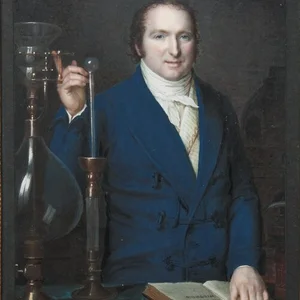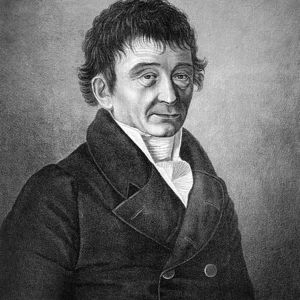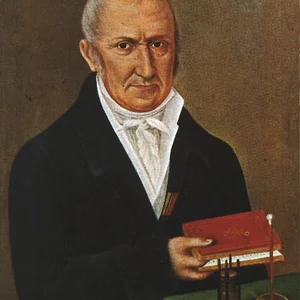

Italian physicist (1745–1827), Alessandro Volta invented the electric battery in 1800, the first source of direct current in history. His work on electricity revolutionized experimental physics and paved the way for electrochemistry.
Alessandro Volta(1745 — 1827)
Alessandro Volta
duché de Milan, royaume de Lombardie-Vénétie, République cisalpine
10 min read
Frequently asked questions
Famous Quotes
« Electricity is not simply a natural phenomenon — it is a tool that man can master.»
Key Facts
- Born in Como (Italy) in 1745
- Invention of the electrophorus in 1775, a machine for generating static electricity
- Invention of the voltaic pile in 1800, the first electric battery in history
- The unit of electrical voltage, the volt, is named in his honor
- Died in Como in 1827
Works & Achievements
Volta's first printed memoir, published in Como. In it, he outlines his initial hypotheses on the nature of electric fire and its attractive force, following in the tradition of Franklin's theories.
A device capable of generating electric charges through electrostatic induction repeatedly without recharging the source. This invention brought him immediate recognition across Europe and allowed him to correspond with the greatest physicists of his time.
Volta isolates and characterizes methane ("inflammable air from marshes") and devises a method for collecting and igniting it with an electric spark. It stands as one of the earliest identifications of a pure combustible gas distinct from hydrogen.
An instrument for detecting and measuring very weak electric potentials by combining a capacitor with a gold-leaf electroscope. It made quantitative measurements in electrostatics possible where none had been achievable before.
Published in the Philosophical Transactions of the Royal Society (vol. 90, 1800), this letter describes the voltaic pile for the first time. It stands as one of the founding documents of modern electrical engineering and electrochemistry.
The first source of continuous electric current in history, made up of zinc-copper pairs separated by moist electrolytes. It immediately opened the way to electrolysis, electromagnetism, and, a century later, industrial electrical engineering.
Anecdotes
Volta and Luigi Galvani, his fellow Italian from Bologna, clashed in a scientific debate that became famous as the “frog war.” Galvani believed he had discovered an “animal electricity” unique to living tissue, having observed frog legs contract when touched with metals. Volta rigorously demonstrated that the electricity came from the contact between two different metals, not from the muscles. This foundational disagreement led directly to the invention of the battery in 1800.
In November 1801, Volta was summoned to Paris to present his battery before Napoleon Bonaparte, who was then First Consul. So captivated was he by the demonstration that Napoleon had a session of the Institut de France interrupted so he could question the scientist himself. He awarded Volta a gold medal, a pension, and, a few years later, the title of count and the rank of senator of the Kingdom of Italy.
In 1776, Volta discovered methane by collecting gases escaping from the marshes of Lake Maggiore. He stirred bubbles to the surface with a stick, collected them in an inverted container, and set them alight: the blue flame that appeared confirmed to him that this was a new combustible gas. He called this substance *aria infiammabile nativa delle paludi* — the native inflammable air of the marshes.
When he announced his invention of the battery to the president of the Royal Society of London, Joseph Banks, on 20 March 1800, Volta described his device as a “column” of alternating zinc and copper discs, separated by cloth discs soaked in salt water. This letter, translated and published within weeks in the Philosophical Transactions, sent shockwaves through the European scientific community: for the first time, a continuous, controllable electric current was available.
Volta long suffered from a reputation as a slow child within his family: he did not speak his first words until he was four years old. His family even considered placing him in a specialist institution. Yet by the age of seven he had caught up with his peers, and by fourteen he was already corresponding with the French physicist Jean-Antoine Nollet on matters of electricity.
Primary Sources
The apparatus of which I speak, and which will, no doubt, astonish you, is only an assemblage of a number of good conductors of different kinds arranged in a certain manner. Thirty, forty, sixty or more pieces of copper, or rather silver, applied each to a piece of tin, or zinc, which is much better, and as many strata of water, or any other liquid which may be a better conductor than pure water…
L'elettricità che si manifesta nel contatto dei metalli è puramente metallica, e non ha nulla in comune con quella pretesa elettricità animale del Galvani. I muscoli della rana non sono altro che uno strumento rivelatore dell'elettricità sviluppata dal contatto dei due metalli dissimili.
Electricus ignis ex nubibus per fulmen in terram devolat, et terrae calorem auget; quod phaenomenon nisi attractivis viribus electricis explicari non potest… Tentabo igitur ostendere quomodo haec vis attractiva cum aliis electricis phaenomenis cohaereat.
Ho trovato nelle acque paludose del lago Maggiore una gran quantità di aria infiammabile. Raccogliendola con cura e applicandovi una scintilla, essa brucia con una fiamma azzurrognola assai bella, diversa dall'idrogeno puro. Questo gas mi sembra una sostanza nuova e degna di ulteriori indagini.
L'elettroforo è uno strumento capace di fornire cariche elettriche in quantità quasi inesauribile senza alcun sfregamento ripetuto, sfruttando unicamente l'induzione elettrostatica su un disco di resina elettrizzato una sola volta. Esso supera in comodità e in potenza tutte le macchine elettrostatiche conosciute.
Key Places
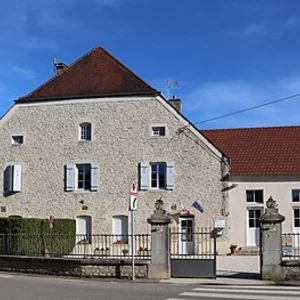
Volta's birthplace and the city where he died, spending most of his life there. The city dedicated a neoclassical temple to him (the Tempio Voltiano), inaugurated in 1927 on the centenary of his death, which preserves his original scientific instruments.
Volta was appointed professor of experimental physics here in 1779 and taught for forty years. It was in this academic setting that he conducted his research on animal electricity, designed the condensing electroscope, and ultimately invented the electric battery.
In November 1801, Volta demonstrated his battery here before Napoleon Bonaparte and the members of the Institut de France. This historic session earned him France's highest distinctions and secured his invention's international fame.
It was while exploring the marshy shores of Lake Maggiore in 1776 that Volta collected gas bubbles rising to the surface and identified methane. These naturalist field excursions illustrate the hands-on experimental method characteristic of Enlightenment physicists.
It was at the University of Bologna that Galvani conducted his experiments on frogs, corresponded with Volta, and where the two scientists met. This scientific dialogue — sometimes contentious — was the direct breeding ground for the invention of the battery.
Typical Objects

Invented by Volta in 1800, it consists of a column of alternating zinc and copper discs separated by cloth pads soaked in salt water or dilute acid. It was the first source of continuous electric current in history, and Volta varied the number of elements to increase the voltage produced.

Invented by Volta in 1775, this instrument consists of a resin disc electrified by friction and a metal plate. By bringing the plate close to the resin, an electric charge is obtained by induction — reproducible indefinitely without re-electrifying the resin — which revolutionized the production of static electricity.

Refined by Volta around 1783, this apparatus combines a capacitor with a gold-leaf electroscope to detect extremely faint electric charges. It allowed Volta to measure minute electrical potentials that were impossible to perceive with the instruments of the time.

Invented in 1745 by Pieter van Musschenbroek, this glass bottle lined with tin foil was the principal electrostatic capacitor of the 18th century. Volta was familiar with it and used it in his experiments before eventually superseding it with his own inventions.

A small sealed tube filled with a mixture of combustible gas and air, in which an electric spark triggers a measurable explosion. Volta used it to analyze the composition of air and to study methane, which he had just discovered seeping from marshes.

A large glass wheel rubbed against leather pads to generate static electricity, a standard piece of equipment in 18th-century laboratories. Volta made extensive use of it before inventing his pile, particularly for his public demonstrations at the University of Pavia.
School Curriculum
Vocabulary & Tags
Key Vocabulary
Daily Life
Morning
Volta rose early, whether in his spacious home in Como or in his university lodgings in Pavia. He spent the first hours of the morning reading European scientific journals — notably the Philosophical Transactions of London and the Annales de chimie of Paris — and writing correspondence with scholars across the continent, often in Latin or French.
Afternoon
His afternoons were divided between teaching at the University of Pavia, where his experimental physics lectures drew students from across Italy, and work in the laboratory. He handled his instruments himself, tested his hypotheses through repeated experiments, and refined his apparatus — as evidenced by his notebooks filled with sketches and measurements.
Evening
Evenings were frequently devoted to social and intellectual gatherings, which were essential for a scientist eager to disseminate his work and secure patronage. Volta received colleagues, attended meetings of local academies, and corresponded with major European scientific institutions. A music lover, he also played the guitar in the evenings.
Food
Like most Lombard bourgeois of his era, Volta ate meals based on polenta, risotto, local cheeses (including Como cheese), roasted meats, and seasonal vegetables. Family meals were occasions for lively discussion; after his marriage in 1794 to Teresa Peregrini, he enjoyed a stable and generous family table.
Clothing
As a university professor and public figure, Volta wore the sober but well-kept attire of late-eighteenth-century scholars: woolen breeches, silk stockings, waistcoat, and a skirted coat, with a powdered wig in his youth and then natural hair tied back in the revolutionary fashion from the 1790s onward. For official demonstrations — most notably in Paris before Napoleon — he wore his academic robes.
Housing
Volta lived primarily in Pavia during his teaching years, in university-provided lodgings adjacent to the campus that included a spacious laboratory. In Como, his hometown, he owned a comfortable family home in the historic center, with a garden overlooking the lake. After his retirement in 1819, he settled permanently in Como, in a villa at Camnago (today renamed Camnago Volta in his honor).
Historical Timeline
Period Vocabulary
Liens externes & ressources
Références
Œuvres
De vi attractiva ignis electrici (Sur la force attractive du feu électrique)
1769
Invention de l'électrophore
1775
Découverte du méthane
1776
Invention de l'électroscope condensateur
vers 1783
Lettre à Joseph Banks annonçant la pile électrique
20 mars 1800
Invention de la pile voltaïque
1799-1800