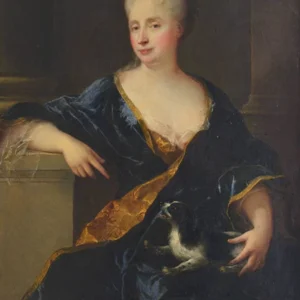

A Parisian writer and salon hostess (1647–1733), she presided over one of the most influential literary salons of the Regency period, frequented by Fontenelle, Montesquieu, and Marivaux. A pioneer in thinking about women's education, she championed their access to intellectual life.
Anne Thérèse de Marguenat de Courcelles, marquise de Lambert
Anne Thérèse de Marguenat de Courcelles, marquise de Lambert
France
8 min read
Frequently asked questions
Famous Quotes
« One must cultivate one's mind in order to converse with others, and one's heart in order to love them.»
« Glory is the sun of the dead.»
Key Facts
- 1647: Born in Paris into a family of the noblesse de robe
- Around 1710: Opening of her salon on the Rue de Richelieu, one of the most influential of the Regency period
- 1727: Posthumous publication of Advice from a Mother to Her Son and Advice from a Mother to Her Daughter
- She campaigned for the admission of women to the Académie française
- 1733: Died in Paris, leaving behind a major moral and philosophical body of work
Works & Achievements
A work of moral education addressed to her son, championing virtue, honor, and personal merit over the mere privileges of birth. Reprinted dozens of times, it was translated into several European languages.
The feminine counterpart to the previous work, it argues for the serious education of young women and their right to intellectual life, challenging the prejudices of the time. A pioneering text in the reflection on women's emancipation through knowledge.
A short but decisive essay denouncing the injustice of denying women an education and then blaming them for their ignorance. Considered a precursor to Enlightenment feminism, it anticipates the arguments later developed by Condorcet.
A philosophical reflection on the nature of true friendship, distinguished from flattery and self-interest. Madame de Lambert develops an ethics of social relationships grounded in shared virtue.
A personal meditation on the art of aging with dignity and serenity, inspired by Antiquity (Cicero) yet infused with intimate experience. It reflects a Stoic sensibility adapted to modern feeling.
Her correspondence with Fontenelle, Montesquieu, and other figures of the Enlightenment forms a valuable document on the intellectual life of the Regency period and on the role of salon hostesses in the circulation of ideas.
Anecdotes
Mme de Lambert's salon at the Hôtel de Nevers was nicknamed 'the antechamber of the Académie française': several academicians were said to have been 'prepared' there before their official election. Fontenelle, La Motte-Houdar, and Marivaux attended her Tuesday literary gatherings, and it was widely understood that no serious candidacy could succeed without her support.
Her 'Réflexions nouvelles sur les femmes' first circulated in manuscript form among literary circles before being printed in 1727 without her authorization, in The Hague. Mme de Lambert, mindful of her reputation and of propriety, publicly disowned this edition — while never actually denying the substance of her ideas.
After her husband's death in 1686, Mme de Lambert had to pursue lengthy legal proceedings to recover her dowry and personal fortune, which had been swallowed up by the marquis's debts. This painful experience deepened her thinking on women's legal dependence and the importance of their education.
Montesquieu, then a young presiding magistrate in Bordeaux, was a regular at Mme de Lambert's salon during the 1720s. He read excerpts from his 'Persian Letters' there and later acknowledged the influence those discussions had on the development of his political thought.
Mme de Lambert wrote her 'Advice to Her Son' and 'Advice to Her Daughter' for private use, as educational letters intended for her own children. When they were published, their success was immediate: they were reprinted dozens of times and translated into several languages — an outcome their seemingly modest author had never planned for.
Primary Sources
"Virtue alone confers true nobility; titles and birth only lend a false brilliance to those who lack it."
"Women have two paths to choose from: either withdrawal and serious pursuits, or society and flirtation. There is no middle ground that does not degrade them."
"Women are denied education and virtue, and are then reproached for having neither. This is a glaring injustice."
"Friendship is a communion of souls; it can only exist between persons who share the same principles and the same feelings about honor and virtue."
"Old age is a condition one must firmly come to terms with: either one accepts it with wisdom, or one resists it with ridicule."
Key Places
Madame de Lambert's Parisian residence from 1710, where she held her celebrated salon for over twenty years. The venue became the intellectual hub of the Regency era, frequented by Fontenelle, Montesquieu, Marivaux, and La Motte-Houdar.
The institution whose elections Madame de Lambert influenced on multiple occasions, despite being barred from membership as a woman. Her salon was nicknamed "the antechamber of the Académie" — so decisive was her support for candidates seeking election.
The seigneurial estate of the Marquis de Lambert, where Anne Thérèse spent part of her married life. It was here that she wrote her first educational texts, intended for her children.
A gathering place for Parisian social life during the Regency, situated near the Lambert salon. The gardens of the Palais-Royal served as a natural extension of the philosophical conversations held in the surrounding salons.
Typical Objects
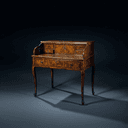
A drop-front bureau decorated with precious wood inlays, an essential piece of furniture for a woman of letters of standing. Mme de Lambert used it to write her 'Advice' essays and her correspondence with the philosophers and academicians of her circle.
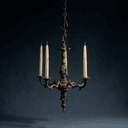
The central lighting fixture of 18th-century drawing rooms, a symbol of evening social life. Gatherings at the Hôtel de Nevers would stretch late into the night by candlelight, centered on philosophical and literary discussion.

Philosophical and literary works — Descartes, Malebranche, Fontenelle — bound in fine leather filled Mme de Lambert's personal library, reflecting a level of erudition that was quite uncommon for a woman of her era.
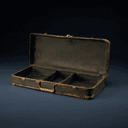
A portable box containing ink, quill pens, and vellum paper, allowing letters to be written while on the move. Correspondence was for Mme de Lambert an essential tool of her intellectual influence.

The pastel technique, fashionable during the Regency period, gave rise to several portraits of Mme de Lambert. These portraits circulated among literary figures as a sign of belonging to a cultivated network.
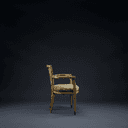
An iconic piece of the French aristocratic drawing room, at once an object of comfort and a marker of social rank. The arrangement of armchairs around the hostess organized the subtle hierarchy of intellectual exchange.
School Curriculum
Vocabulary & Tags
Key Vocabulary
Tags
Daily Life
Morning
Mme de Lambert rose early and devoted her mornings to reading and writing in her private study. She attended to her correspondence — letters to Fontenelle, recommendations for Academy members — and reviewed her works in progress with the exacting stylistic standards she had inherited from classical culture.
Afternoon
Afternoons were reserved for managing her townhouse and paying courtesy calls. She received a small circle of regular visitors, discussed the latest publications, and prepared her evening gatherings by selecting the topics of conversation she would propose to her guests.
Evening
Every Tuesday evening, the Hôtel de Nevers came alive for its famous literary salons: academicians, philosophers, playwrights, and courtiers gathered around Mme de Lambert. Discussions ranged across science, morality, and belles-lettres, and could continue well into the night.
Food
Mme de Lambert's table was that of a great Parisian household of the 18th century: soups, roasted meats, freshwater fish, vegetables in sauce, and sweet entremet desserts, accompanied by Burgundy wines. Salon dinners were occasions to blend gastronomic pleasure with refined conversation.
Clothing
Mme de Lambert wore the robe à la française (the sack-back gown), in embroidered silks of restrained colours — midnight blue, burgundy, pearl grey — with Mechlin lace at the cuffs and neckline. A fontange headdress in her earlier years, later powdered hair, and discreet pearl or cameo jewellery completed a carefully composed image of intellectual elegance.
Housing
The Hôtel de Nevers, on the rue de Richelieu, was a Parisian townhouse with a courtyard and garden, typical of the noblesse de robe. The reception rooms, adorned with carved wood panelling, mirrors, and Old Master paintings, alternated with a study lined with bookshelves. The house reflected both the social standing and the intellectual aspirations of its mistress.
Historical Timeline
Period Vocabulary
Visual Style
Intérieur aristocratique français de la Régence, boiseries dorées et lumière de bougie, dans le style des portraitistes de cour Rigaud et Largillière. Élégance retenue, soieries riches et atmosphère de conversation philosophique.
Sound Ambience
Ambiance feutrée d'un salon parisien sous la Régence : conversations philosophiques au coin du feu, clavecin discret et froissement de papier à lettre. Le monde des idées circule à voix basse dans la lumière des bougies.
Liens externes & ressources
Références
Œuvres
Avis d'une mère à son fils
1726
Avis d'une mère à sa fille
1728
Réflexions nouvelles sur les femmes
1727
Traité de l'amitié
1736 (posthume)
Traité de la vieillesse
1736 (posthume)
Lettres et correspondance
XVIIIe siècle