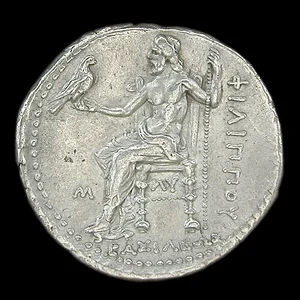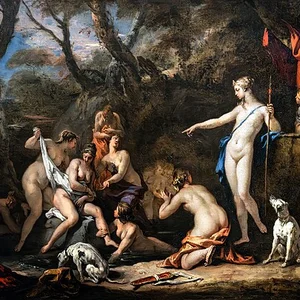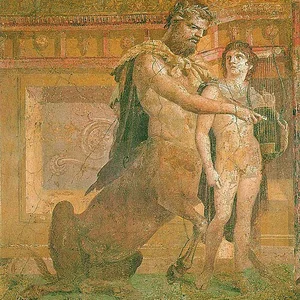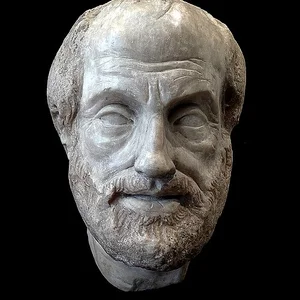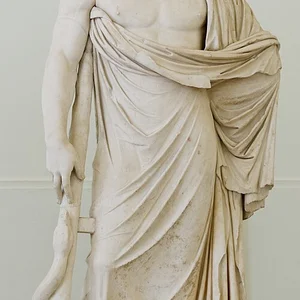

Greek god of medicine and healing, son of Apollo and Coronis. Raised by the centaur Chiron, he mastered the healing arts so completely that he could resurrect the dead — a transgression that led Zeus to strike him down with a thunderbolt.
Asclepius
Asclepius
9 min read
Frequently asked questions
Key Facts
- Son of Apollo and the mortal Coronis, he was raised by the centaur Chiron, who taught him the art of healing
- His sanctuaries, the Asclepeions, served as both temples and places of healing; the most famous was at Epidaurus (4th century BCE)
- His attribute, the staff entwined with a serpent (the Rod of Asclepius), remains the universal symbol of medicine
- Zeus struck him down with a thunderbolt for resurrecting mortals (including Hippolytus), transgressing the cosmic order
- His daughters Hygieia and Panacea personify prevention and universal remedy respectively, giving us the roots of our medical vocabulary
Works & Achievements
Asclepius is credited with bringing the medical art to perfection, mastering surgery, remedies, and resurrection. His tradition was passed on to his sons Machaon (surgeon) and Podalirius (internist), the mythical ancestors of the Asclepiads.
Asclepius is credited with several resurrections in Greek mythology. These transgressive acts of raising the dead led to his being struck down by Zeus's thunderbolt; Zeus feared that the boundary between mortals and immortals would be permanently erased.
More than 200 sanctuary-hospitals dedicated to Asclepius have been documented across the Mediterranean basin, offering ritual care, incubation, and medical consultations — an unprecedented public health network in the ancient world.
Hippocrates and his disciples, claiming descent from Asclepius, composed this corpus of foundational treatises of Western rational medicine. The Hippocratic Oath begins by invoking Asclepius, Hygieia, and Panacea.
After his death by Zeus's thunderbolt, Asclepius was placed in the sky as the constellation Ophiuchus, the "serpent bearer." Visible from the northern hemisphere, it serves as an eternal reminder of his tragic and glorious fate.
Anecdotes
Asclepius was the son of Apollo and the mortal Coronis. When Coronis betrayed the sun god by falling in love with a mortal man, Apollo had Artemis kill her. Before the funeral pyre consumed her body, he drew the child from her womb himself — a birth so miraculous that some ancient writers saw it as the mythological origin of what we now call the caesarean section.
Entrusted to the centaur Chiron on the wooded slopes of Mount Pelion in Thessaly, Asclepius learned botany, surgery, and the healing arts from this exceptional teacher. He soon surpassed his mentor: according to some versions of the myth, Athena gave him the blood of the Gorgon Medusa, whose left vein brought death and whose right vein could raise the dead back to life.
Zeus struck Asclepius down with a thunderbolt after he restored several mortals to life, including Hippolytus and Capaneus. The king of the gods feared that this transgression of the boundary between life and death would upset the cosmic order and rob the gods of their immortal privilege. After his death, Asclepius was placed among the stars as the constellation of the Serpent Bearer, known as Ophiuchus.
In the Asclepieia — the sanctuary-hospitals dedicated to the god — the sick practiced "incubation": after ritual purification and fasting, they lay down in the abaton, the sacred dormitory, hoping to receive a visit from the god in their dreams, who would reveal their cure. Non-venomous snakes roamed freely within the precinct; patients who recovered left anatomical votive offerings in terracotta depicting their afflicted limb or organ.
When Socrates, condemned to death, drank the hemlock, his last words were: "Crito, we owe a cock to Asclepius." This traditional sacrifice offered in thanks to the god after a recovery suggested that Socrates viewed death as the final cure for the illness of life — an enigmatic phrase that philosophers are still debating today.
Primary Sources
He freed some from painful diseases, others from grievous wounds […] but even he was seduced by gold, and he brought back a man already held by death. Zeus struck him down with a thunderbolt.
Then came those from Tricca, rocky Ithome, and Oechalia: thirty ships followed them, commanded by the two sons of Asclepius, Podalirius and Machaon, both skilled physicians.
The Epidaurians say that Asclepius was born in their territory […] The sanctuary of Asclepius is bounded on all sides; neither men nor animals die within it, and women do not give birth there.
These were his last words. Then he said: 'Crito, we owe a cock to Asclepius; pay the debt and do not neglect it.' — 'It shall be done,' said Crito. 'But see if you have anything else to say.' He made no reply.
'I am he whom you seek. Set aside your staff. I shall be greater than it and shall take on the serpent form you see.' He spoke, and, growing larger, he took his place among the heavenly stars, shining as a benevolent deity.
Key Places
The principal sanctuary of Asclepius in the Greek world, founded around the 6th century BCE. Its remarkably well-preserved theater and exceptional archaeological remains have been inscribed on the UNESCO World Heritage List since 1988.
A mountainous massif in Thessaly where the centaur Chiron, master of Asclepius, made his home. It was on these forested slopes that the young god learned the arts of healing, medicinal botany, and surgery.
A city in Thessaly regarded as the mythical birthplace of Asclepius, mentioned by Homer in the Iliad as the home of his physician sons. It is home to the oldest known sanctuary of the god.
In 293 BCE, a sacred serpent brought from Epidaurus settled here of its own accord, designating the site for a temple to Aesculapius. The island remains a medical center to this day, continuing a healing tradition more than two thousand years old.
A sanctuary built in the 4th century BCE on the home island of Hippocrates, symbolizing the dialogue between sacred and rational medicine. It comprises three terraced levels of temples and colonnades overlooking the Aegean Sea.
A great thermal and religious complex in Asia Minor, widely visited during the Roman era for its healing treatments, sacred waters, and medical school. Galen of Pergamon, the greatest physician of the Roman world, began his career here.
Typical Objects

Asclepius's principal attribute, this staff topped with a coiled serpent has become the universal symbol of medicine. The serpent, which regularly sheds its skin, evokes renewal, healing, and the cycle of life and death.

Non-venomous snakes lived in the Asclepieia and were considered living embodiments of the god. Patients sleeping in the abaton hoped to be licked or touched by a serpent, a sign of divine healing.

An animal traditionally sacrificed to Asclepius after a cure, symbolizing the return to life and light. Socrates' last words — "we owe a rooster to Asclepius" — illustrate the importance of this rite of gratitude.

Plaques of bronze, marble, or terracotta on which healed patients inscribed their testimonies of gratitude. Hundreds have been found at Epidaurus, describing miraculous cures attributed to the god.

Figurines depicting diseased limbs, organs, or body parts, offered to the god before or after healing. These ex-votos are now a valuable source for the history of ancient medicine and the diseases of antiquity.

A shallow cup used to pour libations during rituals in honor of Asclepius. It frequently appears in sculptural representations of the god, marking his sacred and ritual dimension.

A wooden bed or stone slab in the sanctuary's abaton, on which the sick would lie to receive the healing visit of Asclepius in a dream. Incubation was the central rite of the Asclepian cult.
School Curriculum
Vocabulary & Tags
Key Vocabulary
Tags
Daily Life
Morning
At sunrise, the priest-physicians of the Asclepion make their way to the patients sleeping in the abaton to collect accounts of their dreams. According to myth, it is at this hour that Asclepius would visit the suppliants in their sleep, prescribing remedies, diets, or baths according to the nature of their ailment. The sacred serpents resume their slow wandering between the columns.
Afternoon
The sanctuary comes alive: sick people who have traveled from across Greece arrive in procession, carrying offerings and anatomical votive terracottas. Asclepiad physicians examine patients in the shaded porticoes, prescribing herbal infusions, hot baths, or bloodletting according to the precepts handed down since Chiron. The sanctuary's attendants receive gifts from grateful families.
Evening
At dusk, the priests lead the new patients through purification rites: baths in the waters of the sacred spring, ritual ablutions, and the sacrifice of a rooster or a lamb. After fasting and these purifications, the suppliants don a white linen tunic and lie down on their klinē in the abaton, praying to Asclepius to come to them in the night and reveal their cure.
Food
In the Asclepia, patients followed strict dietary regimens prescribed by the priests: grains, vegetables, honey, and water from the sacred spring, sometimes supplemented with infusions of medicinal plants such as mint, vervain, or sage. The ritual fast before incubation was mandatory to purify body and mind, encouraging the prophetic dreams sent by the god.
Clothing
Asclepius is invariably depicted draped in a long white or off-white woolen himation, leaving the right shoulder bare in the manner of Greek gods. The priests and physicians of his cult wore white garments symbolizing the purity essential to the practice of sacred medicine; purified patients donned a linen tunic before entering the abaton.
Housing
Asclepia were vast architectural complexes comprising a main temple with Doric or Ionic columns, a sacred abaton dormitory, ritual baths and pools, a circular tholos of mysterious purpose, and often a theater. Set in soothing natural surroundings — wooded hills, springs, and fresh air — they were true sanatorium-cities where divine medicine and practical care existed side by side.
Historical Timeline
Period Vocabulary
Visual Style
Style grec classique et hellénistique : Asclépios en dieu barbu au port serein, drapé de blanc, tenant son bâton à serpent dans un sanctuaire de marbre baigné de lumière méditerranéenne, entre cyprès et sources sacrées.
Sound Ambience
Ambiance d'un Asclépiéion grec au lever du jour — fontaine sacrée, frémissement de serpents dans les portiques, murmures de prières, encens et vent dans les cyprès, silence de l'abaton où dorment les patients en attente d'un rêve guérisseur.
Liens externes & ressources
Références
Œuvres
L'art médical (iatrikè technè) — don divin
Mythique
Résurrections mythiques (Hippolyte, Capanée, Tyndare…)
Mythique
Fondation du réseau des Asclépiéions
VIe–IIIe s. av. J.-C.
Corpus Hippocraticum (héritage de sa lignée)
Ve–IVe s. av. J.-C.
Catastérisme : constellation du Serpentaire (Ophiuchus)
Antiquité