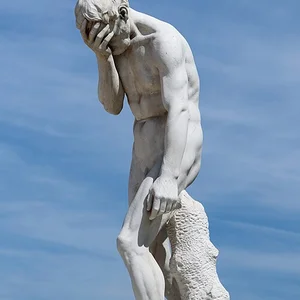

Eldest son of Adam and Eve in the Bible, Cain committed the first murder in human history by killing his brother Abel out of jealousy. Condemned to wander the earth, he received a protective mark from God.
Cain(3899 av. J.-C. — 3199 av. J.-C.)
Cain
8 min read
Frequently asked questions
Famous Quotes
« Am I my brother's keeper? (Genesis 4:9)»
Key Facts
- First son of Adam and Eve according to Genesis (Bible)
- A farmer, he offered the fruits of the earth to God, unlike his brother Abel the shepherd, who offered a lamb
- Killed his brother Abel after God favored Abel's offering over his own
- Condemned by God to wander the earth, but protected by a divine mark against revenge
- Father of Enoch, founder of the first city according to the biblical account
Works & Achievements
The first act of urban construction in the biblical tradition. Paradoxically, this makes Cain the father of civilization, revealing the tension between his fate as a wandering outcast and his unstoppable creative drive.
Byron portrays a Romantic, rebellious Cain tormented by metaphysical questions about death and divine justice. This work had a lasting influence on the image of Cain as a philosophical, defiant figure in European literature.
Baudelaire turns Cain into a symbol of the oppressed and those in revolt against the social and divine order, overturning the traditional moral judgment to cast him as a hero of the damned and the dispossessed.
Hugo imagines the eye of Abel pursuing Cain even into his tomb — a symbol of inexorable moral conscience. This poem is one of the most celebrated reinterpretations of the myth in French literature.
A great American novel structured around the myth of Cain and Abel, transposed to nineteenth-century California. Steinbeck places the Hebrew word 'timshel' ('thou mayest') at the heart of his meditation on human free will.
Anecdotes
Cain was a farmer while his brother Abel was a shepherd. When making offerings to God, Cain presented fruits of the earth, but God preferred Abel's lamb. This divine preference, left unexplained in the biblical text, has sparked millennia of theological debate: why did God favor the herder over the farmer?
After Abel's murder, God confronted Cain: 'Where is your brother?' Cain replied with a question that has echoed through the ages: 'Am I my brother's keeper?' This retort has become one of Western literature's enduring symbols of moral evasion and indifference toward others.
Condemned to wander the earth without ever dying, Cain feared being killed by anyone he encountered. God then granted him a mysterious mark — the 'mark of Cain' — to protect him from vengeance. Paradoxically, this sign became a shield: anyone who killed Cain would suffer a sevenfold retribution.
According to Genesis, Cain founded the first city in human history, which he named Enoch in honor of his son. This tradition casts the cursed murderer as civilization's first builder, introducing a foundational tension: the city as a place of culture, but also of violence.
In the Islamic tradition (Quran, Surah 5), it was a raven that taught Cain how to bury his brother's body. Cain, ignorant of funeral rites, was deeply humbled to have to learn from a bird. This detail, absent from the Hebrew Bible, adds an unexpected and tragic humanity to the figure of Cain.
Primary Sources
Cain said to his brother Abel, 'Let us go out to the field.' And when they were in the field, Cain rose up against his brother Abel and killed him. Then the LORD said to Cain, 'Where is your brother Abel?' He answered, 'I do not know; am I my brother's keeper?'
Then Allah sent a crow scratching in the ground to show him how to hide his brother's corpse. He said, 'Woe to me! Am I not even able to be like this crow and hide my brother's corpse?'
Cain was very wicked and had an eye only on gains; he was the first to enclose land he farmed with hedges and ditches, and drove men to violence and theft.
And in the fourth jubilee, in the first year of the seventh week, he took his sister Awan as wife; she bore him Enoch at the close of the fourth year.
The mark that God placed upon Cain was a letter from His holy Name, so that whoever saw him would know he was under divine protection and that no one could harm him.
Key Places
The original place from which Adam and Eve, Cain's parents, were expelled. Traditionally located in Mesopotamia at the confluence of the Tigris and Euphrates rivers, it is the mythical cradle of humanity according to all three Abrahamic traditions.
The Bible states only that Cain lured Abel 'into the field' to kill him. This unspecified location has become the universal symbol of any isolated space where fratricidal violence is carried out, beyond the sight of God.
The land of Cain's exile, 'east of Eden.' Its Hebrew name means 'wandering.' It is here that Cain settled and paradoxically founded the city of Enoch, making him at once a nomad and a city-builder.
The first city ever built by a human being, according to Genesis — erected by Cain and named after his son. It symbolizes the ambivalence at the origins of urban civilization: a city founded by an accursed murderer.
Typical Objects

Cain presented God with the produce of his labor as a ritual gesture of covenant. The divine rejection of this plant offering was the catalyst for his jealousy and for the first murder in human history.

A mysterious sign placed upon Cain by God to protect him from any vengeance. According to rabbinical traditions, this mark was a letter of the divine Name, a glowing horn, or a tribal tattoo.

Although the Bible does not specify the weapon, iconographic tradition depicts Cain striking Abel with a wooden club or a rough stone, a symbol of primitive, unrefined violence.

As the first farmer in biblical history, Cain is associated with wooden and stone tilling tools. These implements symbolize both the domestication of nature and the punitive labor that arose from the Fall.

The earth itself becomes a symbolic object for Cain: having drunk Abel's blood, it now refuses to yield its fruits to him. This barren soil embodies the divine curse that weighs upon him for eternity.

Cain is the first builder in biblical tradition. The stones and ramparts he erects symbolize both the birth of urban civilization and the paradox of a condemned wanderer who nonetheless puts down roots.
School Curriculum
Vocabulary & Tags
Key Vocabulary
Tags
Daily Life
Morning
Cain rose with the sun to work his land, plowing stony fields with rudimentary tools made of wood and stone. Before any work began, he performed ritual offering gestures to attract divine favor upon his harvests — a practice that would become the very source of his downfall.
Afternoon
After the murder and his exile, his afternoons became those of a marked wanderer, crossing hostile lands unable to cultivate a soil that had turned barren beneath his hands. He searched for water and food in an indifferent wilderness, bearing the weight of humanity's first guilt.
Evening
In the evening, according to the tradition that names him founder of the first city, Cain organized the earliest human communities, assigned tasks, and built shelters of stone and dried mud to protect against the cold and wild animals — transforming his exile into an act of foundation.
Food
As a farmer, Cain's diet consisted mainly of grains (barley, spelt), legumes, fruits, and wild berries. After his exile to the land of Nod, he had to make do with whatever hostile nature would yield: roots, game, and water from the rivers of Mesopotamia.
Clothing
Cain wore the rudimentary garments of early humanity: roughly tanned animal skins and plant fibers woven into coarse cloth. The divine mark on his forehead was his only distinguishing feature — at once a brand of shame and a supernatural shield against all harm.
Housing
Before the exile, Cain lived in simple shelters near his cultivated fields, built from earth, reeds, and rough stone typical of the early Near East. After his condemnation, he paradoxically founded the first city — Enoch — revealing the tension between his fate as a nomad and his unstoppable drive to build.
Historical Timeline
Period Vocabulary
Visual Style
Style biblique sombre et monumental, paysage aride proche-oriental, lumière dramatique en clair-obscur inspirée de Rembrandt et Blake, palette de terres brûlées et de rouges profonds.
Sound Ambience
Ambiance de plaines désolées mésopotamiennes, vent du désert et silence pesant après la violence fratricide, ponctuée des premiers bruits d'une cité en construction.
Liens externes & ressources
Références
Œuvres
Fondation de la ville d'Hénoch
Temps mythiques
Caïn — poème dramatique de Lord Byron
1821
'Abel et Caïn' in Les Fleurs du Mal — Charles Baudelaire
1857
'La Conscience' in La Légende des siècles — Victor Hugo
1859
East of Eden — John Steinbeck
1952