
Callisto is a nymph from Greek mythology and a companion of Artemis, goddess of the hunt. Seduced by Zeus, she was transformed into a bear by the jealous Hera, then placed in the sky as the constellation Ursa Major.
Callisto
Callisto
9 min read
Frequently asked questions
Key Facts
- Callisto is a hunting nymph, devoted companion of Artemis, bound by a vow of chastity
- Zeus seduces her by taking the form of Artemis; she gives birth to Arcas
- Transformed into a bear by the jealous Hera (or, in other versions, by Artemis herself)
- Her son Arcas, now a hunter, nearly killed her without recognizing her
- Zeus placed them both in the sky: Callisto becomes Ursa Major (the Great Bear), Arcas becomes Boötes or Ursa Minor
Works & Achievements
The most complete and influential retelling of the Callisto myth in ancient literature. Ovid narrates in detail Zeus's deception, Hera's jealousy, the transformation into a bear, and the final catasterism, becoming the primary source for the entire Western tradition.
An astronomical treatise that formally identifies Callisto with the constellation Ursa Major. A foundational text of Greek mythological astronomy, it explains the celestial origin of the nymph.
An astronomical poem describing the constellations, including Ursa Major and Ursa Minor. Widely read in antiquity, this text popularized the myth of Callisto throughout the Hellenistic and Roman worlds.
A mythological compendium that summarizes the Callisto myth within the genealogy of Arcadian heroes. An essential source for comparing variants of the story and tracing its transmission in late antiquity.
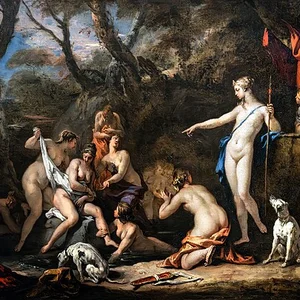
A masterpiece of the Italian Renaissance depicting the discovery of Callisto's pregnancy during her bath with Diana. Shared between the National Gallery of Scotland and the Kunsthistorisches Museum in Vienna, it is one of the most celebrated representations of the myth.
A Baroque painting depicting Zeus disguised as Artemis approaching Callisto. A prime example of how Ovidian themes were revisited in 17th-century European painting.
One of the four large moons of Jupiter discovered by Galileo with his telescope. By giving it the name Callisto, the astronomical tradition permanently preserved the link between the nymph and the god Zeus-Jupiter.
Anecdotes
Callisto means "the most beautiful" in Greek: she was a nymph of Arcadia renowned for her exceptional beauty. She had taken a vow of chastity to Artemis, goddess of the hunt, and lived among her companions hunting in the mountain forests. This vow was sacred, and breaking it meant banishment from the goddess's virginal circle.
Zeus, enamored with Callisto, disguised himself as Artemis herself to approach her without arousing suspicion. This deceptive trick illustrates the cunning Zeus frequently employed in myths to bypass the defenses of mortals and nymphs alike. Callisto, believing she was in the presence of her goddess, could not resist the approach of the master of Olympus.
Callisto's pregnancy was discovered during a communal bath with Artemis and her nymphs: her rounded belly gave her away. Cast out from the group, she gave birth to Arcas, whose name gave rise to the region of Arcadia. Depending on the version, her transformation into a bear was the work of a jealous Hera, a furious Artemis, or Zeus himself trying to conceal her.
When Arcas, now a hunter, encountered a bear in the forest not knowing it was his own mother, he was about to kill her. Zeus intervened at the last moment and placed them both in the sky: Callisto became Ursa Major (the Great Bear) and Arcas the constellation Boötes, according to the most widely known version.
Ursa Major, identified with Callisto, is one of the most recognizable constellations in the northern sky: its seven main stars form the shape known as the Big Dipper, visible year-round from the Northern Hemisphere. In 1610, Galileo discovered a large moon of Jupiter that was named Callisto in honor of the nymph, perpetuating the mythological connection between the nymph and the planet Jupiter.
Primary Sources
Jupiter had seen Callisto resting in the shade of a wood. He took the form of Diana and said: 'Virgin, companion of my hunts, on what mountains have you hunted today?' She rose and answered: 'Hail, goddess, greater than Jupiter himself, though he should hear it.' Zeus laughed at the comparison and embraced her.
Callisto, daughter of Lycaon, hunted with Artemis. Zeus, enamored of her, seduced her by taking on the appearance of Artemis. Hera, consumed by jealousy, transformed her into a bear. Zeus placed her among the stars under the name of the Great Bear.
It is told that Callisto, a nymph of Arcadia, was a hunting companion of Diana. Jupiter fell in love with her and lay with her; Juno, jealous, changed her into a bear. Jupiter, moved by pity, placed her in the sky and made her the constellation known as Arctus, the Great Bear.
The Great Bear is Callisto of Arcadia, who lived with Artemis and was transformed into a bear. Her son Arcas nearly killed her while hunting, and Zeus placed them both in the sky for eternity.
The Arcadians say that Callisto was the daughter of Lycaon, and a wooded mound was pointed out to them as her tomb, upon which stood a statue of Artemis.
Key Places
A mountainous region in the heart of the Peloponnese and the mythological homeland of Callisto. It was in its dense forests that she hunted alongside Artemis, and her son Arcas gave his name to this land.
A sacred mountain in Arcadia and a hunting ground for nymphs and heroes. According to some traditions, it was in these high-altitude forests that Callisto was approached by Zeus disguised as Artemis.
The home of the Greek gods and of Zeus in particular, who decided to place Callisto and her son Arcas among the stars. It was from Olympus that Zeus watched over the nymph he had transformed into a bear.
Pausanias describes a wooded mound in Arcadia that local inhabitants venerated as the tomb of Callisto, topped by a statue of Artemis. This cult site reflects how deeply the myth was rooted in Greek local religion.
Callisto's eternal celestial home, visible year-round from the Northern Hemisphere. Its seven brightest stars form the shape of a large dipper, a landmark used by sailors and travelers for navigation throughout antiquity.
Liens externes & ressources
Références
Œuvres
Ovide, Métamorphoses, Livre II (vers 401-530)
8 apr. J.-C.
Ératosthène, Catastérismes
IIIe s. av. J.-C.
Aratus de Soles, Phénomènes
vers 275 av. J.-C.
Apollodore, Bibliothèque (III, 8)
IIe s. apr. J.-C.
Titien, Diane et Callisto
1556-1559
Rubens, Jupiter et Callisto
1613
Callisto — lune de Jupiter (découverte par Galilée)
1610