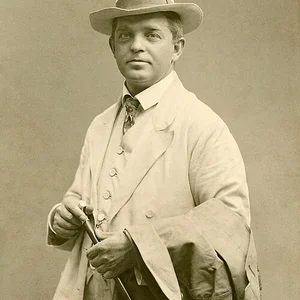

Carl Nielsen was a Danish composer, conductor, and violinist, regarded as the leading figure of Danish classical music. His work, particularly his six symphonies, marks the transition between late Romanticism and modernity.
Carl Nielsen
Carl Nielsen
Royaume de Danemark
6 min read
Frequently asked questions
Key Facts
- Born on 9 June 1865 on the island of Funen in Denmark, into a humble family.
- Composed six symphonies between 1892 and 1925, including the 4th, known as “The Inextinguishable” (1916), and the 5th (1922).
- Author of the operas Saul and David (1902) and Maskarade (1906), the latter regarded as a Danish national opera.
- Professor and later director of the Royal Danish Academy of Music in Copenhagen at the end of his life.
- Died on 3 October 1931 in Copenhagen; his portrait once appeared on the Danish 100-krone banknote.
Works & Achievements
First symphony that reveals an original voice and affirms the emergence of a Danish symphonic school.
A powerful biblical drama, one of his two operas, showing his sense of theatre and of human conflict.
A joyful comedy inspired by Holberg, which became a true Danish national opera still frequently performed.
Work famous for its duel of timpani, a hymn to the indestructible force of life in the midst of the World War.
The summit of his symphonic output, where a snare drum tries to destroy the musical order: a battle between chaos and harmony.
A chamber music masterpiece treating each instrument as a character, a cornerstone of the repertoire for winds.
A refined and humorous concerto, illustrating his love of wind instruments.
Simple, patriotic melodies that Danes still sing, the foundation of his national popularity.
Anecdotes
Carl Nielsen was born in 1865 into a very humble family on the island of Funen: his father was a house painter and a village musician. Young Carl discovered music by playing the violin and the cornet at peasant festivities, long before he ever dreamed of becoming a composer.
As a teenager, Nielsen earned his living as a military musician in Odense, playing the alto trombone and the bugle in a regimental band. This experience with wind instruments would deeply shape his music, renowned for its bold treatment of brass and woodwinds.
His Fourth Symphony, nicknamed “The Inextinguishable” (1916), calls for two timpanists placed on either side of the orchestra who engage in a genuine sonic duel. Nielsen wanted to depict the force of life itself, capable of being reborn despite the war then ravaging Europe.
Nielsen was long more famous in Denmark for his popular and patriotic songs than for his symphonies. Many Danes still sing his melodies today without always knowing that they were composed by their greatest classical musician.
His face and name appeared on the old 100-krone Danish banknotes, proof of his status as a national cultural hero. Denmark grandly celebrated the 150th anniversary of his birth in 2015.
Primary Sources
Autobiographical account in which Nielsen recalls his poor but happy childhood in the countryside and his first encounters with music within the village community.
Collection of essays in which Nielsen sets out his ideas about music, championing clarity, movement and vitality against what he saw as the excesses of late Romanticism.
Letters and personal notebooks documenting his compositional work, his travels and his reflections, now edited by the Royal Danish Library.
At the head of the score, Nielsen writes that music is life and, like life, inextinguishable.
Key Places
Hamlet on the island of Funen where Nielsen was born in 1865, into a modest peasant family. His childhood home is now a museum.
Town on Funen where the young Nielsen served as a military musician in a regimental band. It was there that he practised wind instruments.
Institution where Nielsen studied from 1884, and which he later directed at the end of his life. The heart of Danish musical life.
Stage where his operas Saul and David and Maskarade were premiered, and where he played as a violinist in the Royal Chapel.
Danish capital where Nielsen carried out most of his career as a composer and conductor, and where he died in 1931.