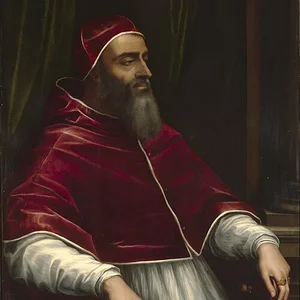

Pope from 1523 to 1534, Clement VII was a sovereign pontiff from the powerful Medici family. His pontificate was marked by the Sack of Rome in 1527 and his refusal to annul the marriage of Henry VIII of England, which triggered the Anglican schism.
Clement VII(1478 — 1534)
Clement VII
9 min read
Frequently asked questions
Key Facts
- 1523: elected pope under the name Clement VII
- 1527: Sack of Rome by the troops of Charles V; Clement VII taken prisoner
- 1531: refuses to annul the marriage of Henry VIII and Catherine of Aragon
- 1534: death of Clement VII, after a pontificate marked by severe crises
Works & Achievements
Commissioned from Michelangelo while Giulio de' Medici was still a cardinal, this library annexed to the Basilica of San Lorenzo was intended to house the Medici family's manuscript collection. It stands as a masterpiece of architectural Mannerism.
Clement VII charged Michelangelo with creating the tombs of Giuliano de' Medici and Lorenzo de' Medici the Younger. These funerary monuments, adorned with the famous allegories of Day, Night, Dawn, and Dusk, rank among the most significant works of the Renaissance.
Shortly before his death, Clement VII commissioned Michelangelo to paint the great fresco of the Last Judgment on the altar wall of the Sistine Chapel. The work would not be completed until 1541, under the pontificate of Paul III.
Although originally issued by Leo X, Clement VII upheld the condemnation of Luther and attempted to curb the spread of Protestantism through diplomatic and doctrinal means, without ultimately succeeding in halting the Reformation.
The Concordat of Bologna, signed by Leo X with Francis I, was upheld by Clement VII, defining the relationship between France and the Catholic Church for more than two centuries.
Clement VII encouraged the publication of 'The Book of the Courtier', a landmark work of the Italian Renaissance describing the ideal of the cultivated and refined courtly gentleman, which went on to exert a profound influence across all of Europe.
Anecdotes
On May 6, 1527, the troops of Charles V — made up of Lutheran lansquenets and routed Spanish mercenaries — swept through Rome and pillaged it for several days. Clement VII barely escaped in extremis through the secret passage connecting the Vatican to Castel Sant'Angelo, where he would remain a prisoner for several months. This traumatic event, known as the Sack of Rome, marks the end of the triumphant Rome of the Renaissance.
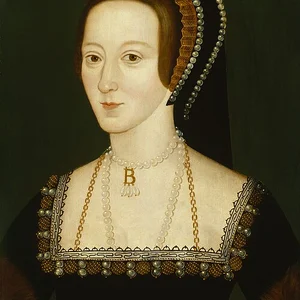
When Henry VIII of England asked the pope to annul his marriage to Catherine of Aragon in order to marry Anne Boleyn, Clement VII found himself in a political deadlock: Catherine was the aunt of Charles V, who had kept the pope under his thumb since 1527. Unable to reach a decision, he stalled for years, ultimately pushing Henry VIII to break with Rome in 1534 and found the Church of England.
A member of the Medici family, Giulio de' Medici was a refined patron of the arts even before his elevation to the papacy. He maintained close ties with Raphael, Michelangelo, and many humanists of his day. It was he who, while still a cardinal, commissioned Michelangelo to sculpt the Medici tombs in the New Sacristy chapel in Florence.
In 1530, in Bologna, Clement VII crowned Charles V emperor of the Holy Roman Empire in a magnificent ceremony. It was the last time in history that a pope would crown an emperor — a gesture that paradoxically symbolized the submission of the Holy See to Habsburg power, whose soldiers had nonetheless sacked Rome just three years earlier.
Born under a tragic sign, Giulio de' Medici was the posthumous son of Giuliano de' Medici, who was assassinated during the Pazzi Conspiracy of 1478 — the very day of his birth, according to some sources. Raised by his uncle Lorenzo the Magnificent, he climbed every rung of the Church hierarchy with his family's support, illustrating both the grandeur and the compromises of the Renaissance ecclesiastical system.
Primary Sources
We, wishing to provide for the salvation of souls and the peace of the universal Church, have deemed it fitting to establish and ordain the following, by apostolic authority...
The Pope, seeing himself abandoned and the enemy already at the gates, withdrew to Castel Sant'Angelo by a secret passage, while Rome was given over to the fury of the imperial soldiers.
His Holiness is by nature irresolute and timid. He always defers important decisions, weighing every matter without ever committing himself firmly, which has earned him many enemies.
The matter of Your Majesty's marriage to Queen Catherine cannot be resolved without thorough examination and the agreement of all parties concerned, in accordance with the canons of our holy Church.
Clement was of fine bearing, of a grave and reflective spirit, learned in Latin and Greek letters, but too hesitant in moments of crisis, which proved the cause of many misfortunes.
Key Places
The official residence of the popes since the fourteenth century, the Vatican was the center of Clement VII's pontificate. He received ambassadors and diplomats there, and continued to make it a major artistic hub of the Renaissance.
An ancient fortress built over the mausoleum of Hadrian and connected to the Vatican by a secret corridor, the *Passetto di Borgo*. It was here that Clement VII took refuge during the Sack of Rome in 1527, remaining a prisoner of the imperial troops for several months.
The birthplace of the Medici family and the hometown of Giulio de' Medici. It was here that Clement VII commissioned Michelangelo to create the tombs in the New Sacristy and the Laurentian Library, masterpieces of the late Renaissance.
The city where Clement VII crowned Charles V as Holy Roman Emperor in 1530, in a lavish ceremony that sealed the forced reconciliation between the Holy See and the Habsburgs. It was the last imperial coronation performed by a pope.
A fortified city where Clement VII found refuge after his escape from Castel Sant'Angelo in late 1527. He stayed there for several months before he could return to Rome, illustrating the political vulnerability of the Holy See at that time.
Liens externes & ressources
Références
Œuvres
Commission de la Bibliothèque Laurentienne (Florence)
1519-1534
Commission des Tombeaux des Médicis (Sacristie Nouvelle, Florence)
1520-1534
Commande du 'Jugement Dernier' à Michel-Ange
1534
Bulle 'Exsurge Domine' (réaffirmée)
1520-1521
Concordat avec François Ier (maintenu)
1516-1523
Soutien au 'Courtisan' de Baldassare Castiglione
1528