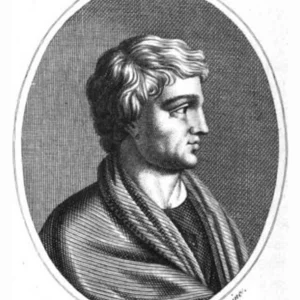

Greek historian of the 1st century BC, born in Sicily, author of the Bibliotheca historica, a vast universal history encyclopedia in 40 volumes covering mythical origins through the age of Caesar.
Diodorus Siculus(89 av. J.-C. — 19 av. J.-C.)
Diodorus Siculus
Agyrion
8 min read
Frequently asked questions
Key Facts
- Born around 90 BC in Agyrium, Sicily
- Lived in Rome under Julius Caesar and Augustus
- Wrote the Bibliotheca historica between 60 and 30 BC
- His 40-volume work covers world history from creation to Caesar's wars
- One of the rare surviving sources on Greek mythology and ancient Egyptian history
Works & Achievements
These books cover Egypt, Mesopotamia, India, and Ethiopia, weaving together mythology, geography, and ethnography in a pioneering comparative approach that makes Diodorus a forerunner of cultural anthropology.
Diodorus recounts the myths of the great Greek heroes — Heracles, Jason, Theseus, Orpheus — offering an euhemeristic reading: gods and heroes are understood as exceptional human beings who were deified after death.
The best-preserved books, covering the Persian Wars, the Age of Pericles, and the conquests of Alexander the Great. They remain an irreplaceable source for modern historians of this period.
Partially lost, these books dealt with the Punic Wars, the rise of Rome, and events up to Julius Caesar, whom Diodorus explicitly names as the closing boundary of the entire work.
A monumental work of which only 15 complete books and fragments of the rest have survived. It remains one of the most ambitious attempts in Antiquity to write a universal history of humanity.
Anecdotes
Diodorus of Sicily spent more than thirty years writing his Library of History, traveling as far as Egypt and Rome to gather his sources. He wanted to offer readers a universal history stretching from the mythical origins of the world to his own time — a project of unprecedented ambition in the ancient world.
During his time in Egypt, Diodorus witnessed a telling incident: a Roman had accidentally killed a sacred cat, and the crowd lynched him despite the authorities' attempts to intervene. To Diodorus, this episode illustrated the power of religious belief over human behavior, far beyond any written law.
Diodorus was convinced that Greek mythology contained a veiled historical truth. He proposed a euhemeristic reading of the gods: Heracles, Dionysus, and Osiris, he argued, had been great men who were deified after their deaths by popular veneration — a bold idea that shocked some of his contemporaries.
His Library of History opened with Egyptian, Greek, and Mesopotamian creation myths, making him one of the first authors to attempt a comparative history of the religions of the ancient world. He drew parallels between Osiris and Dionysus, and between Isis and Hera, searching for a universal common ground shared by all civilizations.
Although criticized by some modern historians for relying heavily on his predecessors without crediting them, Diodorus has passed down to us precious fragments of authors now lost, such as Ephorus and Ctesias. Without him, entire sections of ancient history would be completely unknown to us.
Primary Sources
The Egyptians say that, in the beginning, only Heaven and Earth existed, their natures merged into a single being. Then they separated from one another, and the world took the form we know today.
Heracles, through his countless labors, rendered the greatest services to humanity. That is why men, wishing to honor this outstanding benefactor, granted him divine honors and the rank of immortal.
Semiramis, queen of Babylon, had hanging gardens built to console a wife who longed for the verdant meadows of her homeland. She also raised walls so mighty that no enemy could ever breach them.
The Hyperboreans dwell beyond the breath of Boreas, in a blessed land where the sun shines without cease and men live in happiness, celebrating Apollo with perpetual songs and dances.
The Amazons, it is said, inhabited Libya long before those of the Pontus Euxinus. They formed a nation ruled by women of exceptional martial valor, and their queen Myrina subjugated many peoples by the force of her arms.
Key Places
Diodorus's hometown, known today as Agira in central Sicily. This small city of Greek origin was the starting point of a life entirely devoted to scholarship and universal history.
Capital of the Mediterranean world, where Diodorus spent extended periods to access the libraries and sources needed for his encyclopedia. It was here that he wrote the greater part of his work.
The great Egyptian metropolis home to the famous Library, visited by Diodorus, who drew on it for information about mythology and the history of the pharaohs. It was also where he witnessed the lynching of the man who killed a sacred cat.
The birthplace of Greek historiography and of the authors Diodorus compiled, from Herodotus to Thucydides. The Athenian intellectual tradition lies at the heart of the Sicilian historian's method and culture.
Diodorus devotes lengthy passages to Babylon, its Hanging Gardens, and its queen Semiramis. This mythical city embodies his ambition to write a history that reaches beyond the Greco-Roman world alone.
Typical Objects

The primary writing medium of the ancient world, Diodorus composed his 40 books on papyrus scrolls. Each volumus corresponded to one book of the Bibliotheca historica, carefully stored in a wooden cabinet.

The calamus — a reed cut to a point — dipped in black soot-based ink, was the writing instrument of Greek and Roman historians. Diodorus used it to set down on papyrus the fruits of his long years of research.

The everyday working tool of the ancient intellectual, used for notes and drafts before transcription onto papyrus. Diodorus carried one on his travels to jot down observations and quotations on the spot.

A schematic representation of the *oikoumene* (the known world), stretching from Gaul to India. Diodorus, who describes peoples from every corner of the globe, likely had access to such maps in the libraries of Rome.

Essential for working at night, the terracotta lamp fuelled by olive oil lit the long hours of reading and writing. Ancient scholars quite literally burned oil in pursuit of knowledge.

A piece of furniture for storing *volumi*, it was the symbol of a scholar's accumulated knowledge. Diodorus consulted the great *armaria* of Rome's libraries — and perhaps Alexandria's — to compile his universal encyclopedia.
School Curriculum
Vocabulary & Tags
Key Vocabulary
Daily Life
Morning
Diodorus rose before sunrise, in the cool of the Mediterranean morning. After a brief wash, he would dictate to a scribe or copy his own notes onto wax tablets. The morning hours were devoted to writing — the time most conducive to concentration in the ancient world.
Afternoon
In the afternoon, Diodorus visited public libraries or the private collections of wealthy Romans to consult the authors he intended to cite. He also held conversations with scholars, travelers, and priests who could supply him with information about the peoples and myths of distant lands.
Evening
In the evening, by the light of oil lamps, he would reread and correct the day's work, comparing his notes against the sources he had consulted. In Rome, he may well have frequented intellectual circles where historical and philosophical debates enlivened the dinner gatherings of men of letters.
Food
Like any Greek intellectual living in the Roman world, Diodorus ate barley or wheat bread, olives, fresh cheese, dried legumes, and fresh or dried fish. He drank wine heavily diluted with water, following Greek custom; scholars' meals were reputed to be frugal.
Clothing
Diodorus wore the chiton (a long tunic of linen or light wool) and the himation (a large draped cloak), the typical dress of a Greek intellectual residing in the Roman world. In public in Rome, he might have adapted his appearance to local customs by donning a toga.
Housing
In Rome or Sicily, Diodorus most likely lived in a modest *domus* with an inner courtyard, or rented rooms in an *insula*. His lodgings were above all a workspace: scrolls neatly arranged in wooden cabinets, wax tablets stacked in piles, lamps positioned for reading by night.
Historical Timeline
Period Vocabulary
Visual Style
Un style visuel mêlant la sobriété savante de l'érudit gréco-romain et la chaleur dorée du monde méditerranéen antique, entre bibliothèque et grand large sicilien.
Sound Ambience
L'ambiance sonore d'un érudit gréco-romain au travail : silence studieux du scriptorium ponctué des rumeurs discrètes de la ville méditerranéenne antique.
Liens externes & ressources
Références
Œuvres
Bibliothèque historique — Livres I–III : Orient et mythologies du monde
Vers 60–55 av. J.-C.
Bibliothèque historique — Livres IV–VI : Mythologie grecque
Vers 55–50 av. J.-C.
Bibliothèque historique — Livres XI–XX : Guerres médiques et Alexandre
Vers 50–40 av. J.-C.
Bibliothèque historique — Livres XXI–XL : Rome et le monde hellénistique
Vers 40–30 av. J.-C.
Bibliothèque historique — Vue d'ensemble (40 livres)
Vers 60–30 av. J.-C.