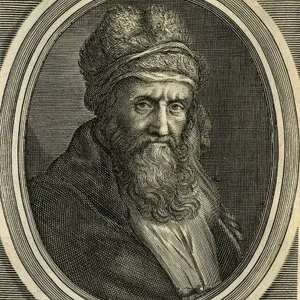

A Greek biographer and doxographer of the 3rd century AD, Diogenes Laërtius is the author of Lives and Opinions of Eminent Philosophers, the principal source of knowledge about ancient Greek philosophers. His work compiles the biographies and views of more than 80 thinkers, from Thales to Epicurus.
Diogenes Laërtius
Diogenes Laërtius
Rome antique
8 min read
Frequently asked questions
Key Facts
- 3rd century AD: composition of Lives and Opinions of Eminent Philosophers
- His work covers more than 80 philosophers, from Thales to Epicurus
- Nearly the sole source of knowledge about many pre-Socratic thinkers
- Preserves letters and original texts by Epicurus that would otherwise be lost
- Organizes Greek philosophy into two 'successions': the Ionian and the Italic
Works & Achievements
A monumental work in ten books covering the life and thought of more than 80 Greek philosophers, from Thales to Epicurus. It is the principal surviving ancient source on Greek philosophy and our only access to many thinkers whose original writings have been lost.
Short poems in Greek verse composed by Diogenes Laërtius for each philosopher he discusses, vividly capturing their character or the manner of their death. These epigrams reveal a personal literary sensibility behind the work of the scholarly compiler.
A poetry collection written in various meters, mentioned by Diogenes Laërtius himself in the Lives, of which no independent fragments survive. Its existence attests to a personal literary activity beyond mere philosophical compilation.
Anecdotes
Diogenes Laërtius is, paradoxically, one of the ancient authors about whose own life we know the least — he who devoted his entire work to telling the lives of others. Even his name raises questions: does "Laërtius" refer to his hometown of Laertes in Cilicia, or is it simply a nickname? Historians have yet to settle the matter.
It is thanks to Diogenes Laërtius that we know the famous retort of Diogenes the Cynic to Alexander the Great. When the conqueror asked what he wished for, the philosopher reportedly replied: "Stand out of my sunlight." Without this late author, many such sayings would have been lost forever.
Diogenes Laërtius compiled his sources with a method not unlike that of a modern journalist: he cited dozens of authors, reproduced letters, wills, epigrams, and even second-hand anecdotes. For the Presocratic philosophers whose entire works have vanished, his testimony often remains our only window into their thought.
Diogenes Laërtius was also a poet in his own right: he wove throughout his work numerous verse epigrams of his own composition, summarizing the life or death of each philosopher with a sharp wit. This literary flourish stands in contrast to the dryness of his compilations and reveals a curious and endearing personality.
His work nearly disappeared several times during the Middle Ages. It is largely thanks to Byzantine monks who painstakingly copied the manuscripts that the Lives of the Philosophers has survived. Without them, entire chapters of Greek philosophy — Epicurus, Pyrrho, the Cynics — would be unknown to us.
Primary Sources
Epicurus to Menoeceus, greetings. Let no one be slow to seek wisdom when young, nor weary in the search of it when grown old. For no age is too early or too late for the health of the soul.
Thales held that water is the principle of all things, and that the world is alive and full of spirits. He is credited with the discovery of the seasons and the division of the year into 365 days.
When Alexander the Great came up to him and said, 'I am Alexander, the great king,' Diogenes replied, 'And I am Diogenes the Cynic.' Alexander asked whether he needed anything: 'Yes,' he said, 'stand out of my sunlight.'
Zeno's first teacher was Crates the Cynic. He later also studied under Stilpo and Xenocrates. He is said to have been the first to use the term 'appropriate action' (kathêkon) and to have founded the school of the Porch.
Pyrrho of Elis maintained that nothing should be asserted, but that judgment should be suspended on all things. He lived in a state of complete impassivity, so much so that his friends would follow him everywhere to keep him from falling into wells or under passing carts.
Key Places
An ancient city in Cilicia (present-day southern Turkey) from which Diogenes is most commonly thought to have taken his surname. Its exact location remains debated among historians, but it is closely tied to the author's very identity.
The birthplace of Greek philosophy and home to the great schools (the Academy, the Lyceum, the Stoa, and Epicurus's Garden), Athens lies at the heart of Diogenes Laërtius's work, which traces its intellectual history across several centuries.
One of the greatest intellectual centers of late Antiquity, famous for its library, Alexandria represents the kind of scholarly environment in which a learned compiler like Diogenes Laërtius could have accessed the works of Greek philosophers from every era.
The capital of the Empire and a hub of philosophical life in the 3rd century, Rome was home to schools of every Greek tradition — Stoicism, Epicureanism, Platonism. It was in this cosmopolitan setting that Diogenes Laërtius most likely compiled his encyclopedic work.
Typical Objects

The primary writing medium of late Antiquity, the papyrus volumen allowed Diogenes Laërtius to consult and copy the works of philosophers. His compilation required access to dozens of scrolls spanning several centuries of Greek thought.

The sharpened reed dipped in soot-based black ink was the writing tool of every Greek or Roman scholar. It was with this instrument that Diogenes Laërtius composed all ten of his books and his poetic epigrams.

Used for notes and drafts, the wax tablet allowed a scholar to prepare texts before copying them neatly onto papyrus. Diogenes Laërtius most likely used one to jot down excerpts and organize his compilations.

Terracotta or bronze lamps burning olive oil lit the scriptoria and libraries of the ancient world. Scholars like Diogenes Laërtius often worked by the light of these lamps, pressing on with their reading and writing late into the night.

A cylindrical container made of wood or wicker used to store and organize papyrus scrolls by author. To compile biographies of more than 80 philosophers, Diogenes Laërtius must have maintained a substantial and carefully organized text collection.

Sculpted portraits of the great philosophers adorned the libraries and cultivated homes of the Roman Empire. Diogenes Laërtius, who carefully describes the physical appearance of each thinker, worked in an environment steeped in these iconic likenesses.
School Curriculum
Vocabulary & Tags
Key Vocabulary
Daily Life
Morning
Diogenes Laërtius began his day before dawn, by the light of an oil lamp, consulting and annotating papyrus scrolls. He drew up lists of sources to cross-reference and would likely dictate passages to a slave copyist for faithful transcription.
Afternoon
Afternoons were devoted to visiting the public or private libraries of the city in search of new texts about the philosophers. He compared contradictory accounts and selected the most revealing anecdotes — the chreiai — about each thinker.
Evening
In the evening, at home, he composed his own poetic epigrams to summarize each philosopher's life. He would reread his compilations by the flickering lamplight, revising and organizing the ten books of his monumental work.
Food
Like the learned men of his era, Diogenes Laërtius most likely subsisted on bread, olives, vegetables, cheese, and dried fish, washed down with wine diluted with water. His sedentary scholarly work required nothing as substantial as the diet of soldiers or craftsmen.
Clothing
He most likely wore the Greek himation (a large draped cloak) or the Roman toga depending on the occasion — typical garments of the Hellenized intellectuals of the Roman Empire in the 3rd century. Leather sandals completed this understated attire, befitting a philosopher of the study.
Housing
Diogenes Laërtius probably lived in a modest domus or an insula (a multi-unit apartment building), fitted with a workspace lined with scroll cabinets. His home was above all a place of study, free from the ostentatious luxuries of Rome's great patrons.
Historical Timeline
Period Vocabulary
Visual Style
Style fresque romaine tardive aux tons ocre et terracotta, représentant un érudit grec entouré de rouleaux de papyrus dans une bibliothèque à colonnades, éclairé à la lampe à huile.
Sound Ambience
Ambiance d'une bibliothèque de l'Antiquité tardive — grattement du calame sur papyrus, froissement des rouleaux, rumeurs de la cité romaine au loin et lumière tamisée des lampes à huile.
Liens externes & ressources
Références
Œuvres
Vies, doctrines et sentences des philosophes illustres
IIIe siècle apr. J.-C.
Épigrammes (intégrées aux Vies)
IIIe siècle apr. J.-C.
Pammétrès (perdu)
IIIe siècle apr. J.-C.