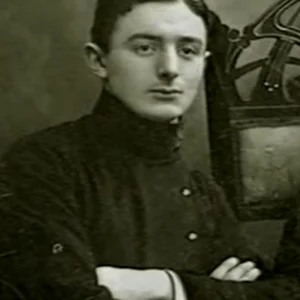

Soviet avant-garde filmmaker (1896–1954), pioneer of documentary cinema and theorist of the "Cine-Eye." He revolutionized cinematic language with his Cine-Pravda newsreels and his masterpiece Man with a Movie Camera (1929).
Dziga Vertov(1896 — 1954)
Dziga Vertov
république socialiste fédérative soviétique de Russie, Union soviétique, Empire russe, Russie soviétique
8 min read
Frequently asked questions
Famous Quotes
« I am the Cine-Eye. I am the mechanical eye.»
« Long live life as it is!»
Key Facts
- 1896: born in Białystok (Russian Empire) under the name Denis Kaufman
- 1918–1919: joins the Bolshevik film committee and begins producing Cine-Newsreels
- 1922–1925: produces the Cine-Pravda (Kino-Pravda), 23 issues of filmed newsreels
- 1929: directs Man with a Movie Camera, an experimental film with no intertitles or script
- 1954: dies in Moscow in relative disgrace after being sidelined under Stalin
Works & Achievements
A series of 23 newsreels distributed throughout the USSR, mixing current events, Bolshevik propaganda, and cinematic experimentation (superimpositions, fast motion, poetic intertitles). A true laboratory for the Cine-Eye theory.
Vertov's first feature-length documentary illustrating his method of “life caught unawares”: filming Soviet life without actors or staging. It received the silver medal at the Paris World's Fair in 1925.
A film commissioned by the Soviet organization Gostorg, presenting the diversity of the USSR's peoples. Vertov shaped it into a visual poem on the human geography of the Soviet empire.
Vertov's undisputed masterpiece and a monument of world cinema: a day in Soviet life, with no actors or screenplay, showcasing dazzling technical virtuosity (split-screen, slow motion, freeze frames). It regularly appears in rankings of the greatest films ever made.
The first Soviet sound feature film, shot in the mines of the Donbas. Vertov uses industrial sound as musical material, creating a documentary symphony about the labor of the working class.
A lyrical film dedicated to the memory of Lenin through the traditional songs of Central Asian women. Vertov's last major success, internationally acclaimed as a landmark of documentary cinema.
Anecdotes
Denis Kaufman chose the pseudonym "Dziga Vertov" at the very start of his career in Soviet cinema: in Ukrainian
dziga" means a spinning top that never stops turning, and "vertov" comes from the verb "to spin." This programmatic name summed up his entire philosophy — cinema must be in perpetual motion, capturing life at the speed of reality itself.
Convinced that the camera saw better than the human eye, Vertov developed the theory of the "Cine-Eye
(*Kino-Glaz*): the camera lens
free from prejudice
records reality more purely than the biased gaze of a human being. He experimented with impossible angles — a camera strapped to a motorcycle
filmed from inside a well or through a moving window — to show what the ordinary eye cannot see.
For *Man with a Movie Camera* (1929), Vertov imposed a radical rule: no actors, no constructed sets, no script, no explanatory intertitles. His wife and editor **Elizaveta Svilova** even appears on screen assembling the reels, making the filmmaking process visible and breaking the fourth wall of documentary cinema.
As early as **1918**, at just 22 years old, Vertov boarded the government's "agitation trains
(*agit-trains*): these convoys crisscrossed Civil War–era Russia
screening propaganda films in rural areas and filming battles and Soviet daily life. It was here
far from any studio
that he forged his radical documentary style.
Despite his Soviet propaganda films, Vertov gradually fell out of favor after socialist realism became the official doctrine in **1934**. His experimental cinema, deemed too abstract and "formalist" for the masses, was pushed to the margins. He died in **1954**, nearly forgotten, after years of being unable to bring his projects to fruition.
Primary Sources
We turn away from cinema-eye toward real life. We set out to conquer life as it is, outside of all staging and all studios.
I am the kino-eye. I am the mechanical eye. I, a machine, show you the world as only I can see it.
The camera must be freed from human immobility [...] The mobile, aerial, suspended, plunging camera must explore the world in every direction.
Kino-eye is not a means of reproducing reality but of organizing and revealing it according to laws proper to mechanical vision.
Key Places
Birthplace of Denis Kaufman (Dziga Vertov), born in 1896 in this industrial and cultural center of the Russian Empire. The Kaufman family, of Jewish origin, left the city during the First World War.
Vertov's main place of work: he edited the Kino-Pravda newsreels there, developed his Kino-Eye theory, and worked for Soviet state studios until his death in 1954. He experienced both his years of glory and his slow marginalization in the city.
Vertov spent several years working at the VUFKU studio in Kyiv, where many sequences of *Man with a Movie Camera* (1929) were shot, alongside Odessa and Kharkiv.
A mining and industrial region where Vertov filmed *Enthusiasm* (1931), his first sound film. He recorded the noise of machinery and mine shafts there, revolutionizing the use of sound in cinema.
Ukrainian port city where important sequences of *Man with a Movie Camera* (1929) were filmed: beach scenes, market scenes, and urban traffic illustrating everyday Soviet life.
Typical Objects

The central instrument of Vertov's practice, the 35 mm camera was for him a mechanical "eye" superior to the human eye. He filmed with it from every conceivable angle — in motion, from moving vehicles, in extreme high-angle or low-angle shots.

The secret workshop of Vertov and his wife and editor Elizaveta Svilova, the editing table allowed them to assemble reels of film. This is where the meaning of a film was born: by cutting and juxtaposing shots, they transformed raw footage into a discourse on Soviet society.

The material support of Vertov's entire body of work, the 35 mm nitrate film reel captured images of the Soviet world. For him, editing these reels was the fundamental creative act, comparable to writing for a poet.
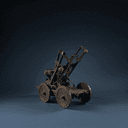
A true mobile Soviet studio, the agit-train traveled through the remote regions of the USSR to screen films and spread Bolshevik propaganda. Vertov honed his craft aboard these trains, filming raw realities far from the Moscow studios.

Vertov wrote prolifically: manifestos, working notes, personal diaries. These notebooks bear witness to his constant theoretical reflection on the nature of cinema and its role in building Soviet socialism.

With the advent of sound in cinema, Vertov made the microphone as radical an exploratory tool as the camera. In *Enthusiasm* (1931), he recorded the sounds of mines and machinery to create an industrial symphony.
School Curriculum
Vocabulary & Tags
Key Vocabulary
Daily Life
Morning
Vertov's mornings were often devoted to location scouting and filming in the streets of Moscow or other Soviet cities, seeking to capture everyday life "on the spot." He would head out with his camera operators at dawn to film markets, factories, and public transport in natural light.
Afternoon
His afternoons alternated between the editing room, where he worked in close collaboration with his wife Elizaveta Svilova, and meetings within Soviet film organizations. He actively participated in theoretical debates about cinema, defending his vision against advocates of fiction film.
Evening
His evenings were spent writing manifestos and theoretical articles, analyzing rushes, and discussing with other filmmakers and Soviet intellectuals in Moscow's cultural circles. During the 1930s–1940s, these evenings were often shadowed by political uncertainty and the repeated rejection of his projects.
Food
Like the vast majority of Soviets in the 1920s–1930s, Vertov lived under conditions of food austerity, with simple meals based on black bread, soup (shchi or borscht), kasha (grain porridge), and vegetables. During shoots in the regions, he shared the living conditions of the workers he filmed.
Clothing
Vertov adopted a functional, proletarian style of dress in keeping with Soviet ideology: plain jacket and trousers, worker's cap. Photographs show him in the simple attire of a Soviet intellectual, with no trace of bourgeois elegance.
Housing
Vertov lived in Moscow in communal apartments (kommunalki), the collective housing typical of the USSR where several families shared a kitchen and bathroom. His living conditions deteriorated in the 1940s, when political marginalization prevented him from making new films.