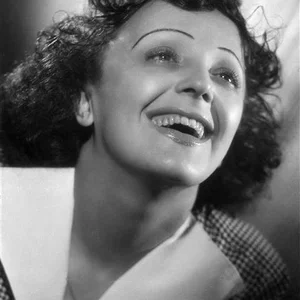

Born Édith Giovanna Gassion in 1915 in Paris, Édith Piaf became one of the most celebrated French singers of the 20th century. Nicknamed 'La Môme Piaf' (The Little Sparrow), she is the defining figure of French chanson réaliste and achieved worldwide fame.
Édith Piaf(1915 — 1963)
Édith Piaf
France
7 min read
Frequently asked questions
Famous Quotes
« Non, je ne regrette rien.»
« Life is what you make of it.»
Key Facts
- 1915: born in Paris (19th arrondissement) into a working-class family
- 1935: discovered by Louis Leplée in Pigalle, launching her professional career
- 1946: composition of 'La Vie en rose', the anthem that cemented her worldwide fame
- 1961: triumphant comeback at the Olympia despite declining health, performing 'Non, je ne regrette rien'
- 1963: death in Grasse on October 10th; buried at Père-Lachaise Cemetery, followed by thousands of Parisians
Works & Achievements
Piaf's iconic song, written by herself, has become a universal symbol of French chanson. Translated and covered worldwide, it remains her most internationally recognized song.
Composed as a tribute to Marcel Cerdan, who died in October 1949, this poignant song is one of the most moving in her repertoire. It illustrates her ability to transform personal grief into universal art.
Composed by Charles Dumont with lyrics by Michel Vaucaire, this song immediately became an anthem to resilience. Adopted by the French Foreign Legion, it embodies the image of a woman standing strong in the face of adversity.
A song composed by Marguerite Monnot with lyrics by Georges Moustaki, which was a huge success both in France and abroad. It showcases Piaf's talent for bringing popular characters to life with dramatic intensity.
A French adaptation of an Argentine melody by Michel Rivgauche, this dramatic song tells the story of a fleeting love affair amid a jubilant crowd. Her performance makes it one of Piaf's most impressive vocal achievements.
An autobiographical work in which Piaf recounts her life, from a childhood in Belleville to international stardom. An invaluable document for understanding her personality and the social context of her era.
Anecdotes
Édith Piaf was reportedly abandoned by her mother at a very young age and raised for a few years in a Norman brothel run by her paternal grandmother, where the prostitutes doted on her like a mascot. This marginal childhood would shape her lifelong connection to the streets and social poverty.
At 15, Piaf sang in the streets of Belleville and Pigalle to survive alongside her acrobat father. It was in 1935 that cabaret manager Louis Leplée spotted her on rue Troyon and gave her the nickname 'La Môme Piaf' — 'piaf' being Parisian slang for 'sparrow'.
During the German Occupation, Piaf performed in French prisoner-of-war camps in Germany. She allegedly used photographs taken with the prisoners to forge fake papers that allowed some of them to escape — a quiet but very real act of resistance.
The song 'Non, je ne regrette rien,' composed by Charles Dumont in 1960, was adopted by the French Foreign Legion as an unofficial anthem during the Algerian War. Piaf recorded it while suffering terribly from rheumatoid arthritis, barely able to stand on stage.
Piaf married officially only once, to singer Jacques Pills in 1952 — with Marlene Dietrich as her maid of honor. She had several great love affairs, however, the most famous being with boxer Marcel Cerdan, who died in a plane crash in 1949 — a loss that marked her for the rest of her life.
Primary Sources
I've had a wonderful life. I loved, I suffered, I sang. I regret nothing.
You know, Momone, when I sing, I think of those who have nothing, of those who are hungry. It's for them that I sing.
I always sing for myself first. If others enjoy it, all the better. But it has to be real, it has to come from the gut.
Belleville was my street, my neighborhood, my poverty too. But I wasn't ashamed. I knew that one day I would sing in the great halls.
Key Places
A working-class neighborhood of Paris where Édith Piaf grew up and began her career singing in the streets. This vibrant, cosmopolitan, working-class district shaped her artistic and social identity.
The legendary concert hall on the Boulevard des Capucines where Piaf gave some of her most memorable performances, most notably in 1961 as her health was declining. Her appearances at the Olympia remain iconic moments in the history of French song.
The burial place of Édith Piaf, where she has rested since October 14, 1963. Her grave is one of the most visited in the cemetery and remains a place of pilgrimage for admirers from around the world.
In 1956, Piaf became the first French artist to perform solo at this legendary Manhattan venue, cementing her status as an international star.
A cabaret in the 5th arrondissement run by Louis Leplée where Piaf was discovered in 1935. It was here that she received her nickname and began her true professional career.