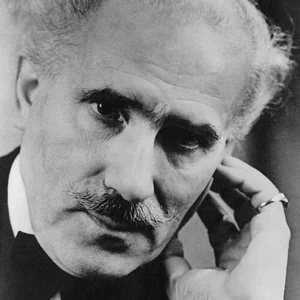

Italian conductor (1867–1957), considered one of the greatest in history. Music director of La Scala in Milan, the Metropolitan Opera, and the New York Philharmonic, he was renowned for his absolute rigor and prodigious memory.
Arturo Toscanini(1867 — 1957)
Arturo Toscanini
Italie, royaume d'Italie
8 min read
Frequently asked questions
Famous Quotes
« Music is a necessity of the soul, not a luxury.»
« No composer ever wanted his music played differently from how he wrote it.»
Key Facts
- Born March 25, 1867 in Parma, Italy; died January 16, 1957 in New York
- Artistic director of La Scala in Milan (1898–1908 and 1920–1929)
- Refused to conduct under Mussolini's fascist and Hitler's Nazi regimes in the 1930s
- Led the NBC Symphony Orchestra, created especially for him (1937–1954), broadcast on radio
- Celebrated for his exceptional musical memory, he conducted entirely from memory
Works & Achievements
Toscanini conducts the world premiere of Puccini's opera at the Teatro Regio in Turin, a historic evening that cements both the work's legacy and the conductor's international reputation.
Toscanini transforms La Scala into a world-class institution of excellence, revolutionizing rehearsal practices, the repertoire, and orchestral discipline.
In tribute to his friend Puccini, who had died in 1924, Toscanini conducts the world premiere of Turandot at La Scala, solemnly setting down his baton at the very point where the composer had laid down his pen.
At the helm of one of America's finest orchestras, Toscanini champions a demanding repertoire and performance standards that remain a lasting benchmark.
Seventeen years of weekly concerts broadcast live on American radio, revolutionizing public access to classical music — the recordings remain essential references in the discography.
An exceptional concert broadcast in support of the Allies and war victims, a symbol of Toscanini's antifascist and humanist commitment, heard by millions of listeners.
Anecdotes
In 1886, then 19 years old and a mere cellist in a touring company in Rio de Janeiro, Toscanini was urgently called upon to replace the conductor who refused to take the stage. He conducted the entirety of Verdi's opera *Aïda* from memory, without a score, before an incredulous audience. This feat earned him a standing ovation and definitively launched his career as a conductor.
In 1931, Toscanini refused to conduct the fascist anthem before a concert in Bologna. As he left the hall, militants of the Mussolini regime struck him violently in the face. Rather than submit, he left Italy and did not return until after the liberation in 1945, becoming a worldwide symbol of artistic resistance to totalitarianism.
Toscanini had suffered from severe myopia since his youth, which prevented him from reading a score on a music stand during concerts. As a result, he developed a prodigious musical memory, fully memorizing every work he conducted — the parts of each instrument, the dynamics, and the tempos — a feat that impressed his contemporaries throughout sixty years of career.
In 1937, NBC created an elite orchestra specifically for him, the NBC Symphony Orchestra, so that he could conduct concerts broadcast live on American radio. These broadcasts reached millions of listeners each week, making Toscanini one of the first musical celebrities of the modern media age.
At the world premiere of *Turandot* at La Scala in 1926, Toscanini abruptly stopped the performance at the exact point where his friend Puccini, who had died two years earlier, had laid down his pen. Turning to the audience, he declared: “Here the master laid down his pen.” He then left the podium in silence, leaving the hall in hushed, moved contemplation.
Primary Sources
The crimes committed against my best friends and against my compatriots have caused me such moral pain that it is impossible for me to return to Bayreuth.
Music is for me an absolute necessity. I cannot live without it, just as I cannot live without air. What the composer has written is sacred.
He demanded from each musician not what they could give, but what the work required. For him, there was only one way to play music: the right way.
Toscanini possessed a musical authority of an entirely different nature from that of his contemporaries. His memory was unequalled, and his ear tolerated no imprecision.
Key Places
Toscanini's birthplace and a cultural capital of Italian opera, the city where his musical vocation took root and where he trained at the Royal Conservatory.
Italy's premier opera house, which Toscanini conducted on multiple occasions and where he revolutionized artistic practices and raised the standards of musical excellence.
The temple of American opera where Toscanini served from 1908 to 1915, bringing the same rigor and perfectionism that had defined his work at La Scala.
A studio purpose-built by NBC to house the NBC Symphony Orchestra and Toscanini's weekly radio broadcasts between 1937 and 1954.
A small island on Lake Maggiore where Toscanini owned a summer villa — an intimate retreat where he liked to rest and study his scores far from the concert hall.
The Wagnerian festival where Toscanini conducted in 1930 and 1931, before categorically refusing to return in 1933 in protest against the Nazi regime.