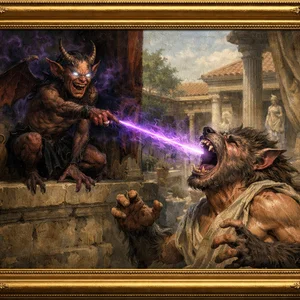

A demonic creature of Greek mythology, servant of Hecate. Endowed with one leg of bronze and one leg of a donkey, she transforms herself to seduce lone travelers before devouring them.
Empousa
Empousa
8 min read
Frequently asked questions
Key Facts
- Empousa is mentioned by Aristophanes in *The Frogs* (405 BCE), which attests to her antiquity in the Greek tradition
- She has a leg of bronze and a leg of a donkey, marks of her hybrid and supernatural nature
- She is associated with the retinue of Hecate, goddess of crossroads, magic, and the boundaries between worlds
- She transforms herself into a beautiful woman, a cow, a mare, or a she-dog to deceive her victims
- The Empousai sometimes form a group of demonic creatures sent by Hecate to terrorize mortals
Works & Achievements
The earliest detailed literary portrayal of Empousa, in which the creature terrifies Dionysus and Xanthias during their descent into the Underworld. This comedy is the primary source for the monster's physical description.
A second comic reference attesting to Empousa's prominence in the Athenian imagination of the 5th century BC, where her name is used as a byword for a frightening appearance.
An account of the confrontation between the philosopher Apollonius and an Empousa disguised as a woman in Corinth. This text equates Empousa with the Lamia, greatly enriching the myth and its vampiric legacy.
A corpus of magical spells mentioning the creatures of Hecate, including the Empusai. These texts bear witness to the real role Empousa played in the practical magic of late Antiquity.
The first comprehensive lexicographic definition of Empousa, transmitting her physical characteristics and mythological role to Byzantine and medieval generations.
Directly inspired by Philostratus's account of the Empousa of Corinth, this long English Romantic poem illustrates the extraordinary legacy of the Empousa myth in modern European literature.
Anecdotes
In Aristophanes' comedy The Frogs (405 BC), Dionysus and his slave Xanthias descend to the Underworld and suddenly encounter Empousa. The creature successively takes the appearance of a cow, a mule, a beautiful woman, and a dog, sending Dionysus into a panic as he trembles with fear. Xanthias, for his part, keeps his cool and insults her until she flees — a comic scene showing that cunning can defeat terror.
The name Empousa probably comes from the Greek *empodizô*, “to put a fetter, to block the path.” The creature would station itself at crossroads — places sacred to Hecate — to intercept night travelers, especially those returning alone after festivals. Encountering an Empousa at night was considered an omen of imminent death.
According to Philostratus (2nd century AD), the philosopher Apollonius of Tyana unmasked an Empousa disguised as a beautiful young woman in Corinth: she was on the verge of marrying one of his disciples. Apollonius forced her to reveal her true nature by staring her down; she vanished with a piercing shriek. This scene much later inspired Keats' poem *Lamia*.
Empousa belonged to Hecate's nocturnal retinue, alongside the Lamiae and the Mormoes. These creatures were sent to Earth to test impure mortals or punish those who had offended the goddess. Greek mothers would invoke the fear of Empousa to keep their children in line: “Behave yourself, or Empousa will come tonight!”
Empousa's bronze leg is an enigmatic detail that mythographers have interpreted in various ways: a sign of her divine origin, a mark of her hybrid status as a creature straddling the world of the living and the world of the dead, or the vestige of a pre-Hellenic deity that was part animal. Her donkey leg, meanwhile, links her to the chthonic creatures associated with Hecate.
Primary Sources
XANTHIAS: I see a monstrous beast, an Empousa! She takes on all forms: now she is an ox, now a mule, now a beautiful woman, now a she-dog.
She looks just like an Empousa covered in crimson leather, there is no doubt about it.
Apollonius declared that the beautiful hostess was nothing but an Empousa, whom common people call a Lamia or a Strix; these creatures are seized by amorous desires and seek out human flesh to devour.
Empousa: a phantom sent by Hecate, endowed with one leg of bronze and one leg of a donkey, who transforms herself to frighten and deceive mortals.
Empousa is a creature of Hecate capable of changing shape at will; she is said to have only one leg, signifying that she is only half-present in the world of the living.
Key Places
Empousa's place of origin, the Greek Underworld is the realm from which Hecate sends her to Earth to test or punish mortals. It is there that Dionysus and Xanthias encounter her in Aristophanes' *The Frogs*.
Three-way crossroads were Empousa's favored haunts — liminal spaces between worlds and sacred ground of Hecate. At night, ritual meals were left there to ward off her creatures.
The city where, according to Philostratus, Apollonius of Tyana unmasked an Empousa disguised as a young woman about to marry one of his disciples. Corinth was renowned for its esoteric cults and magical practices.
The great sanctuary of Hecate in Caria (present-day Turkey), center of the cult of the goddess whom Empousa serves. Nocturnal rites were celebrated there in honor of Hecate and her demonic retinue.
The city of the great Greek Mysteries, where Hecate plays an important role as guide to Persephone in the Underworld. The cult of Hecate at Eleusis reinforced belief in her nocturnal creatures, Empousa among them.
Typical Objects

Empousa is often associated with Hecate's twin torches, symbol of her divine mistress. These torches illuminate the nocturnal crossroads where the creature waits for its prey.

A distinctive attribute of Empousa, the bronze leg immediately sets her apart from any human being. It symbolizes her hybridity between the divine — bronze being the metal of the gods — and the demonic.

Empousa's donkey leg connects her to chthonic creatures, the donkey being associated with the forces of the underworld in Greek thought. It marks her belonging to the lower world and her irreducible hybrid nature.

To lure her victims, Empousa takes on the appearance of a beautiful woman draped in seductive garments. This metaphorical veil represents the creature's deceptive power, capable of concealing a monstrous nature beneath a beguiling beauty.

The Greeks performed libations at crossroads to ward off Empousa and the other demons of Hecate. The *phiale*, a flat, footless cup, was the instrument of these nocturnal propitiatory rites aimed at appeasing the creature.

The triodite crossroads is less an object than a sacred space, yet it constitutes Empousa's territorial attribute. It is there that nocturnal offerings were left, and where the risk of encountering her was at its greatest.
School Curriculum
Vocabulary & Tags
Key Vocabulary
Tags
Daily Life
Morning
In the morning, Empousa remains in the underworld, alongside the other creatures of Hecate's retinue. The light of day keeps her away from the world of the living, for like all Greek nocturnal demons, she holds power only under the cover of darkness.
Afternoon
As the sun begins to set, Empousa starts preparing for her nocturnal mission. She can take the form of an animal — a cow, a dog, a mule — to move unnoticed or to spot travelers lingering on country roads.
Evening
After nightfall, Empousa stations herself at crossroads — places of passage between worlds — and takes the form of a beautiful woman to seduce solitary travelers. Once her victim is under her spell, she reveals her true nature and devours them.
Food
Empousa feeds on human flesh, preferring that of unwary travelers who venture out alone at night. Like Lamia and other Greek nocturnal demons, she is particularly drawn to the blood of strong, vigorous men.
Clothing
Empousa is described as naked or dressed in rags when she reveals her true nature, but she can don the most alluring garments when she transforms into a beautiful woman. In animal form, her “outfit” is the hide of whatever beast she embodies.
Housing
Empousa has no fixed dwelling in the world of the living: she roams between Tartarus, Hecate's subterranean realm, and the crossroads of the earthly world. The boundaries between worlds — doorways, thresholds, crossroads — are her natural domain.
Historical Timeline
Period Vocabulary
Liens externes & ressources
Références
Œuvres
Les Grenouilles d'Aristophane (Βάτραχοι)
405 av. J.-C.
L'Assemblée des femmes d'Aristophane (Ἐκκλησιάζουσαι)
392 av. J.-C.
Vie d'Apollonios de Tyane de Philostrate
vers 220 ap. J.-C.
Papyrus Magiques Grecs (PGM)
IIe siècle av. J.-C. — IVe siècle ap. J.-C.
Lexicon d'Hésychios d'Alexandrie
Ve siècle ap. J.-C.
Lamia, poème de John Keats
1820