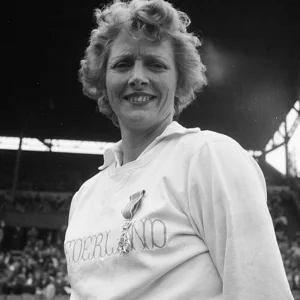

Dutch athlete regarded as one of the greatest sprinters of the 20th century. At the 1948 London Olympic Games, a mother of two and aged 30, she won four gold medals, a feat that earned her the nickname “the Flying Housewife”.
Fanny Blankers-Koen(1918 — 2004)
Fanny Blankers-Koen
Royaume des Pays-Bas
6 min read
Frequently asked questions
Key Facts
- Born on 26 April 1918 in Lage Vuursche (Netherlands)
- Competed in her first Olympic Games in Berlin in 1936
- Won 4 gold medals at the 1948 London Olympic Games (100 m, 200 m, 80 m hurdles, 4×100 m relay)
- Held several world records in various track and field disciplines over the course of her career
- Voted the greatest female athlete of the 20th century by the IAAF in 1999; died on 25 January 2004
Works & Achievements
Victories in the 100 m, 200 m, 80 m hurdles and 4×100 m relay: a unique feat for a female athlete in a single Olympic tournament.
A performance set in the midst of war, showcasing her versatility beyond running events alone.
A mark that makes her one of the most complete athletes of her era.
Peaks of speed reached in the year of her Olympic triumph.
An event combining running, jumping and throwing, crowning her exceptional versatility.
International recognition of her entire career by the International Association of Athletics Federations.
Anecdotes
At the London Games in 1948, Fanny Blankers-Koen was 30 years old and already a mother of two. Many considered her too old to win: a British athletics official reportedly suggested she would be better off staying at home. She answered on the track by winning four gold medals, which earned her the nickname “the Flying Housewife”.
During the 80 metres hurdles final in London, the race was so close that Fanny and Britain's Maureen Gardner crossed the line almost together. At that very moment, the stadium orchestra played the British anthem: for an instant Fanny thought she had lost. In reality, the anthem was greeting the arrival of the royal family, and it was indeed she who had won.
At the Berlin Games in 1936, Fanny was only 18 and won no medal, but she obtained the autograph of the great American champion Jesse Owens, her idol. Twelve years later, having herself become a four-time Olympic champion, she met him again: Owens congratulated her warmly.
Over the course of her career, Fanny Blankers-Koen held world records in very different events: sprint, hurdles, high jump, long jump and pentathlon. This rare versatility made her one of the most complete athletes of her time.
On her return from London, Fanny was welcomed in Amsterdam by an enormous crowd and paraded through the city in a carriage drawn by four horses. Her neighbours gave her a new bicycle “so that she would never have to run again”.
Primary Sources
All I did was run fast. I don't see why people make such a fuss about it.
“The Flying Housewife”: this is how the newspapers nicknamed the Dutch mother of two after her four Olympic titles.
Fanny Blankers-Koen is named the greatest female athlete of the 20th century for her entire career.
Key Places
The countryside around Baarn where Fanny Koen was born in 1918, into a rural Dutch family.
The city where Fanny trained and spent most of her career, and where a crowd welcomed her in triumph after the 1948 Games.
The site of her first Olympic Games in 1936, where she got Jesse Owens's autograph.
The stage for her legendary feat in 1948: four gold medals at the first post-war Games.
The town where Fanny Blankers-Koen passed away in 2004 at the age of 85.
Typical Objects

Athletic shoes fitted with metal spikes under the sole for better grip on the cinder track. They were essential for sprinting and jumping.

A running surface made of clinker and packed ashes, used in stadiums before the arrival of synthetic tracks. It was slower and more uneven than modern tracks.

A wooden obstacle that the athlete must clear without knocking it over during hurdle races. Fanny excelled at the 80 metres hurdles.

The award given to the winner of each event at the Olympic Games. Fanny won four of them at the single London Games in 1948.

A hand-dial instrument used to measure race times to a fraction of a second. It served to validate records and rankings.

A racing outfit in the colours of the Netherlands that Fanny wore in international competition. She represented her country on tracks all over the world.
School Curriculum
Vocabulary & Tags
Key Vocabulary
Daily Life
Morning
Fanny often started her days with household chores and caring for her two children before heading to the track. Both mother and champion, she juggled home life and training — something rare for a top-level athlete of her time.
Afternoon
Her afternoons were devoted to intensive training under the guidance of her husband and coach, Jan Blankers. She worked on her speed, her hurdling, and her jumps on a cinder track, without the scientific resources available to athletes today.
Evening
In the evening, Fanny returned to her family life, far from the bustle of the stadiums. She also prepared for upcoming competitions and planned her travels with Jan.
Food
Her diet was simple and ordinary for a mid-twentieth-century Dutch family: bread, dairy products, vegetables, and potatoes. Back then there was no elaborate sports diet or supplements like there are today.
Clothing
In competition, she wore an athletics vest and shorts in the colours of the Netherlands, along with spiked shoes. In everyday life, she dressed like a housewife of her time, in a dress or city clothes.
Housing
Fanny lived in an ordinary house in the Amsterdam area, leading a modest family life despite her fame. Her domestic life stood in sharp contrast to her image as an international sports star.
Historical Timeline
Period Vocabulary
Liens externes & ressources
Références
Œuvres
Quatre médailles d'or aux Jeux olympiques de Londres
1948
Record du monde du saut en longueur
1943
Record du monde du saut en hauteur
1943
Records du monde du 100 yards et du 80 m haies
1948
Record du monde du pentathlon
1951
Titre d'athlète féminine du XXe siècle (IAAF)
1999