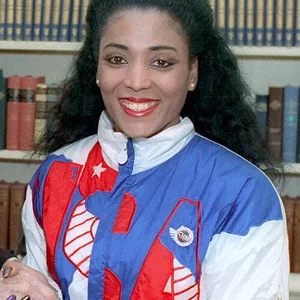

American athlete specializing in sprinting, nicknamed “Flo-Jo.” She still holds the world records in the 100 m and 200 m set in 1988, and was one of the fastest and most high-profile sprinters in history.
Florence Griffith-Joyner(1959 — 1998)
Florence Griffith-Joyner
États-Unis
5 min read
Frequently asked questions
Key Facts
- Born December 21, 1959, in Los Angeles, California
- Set the 100 m world record at 10.49 s in July 1988 (still unbeaten)
- Won three gold medals at the 1988 Seoul Olympic Games (100 m, 200 m, 4×100 m relay)
- Set the 200 m world record at 21.34 s in Seoul in 1988 (still unbeaten)
- Died prematurely on September 21, 1998, in Mission Viejo, at the age of 38
Works & Achievements
Set at the U.S. trials in Indianapolis, this time remains the women's world record more than thirty-five years later.
Achieved in the final of the Seoul Games, this record has never been approached since.
Gold in the 100 m, the 200 m and the 4×100 m relay, making her the queen of those Olympics.
Her first major Olympic medal, which heralded the triumphs of Seoul.
Her fourth medal of the Seoul Games, over a distance unusual for a sprinter.
Appointed by President Bill Clinton to promote physical fitness and sport in the United States.
Anecdotes
At the 1988 Seoul Olympic Games, Florence Griffith-Joyner did more than just run fast: she wore spectacular one-legged bodysuits and fingernails several centimeters long, painted in bright colors. Her flamboyant style earned her the nickname “Flo-Jo” and made her a true media star.
On July 16, 1988, at the U.S. Olympic Trials in Indianapolis, Flo-Jo ran the 100 m in 10.49 seconds. This world record, still unbeaten today, was so astonishing that some wondered whether the wind had been measured correctly that day.
In Seoul, Florence Griffith-Joyner won three gold medals (100 m, 200 m, 4×100 m relay) and one silver (4×400 m relay). Her 200 m record of 21.34 seconds still stands, more than thirty-five years later.
Her sister-in-law, Jackie Joyner-Kersee, was also an Olympic champion: the family thus counted several of the greatest athletes in history among its members. Florence had married Al Joyner, himself an Olympic champion in the triple jump.
Florence Griffith-Joyner died suddenly in September 1998, at just 38 years old, the victim of an epileptic seizure linked to a vascular malformation in her brain. Her untimely death shocked the world of sport.
Primary Sources
Women's 100 m: 10.49 s, Florence Griffith-Joyner (USA), Indianapolis, July 16, 1988. Women's 200 m: 21.34 s, Seoul, September 29, 1988.
Florence Griffith-Joyner wins the 100 m and the 200 m, setting a new world record over the longer distance.
Florence Griffith-Joyner's death is attributed to positional asphyxia that occurred during an epileptic seizure, itself linked to a congenital cavernous malformation of the brain.
Key Places
Birthplace of Florence Griffith-Joyner, where she grew up in a modest neighborhood. It was there that she developed her passion for running at a very early age.
The stage for her feats at the 1988 Games, where she captured three Olympic titles and a world record. The site of her global triumph.
Site of the 1988 U.S. Olympic Trials, where she ran the 100 m in 10.49 s. This world record has never been broken.
The institution where she studied and trained in collegiate track and field. It was there that she refined her sprinting technique.
The town where Florence Griffith-Joyner lived and where she died suddenly in 1998. Her passing at age 38 shocked the world of sport.
Typical Objects

An asymmetrical, colorful racing outfit she designed herself, which became her visual signature. She revolutionized the aesthetics of women's athletics.

Lightweight track shoes fitted with metal spikes to grip the track. Essential for unleashing her explosive acceleration.

Extremely long nails painted with spectacular colors and patterns that were part of her image. They added to her fame far beyond the stadiums.

Adjustable pads against which a sprinter pushes off at the start. The reaction to the starting gun was decisive for her records.

An award given to the winners of the Olympic Games. Flo-Jo won four of them at the 1988 Seoul Games alone.

A timing device accurate to the hundredth of a second used in official competition. It recorded her world records, still unbeaten today.
School Curriculum
Vocabulary & Tags
Key Vocabulary
Tags
Daily Life
Morning
A top-level sprinter's day began early with an energizing breakfast and stretching. Flo-Jo moved through warm-ups, flexibility exercises, and starting-block work on the track.
Afternoon
The afternoon was devoted to intensive training: weight-room sessions, stride work, and repeated sprints under her coach's watchful eye. Recovery between efforts was part of the program.
Evening
In the evening, she rested to safeguard her recovery, but also set aside time for her passion for fashion and designing her own outfits. Her fame brought media appearances and advertising commitments.
Food
A sprint athlete's diet rested on a carefully controlled balance of protein, carbohydrates, and hydration. Meals were tailored to training loads and competition periods.
Clothing
Away from competition, Florence cultivated a strong taste for colorful, original clothing. On the track, she wore her famous one-leg bodysuits, which she designed herself.
Housing
She lived in California, in a comfortable suburban home befitting the lifestyle of an established professional athlete. Her surroundings reflected her status as a track-and-field star.
Historical Timeline
Period Vocabulary
Liens externes & ressources
Références
Œuvres
Record du monde du 100 m (10,49 s)
16 juillet 1988
Record du monde du 200 m (21,34 s)
29 septembre 1988
Triple médaille d'or aux Jeux de Séoul
1988
Médaille d'argent au 200 m de Los Angeles
1984
Médaille d'argent au relais 4×400 m de Séoul
1988
Coprésidence du Conseil présidentiel sur le sport
1993