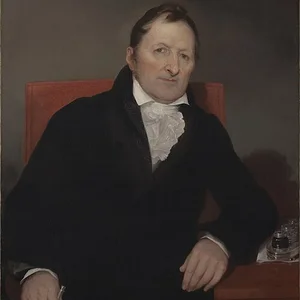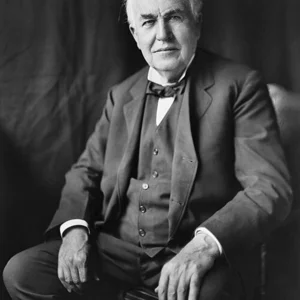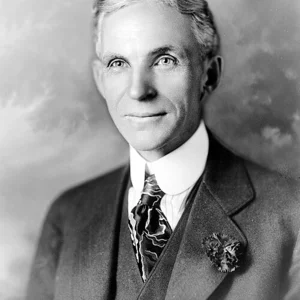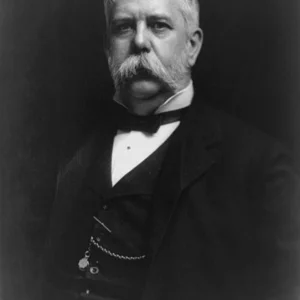

American engineer and industrialist (1846–1914), George Westinghouse invented the air brake for trains, revolutionizing railroad safety. He championed alternating current (AC) against Thomas Edison in the famous "War of Currents," helping to electrify the modern world.
George Westinghouse(1846 — 1914)
George Westinghouse
États-Unis
10 min read
Frequently asked questions
Key Facts
- 1869: patent filed for the air brake, rapidly adopted by railroad companies
- 1886: founding of the Westinghouse Electric Company to develop alternating current
- 1888: acquisition of Nikola Tesla's patents on alternating current motors
- 1893: victory at the Chicago World's Fair — the Westinghouse AC network powers the entire site
- 1896: inauguration of the Niagara Falls hydroelectric power station, a symbol of AC's triumph
Works & Achievements
The first pneumatic braking system controlled from the locomotive alone and applied simultaneously to every car in a train. Rapidly adopted by American and then worldwide railroad companies, it became a mandatory international safety standard and saved thousands of lives.
Company founded in Pittsburgh to commercialize the air brake and related railroad technologies. It became one of the world's largest manufacturers of railway safety equipment and continues to exist in the 21st century in various forms.
Company founded to develop and commercialize alternating current electrical networks. It acquired Tesla's patents, built power stations across the country, and became General Electric's main rival, playing a decisive role in electrifying the modern world.
Contract won against Edison to light the "White City" with 100,000 alternating current bulbs, in front of millions of visitors. This global event sealed the commercial and symbolic victory of the Westinghouse-Tesla system over Edison's direct current network.
The world's first large-scale polyphase alternating current hydroelectric power station, harnessing the power of Niagara Falls to supply Buffalo over 40 kilometers away. A technical masterpiece that demonstrated for the first time the viability of long-distance electrical power transmission.
A network of pneumatic and electric railway signals designed to secure tracks by warning trains of other trains ahead. Commercialized through the Union Switch and Signal Company founded by Westinghouse in 1881, this system became a worldwide railway safety standard.
Anecdotes
In 1866, at just twenty years old, George Westinghouse was deeply shaken by the account of a railroad collision in New York State: two trains crashed head-on because the engineers could not operate the brakes independently on each car. This realization haunted him until, three years later, he developed a compressed-air braking system controlled from the locomotive alone, which instantly revolutionized safety on American railroads.
During the “War of Currents” in the late 1880s, Thomas Edison orchestrated a fear campaign against the alternating current championed by Westinghouse. He publicly electrocuted dogs, calves, and even a circus elephant using alternating current to demonstrate its supposed danger. Westinghouse responded with scientific and economic arguments, and history would prove him right: it was alternating current that would ultimately power the electrical grids of the entire world.
In 1893, at the Chicago World’s Fair, Westinghouse beat out Edison to win the contract to illuminate the fairgrounds for roughly one million dollars less than his competitor. For the first time, enormous crowds discovered the magic of large-scale electric lighting: more than 100,000 light bulbs running on alternating current illuminated the buildings. This global media event convinced America that the Westinghouse-Tesla system was the future.
In 1888, Westinghouse purchased Nikola Tesla’s alternating current patents for $60,000 plus royalties. A few years later, seeing that his company risked bankruptcy because of these royalty payments, Tesla himself made the decision to tear up the contract, relinquishing millions of dollars that were rightfully his. Westinghouse considered this gesture one of the most noble he had ever witnessed from a partner.
In 1895, the Niagara Falls hydroelectric power plant, designed by Westinghouse in collaboration with Tesla, began operation. For the first time in history, a natural energy source was converted into alternating current electricity and transmitted nearly 40 kilometers to the city of Buffalo. This technical feat marked the birth of large-scale electrification and definitively confirmed the victory of alternating current over direct current.
Primary Sources
The nature of my invention consists in the arrangement of a driving-wheel cylinder and piston in combination with a train-pipe and a triple valve, for the purpose of applying brakes to railway-cars by means of compressed air, substantially as herein described.
I have no hesitation in saying that I regard the fears expressed as to the dangers of alternating currents as entirely unnecessary. The alternating system is not only safe but is the only practical system for long-distance transmission of electricity.
Be it known that I, Nikola Tesla, a subject of the Emperor of Austria, from Smiljan, Lika, border country of Austria-Hungary, have invented certain new and useful Improvements in Electro-Magnetic Motors, of which the following is a specification.
The air-brake as applied to trains of railway-cars consists essentially of a continuous pipe extending through the train, connected to a reservoir of compressed air at the locomotive, with automatic valves on each car which apply the brakes upon a reduction of pressure in the pipe.
George Westinghouse was, in my opinion, the only man on this globe who could take my alternating current system under the circumstances then existing and win the battle against prejudice and money power. He was a pioneer of imposing stature and one of the world's true nobleman.
Key Places
A small rural town in New York State where George Westinghouse was born on October 6, 1846, into a family of mechanics who manufactured agricultural machinery. This environment of workshops and machines shaped his calling as an inventor from childhood.
The industrial capital of 19th-century America, where Westinghouse settled in 1869 to found the Westinghouse Air Brake Company, then the Westinghouse Electric Company in 1886. Pittsburgh remained the heart of his industrial empire and his family life throughout his career.
Site of the world's first large-scale alternating current hydroelectric power station, designed by Westinghouse and inaugurated in 1895. This monumental achievement demonstrated that natural energy could be harnessed, converted into electricity, and transmitted over long distances to power entire cities.
In 1893, Westinghouse won the contract to illuminate this "White City," beating out Edison. More than 100,000 alternating current light bulbs lit up the fairgrounds, convincing the general public and investors alike of the superiority of the AC system — marking the decisive turning point in the War of Currents.
An upscale resort town in the Berkshires where Westinghouse owned a grand country estate called "Erskine Park." It was in this pastoral setting that he partially withdrew in his later years, though he continued to invent and patent new ideas until the end.
Westinghouse died here on March 12, 1914. The city was also the backdrop for the first public clashes between Westinghouse and Edison during the War of Currents, and the site of the opening of Pearl Street Station — Edison's DC power plant that Westinghouse fought against for years.
Typical Objects

Westinghouse's landmark invention: a pneumatic braking system activated from the locomotive and applied simultaneously to every car in the train through a continuous pipe. Before its invention, each car had to be braked manually by a brakeman, making emergency stops virtually impossible on fast-moving trains.

An essential component of the alternating current network, capable of stepping up voltage for efficient long-distance transmission and then stepping it back down for safe household use. Westinghouse and his engineers refined the earliest transformers to make AC power economically viable on a large scale.

An AC electric motor patented by Tesla and commercialized by Westinghouse. Rugged, inexpensive, and requiring no commutator maintenance, it became the universal workhorse of industry throughout the twentieth century.

A machine that generates the alternating current distributed across Westinghouse's networks. Power stations equipped with these alternators, such as the one at Niagara Falls, could supply entire cities over great distances — unlike Edison's direct-current generators, which were limited to a few kilometers.

A railway signaling system developed by Westinghouse and marketed through the Union Switch and Signal Company (founded in 1881). The system uses compressed air and electricity to automatically warn trains of other trains ahead on the track, drastically reducing the risk of collision.

Westinghouse adapted Edison's bulb to run on his alternating current networks, proving that AC could power everyday household needs just as well as DC. The spectacular illumination of the 1893 World's Columbian Exposition in Chicago definitively brought the electric light bulb to a mass audience.
School Curriculum
Vocabulary & Tags
Key Vocabulary
Tags
Daily Life
Morning
Westinghouse rises early and begins his day with an intensive review of correspondence, engineers' reports, and ongoing patent files, often at his Pittsburgh office before breakfast. A man of prodigious energy, he is known for arriving at work before his employees and leaving after them, simultaneously handling multiple technical and business matters.
Afternoon
The afternoon is devoted to technical meetings with his engineering teams, visits to manufacturing workshops, and sometimes personal experiments in his private laboratory. Westinghouse is famous for his insatiable curiosity and love of hands-on work: he involves himself directly in solving technical problems rather than simply managing from a distance.
Evening
In the evening, Westinghouse frequently hosts business partners, investors, or engineers for dinner at his large family home in Pittsburgh. A sociable and generous man, he organizes receptions where technical discussions and social conversation mingle, and he also devotes part of his evenings to reading scientific journals and sketching out new inventions.
Food
Like most prosperous industrial magnates of the American Victorian era, Westinghouse enjoys rich, abundant food: roasted meats, seasonal vegetables, and hearty desserts. His wife Marguerite, whom he married in 1867, personally oversees the quality of the family table. In the later years of his life, the heart problems he suffers force him to adopt a more modest, carefully monitored diet.
Clothing
Westinghouse dresses as a true captain of industry of the Gilded Age: a three-piece suit in dark wool, a stiff white collar, a sober tie, and a top hat for official occasions. In his workshops, he readily swaps the suit for a work coat, as he has no hesitation getting his hands dirty alongside his workers — earning him an unusual reputation among the employers of his era.
Housing
His main residence is an imposing manor in the upscale Homewood neighborhood of Pittsburgh, set amid sweeping gardens. He also owns “Erskine Park,” a magnificent vacation estate in Lenox, in the Berkshires of Massachusetts, where he spends the summer with his family. These two homes reflect the enormous fortune and social status he acquired through his inventions and industrial empire.
Historical Timeline
Period Vocabulary
Liens externes & ressources
Références
Œuvres
Frein à air comprimé (Westinghouse Air Brake)
1869
Westinghouse Air Brake Company (WABCO)
1869
Westinghouse Electric Company
1886
Illumination de l'Exposition universelle de Chicago
1893
Centrale hydroélectrique des chutes du Niagara
1895
Système de signalisation ferroviaire automatique (Union Switch and Signal)
1881