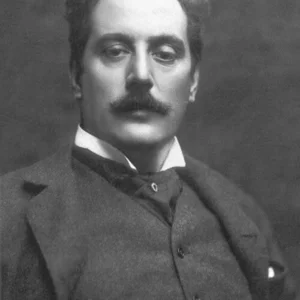

Giacomo Puccini was an Italian composer, one of the greatest masters of opera of the late nineteenth and early twentieth centuries. An heir to Verdi, he left his mark on the verismo movement with works of exceptional dramatic and melodic intensity.
Giacomo Puccini(1858 — 1924)
Giacomo Puccini
grand-duché de Toscane, royaume d'Italie
6 min read
Frequently asked questions
Key Facts
- Born in 1858 in Lucca (Tuscany) into a family of church musicians.
- Premiered *La Bohème* in 1896, one of the most frequently performed operas in the world.
- Composed *Tosca* in 1900, a lyric drama of verismo inspiration.
- Premiered *Madama Butterfly* in 1904, at first coldly received and later triumphant.
- Died in 1924 in Brussels, leaving *Turandot* unfinished.
Works & Achievements
Puccini's first major success, revealing him as the potential successor to Verdi.
The tender and tragic story of poor young artists in Paris; one of the most frequently performed operas in the world.
A political and passionate drama set in Rome under Napoleon, famous for its intensity and verismo realism.
The tragedy of a young Japanese woman abandoned by an American officer, shaped by the era's taste for exoticism.
An opera set in the American West during the Gold Rush, premiered at the Metropolitan Opera in New York.
His final opera, left unfinished at his death, set in a legendary China; it contains the famous aria “Nessun dorma.”
Anecdotes
Giacomo Puccini came from a long line of musicians: for five generations, his family had provided the organists and choirmasters of Lucca Cathedral. The young Giacomo was therefore expected to take up the mantle, but he chose a different path after discovering opera.
In 1876, when he was 17, Puccini walked nearly 30 kilometres to Pisa to attend a performance of Verdi's *Aida*. Dazzled, he decided that night to become an opera composer rather than an organist.
Puccini was passionate about the technical novelties of his time: he loved fast cars, motorboats and duck hunting. In **1903**, a serious car accident broke his leg and delayed the completion of his opera *Madama Butterfly*.
At the premiere of *Madama Butterfly* at La Scala in Milan in **1904**, the opera was a resounding failure: the audience hissed and jeered loudly. Puccini, deeply wounded, withdrew the score, reworked it, and the revised version triumphed a few months later in Brescia.
Puccini died in **1924** without having been able to finish his last opera, *Turandot*. At its premiere in **1926**, the conductor Arturo Toscanini stopped mid-performance at the exact spot where Puccini had ceased writing, turned to the audience and declared that the work ended there, where the master had laid down his pen.
Primary Sources
It was a real lynching. Those cannibals didn't listen to a single note. What a terrible orgy of madmen drunk on hatred.
The Almighty touched me with His little finger and said: write for the theatre, only for the theatre. And I obeyed that supreme command.
My opera will be performed unfinished, and then someone will come onto the stage and say to the audience: at this point the master died.
Key Places
City in Tuscany where Puccini was born in 1858 into a family of musicians. There he received his first musical training as an organist.
Puccini studied composition here from 1880, notably under Amilcare Ponchielli. Milan was then the heart of Italian operatic life, with La Scala and the publisher Ricordi.
Village on the shore of Lake Massaciuccoli where Puccini set up his villa and composed most of his great operas. There he enjoyed the quiet, hunting and nature.
Italy's most prestigious opera house, where the failure of Madama Butterfly took place in 1904 and the posthumous premiere of Turandot in 1926.
Puccini traveled here to be treated for throat cancer and died in November 1924, shortly after an operation. Turandot remained unfinished.