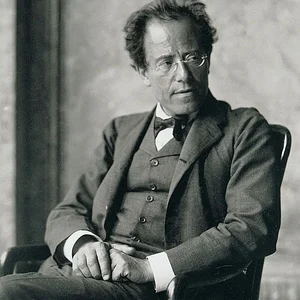

Gustav Mahler (1860-1911) was an Austrian composer and conductor, a major figure of post-Romanticism. His vast symphonies and song cycles bridge the Romantic tradition of the 19th century and the musical modernism of the 20th century.
Gustav Mahler(1860 — 1911)
Gustav Mahler
empire d'Autriche, Cisleithanie
6 min read
Frequently asked questions
Famous Quotes
« Tradition is the handing down of the flame, not the worship of the ashes.»
« A symphony must be like the world. It must embrace everything.»
Key Facts
- Born in 1860 in Kalischt (Bohemia), in the Austrian Empire
- Director of the Vienna Court Opera from 1897 to 1907
- Composed nine completed symphonies and the cycle The Song of the Earth (Das Lied von der Erde, 1908-1909)
- Author of major song cycles such as the Kindertotenlieder (1901-1904)
- Died in 1911 in Vienna, leaving his Tenth Symphony unfinished
Works & Achievements
Mahler's first great symphony, which establishes his personal language blending lyricism, funeral march and popular fanfares.
A vast fresco for orchestra, choir and soloists on death and rebirth; one of his most frequently performed works.
A cycle of lieder set to German folk poems, where humor, irony and tragedy intertwine.
A symphony famous for its Adagietto, a love song made known worldwide by cinema in the 20th century.
A deeply moving cycle of lieder on the death of children, of poignant intimacy, composed before the loss of his own daughter.
A monumental work bringing together hundreds of musicians and choristers, the pinnacle of symphonic gigantism.
A symphony for voices and orchestra set to Chinese poems, a meditation on the fleeting nature of life; Mahler avoided giving it a number.
His last completed symphony, a heart-rending farewell to life that heralds the musical modernity of the 20th century.
Anecdotes
Mahler ran the Vienna Opera with legendary strictness: he had the chandeliers dimmed during performances and barred latecomers from entering, scandalizing a fashionable audience used to chatting away. These reforms made him a feared but admired conductor who lastingly transformed the customs of the opera house.
Born into a Jewish family in Bohemia, Mahler converted to Catholicism in 1897 in order to take up the post of director of the Vienna Opera, which was then closed to Jews. He later declared: “I am thrice homeless: as a Bohemian among Austrians, as an Austrian among Germans, and as a Jew throughout the world.”
In 1910, tormented by anguish after discovering the infidelity of his wife Alma, Mahler consulted the famous psychoanalyst Sigmund Freud during a long walk of several hours in Leiden, in the Netherlands. It is one of the few documented encounters between two giants of Viennese culture.
Mahler composed during the summer in small isolated huts (the Komponierhäuschen) built out in nature, far from any noise. He demanded absolute silence: it is said that the bells of a herd of cattle had to be silenced and a barrel organ kept away so that he could work.
Convinced that he was struck by a “curse of the Ninth” (Beethoven, Schubert, and Bruckner having died after their ninth symphony), Mahler tried to cheat fate by not numbering Das Lied von der Erde. He died nonetheless, leaving his Tenth Symphony unfinished.
Primary Sources
I am thrice homeless: a Bohemian among Austrians, an Austrian among Germans, and a Jew throughout the world. Everywhere an intruder, never welcomed.
A symphony must be like the world. It must embrace everything.
My time will come. Posterity will understand me.
I spent a memorable afternoon with him; he seemed the man most capable of understanding analysis that I had ever met.
Key Places
Village in Bohemia where Mahler was born in 1860, into a modest German-speaking Jewish family. Today in the Czech Republic.
Prestigious opera house that Mahler directed from 1897 to 1907, introducing artistic reforms that remain famous to this day. The peak of his career as a conductor.
Holiday retreat in Carinthia where Mahler had a villa and a secluded composing hut built. There he composed several of his great symphonies during the summer.
Institution where Mahler studied music starting in 1875, in a Vienna that was the cultural capital of Europe. There he shaped his training as a composer and pianist.
American opera house where Mahler conducted from 1908, after leaving Vienna. There he continued his career across the Atlantic in his final years.
Place where Mahler was buried after his death in 1911, according to his wish, without ceremony or music. His grave bears only his name.
Typical Objects

A slender wooden baton that Mahler wielded with feverish intensity to lead the Vienna Opera and the great orchestras. It symbolizes his absolute authority over the musicians.

Vast pages covered in dense handwriting, where Mahler stacked dozens of staves for an oversized orchestra. His manuscripts bear countless annotations of dynamics and tempo.

A piano set up in the Komponierhäuschen, the small isolated hut where Mahler composed during the summer. There he worked in strict silence, far from any distraction.

The small wire-rimmed glasses characteristic of Mahler's face, inseparable from his nervous, intellectual demeanor. They are part of his most familiar image.

Sounds of the Alpine countryside that Mahler wove into his symphonies, such as cowbells or birdsong. They express his pantheistic love of nature.

A collection of German folk poems (“The Boy's Magic Horn”) from which Mahler drew the texts of many lieder and symphonic themes. A major source of inspiration for his work.
School Curriculum
Vocabulary & Tags
Key Vocabulary
Daily Life
Morning
During the summer at Maiernigg, Mahler rose early and walked to his secluded composing hut in the woods, where he demanded absolute silence. There he worked with intense concentration throughout the entire morning, with coffee and breakfast brought to him without a sound.
Afternoon
Afternoons were often devoted to long, vigorous walks and to swimming in Lake Wörthersee, activities he considered essential to his inspiration. During the Vienna season, he spent his days in demanding rehearsals at the Opera.
Evening
In the evening, Mahler frequently conducted performances at the Vienna Opera, scrutinizing every detail of the staging and the orchestra. His free evenings were spent reading, in philosophical conversations, or in the intellectual salons of Vienna.
Food
Mahler followed a rather frugal diet and was careful about what he ate, mindful of his fragile health and his digestive troubles. Nevertheless, he enjoyed Viennese cuisine and meals shared with Alma and their artist friends.
Clothing
He wore the dark, severe suits of the Viennese bourgeoisie at the turn of the century: frock coat, stiff collar, and necktie. His small round glasses and unruly hair made for a nervous, instantly recognizable figure.
Housing
In Vienna, Mahler occupied a comfortable bourgeois apartment near the Opera. In summer, he stayed at his villa in Maiernigg by the lake, equipped with a separate composing hut nestled in the forest.