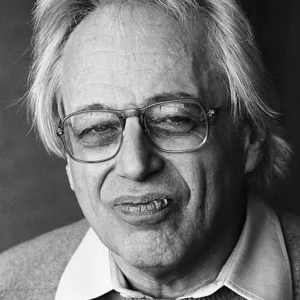

Hungarian-born composer who became a naturalized Austrian citizen, a major figure of 20th-century contemporary music. The inventor of micropolyphony, he left his mark on the avant-garde through his dense sound textures and his rejection of serialist dogmas.
Gyorgy Ligeti(1923 — 2006)
György Ligeti
Hongrie, Autriche
5 min read
Frequently asked questions
Key Facts
- Born in 1923 in Transylvania (Romania) into a Hungarian Jewish family, a survivor of the Holocaust
- Fled Hungary after the Budapest uprising was crushed in 1956 and settled in the West
- Composed *Atmosphères* (1961), the founding work of micropolyphony
- Several of his works (*Atmosphères*, *Lux Aeterna*, *Requiem*) were used by Stanley Kubrick in *2001: A Space Odyssey* (1968)
- Died in 2006 in Vienna after a career acclaimed worldwide
Works & Achievements
A work for large orchestra, a manifesto of micropolyphony: a continuous sonic fabric with no apparent melody or rhythm.
A provocative, conceptual piece toying with chance and the gradual fading of sound.
A vast vocal and orchestral work whose “Lacrimosa” was used in “2001”.
A piece for sixteen a cappella voices, a pinnacle of dense, ethereal polyphony.
Ligeti's only opera, an absurd and grotesque satire of the end of the world.
A collection of virtuosic pieces blending African rhythms, fractals, and sonic optical illusions.
A late work incorporating microtones, folk instruments, and fragmented writing.
Anecdotes
In 1968, without knowing it, Ligeti became world-famous: Stanley Kubrick used several of his works (Atmosphères, Lux Aeterna, Requiem) in the film *2001: A Space Odyssey*. The director had not warned him, and the composer had to take legal action to obtain compensation, while still delighting in this unexpected exposure.
During the Second World War, Ligeti, a Hungarian Jew, was sent to a forced labor camp. His father and brother died in deportation. He survived, but this tragedy left a deep mark on a man who would go on to devote his life to inventing sounds never heard before.
In December 1956, after Soviet tanks crushed the Budapest uprising, Ligeti fled communist Hungary. He secretly crossed the border into Austria, at times hidden under mail sacks on a train, to reach the artistic freedom of the West.
Ligeti loved paradoxes and illusions. Fascinated by African rhythms, mathematical fractals, and the impossible staircases of the artist Escher, he composed *Études* for piano of formidable difficulty, in which the ear thinks it hears one thing while another is being played.
His piece *Poème symphonique* (1962) is written for 100 mechanical metronomes! You wind them up, release them all together, then they stop one by one, the last tick-tock echoing alone in the silence. A joyful scandal that poked fun at overly serious avant-gardes.
Primary Sources
I prefer to speak of musical structures rather than mathematics. What interests me are textures, the sonic fabric in which one no longer hears the individual voices but the movement of the whole.
There is no melody, no harmony, no rhythm in the traditional sense: only sheets of sound that transform slowly, a polyphony so dense that it becomes motionless.
When I first heard my music in Kubrick's film, I did not know it was featured there. It was a total surprise, and part of that music had even been altered without my consent.
Key Places
Ligeti's birthplace, in Romania, in a region where Hungarian, Romanian, and German cultures intersected.
The city where Ligeti studied and taught at the Franz Liszt Academy before fleeing the communist regime in 1956.
The avant-garde's sound laboratory, where Ligeti joined Stockhausen and explored electronic music starting in 1957.
The conservatory where Ligeti was a professor of composition from 1973 onward, training a new generation of musicians.
The city where Ligeti obtained Austrian citizenship and where he died in 2006.
Typical Objects

A pendulum device that beats time. Ligeti used 100 of them simultaneously in his *Poème symphonique*, turning a precision tool into pure musical material.

A sheet of notation with sometimes invented symbols (sound sheets, clusters, graphics). Ligeti had to devise new ways of writing down his dense sonic textures.

A pipe instrument for which Ligeti wrote *Volumina*, a work made of massive clusters that play on density and duration rather than melody.

A machine in the Cologne electronic studio used to cut, splice and layer recorded sounds. There Ligeti composed *Artikulation* out of electronic noises.

The central instrument of his *Études*, extremely difficult, where African rhythms, illusions and polyrhythms inspired by fractals intertwine.

A small metal instrument that gives a reference note. Ligeti loved playing with micro-intervals and false pitches, blurring the ear's bearings.
School Curriculum
Vocabulary & Tags
Key Vocabulary
Daily Life
Morning
Meticulous and demanding, Ligeti devoted his mornings to composing in his study. He worked slowly, crossing out a great deal, searching for the exact sound he heard in his head before committing it to paper.
Afternoon
The afternoon might be given over to teaching, correspondence, or reading. Curious about everything, he devoured works on mathematics, biology, and ethnomusicology that fed his sonic imagination.
Evening
In the evening, he attended concerts, listened to music from around the world, or talked passionately with fellow composers and intellectual friends. Debates about art and ideas energized him.
Food
A man of twentieth-century European city life, Ligeti shared the diet of Mitteleuropa: Hungarian and Austrian cuisine, and Viennese cafés where conversation mingled with pastries.
Clothing
He wore the ordinary clothes of a professor and composer of the later twentieth century: a suit, shirt, and jacket, often understated, sometimes set off by glasses with frames typical of the era.
Housing
After his exile, Ligeti lived in apartments in European cities, notably Vienna and Hamburg. His home reflected his life as an artist: scores, books, and instruments filled the workspace.