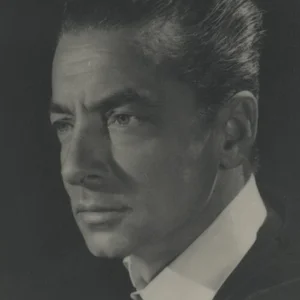

Herbert von Karajan (1908-1989) was an Austrian conductor, one of the most famous of the 20th century. Music director of the Berlin Philharmonic Orchestra for more than thirty years, he left his mark on the history of orchestral conducting and the classical recording.
Herbert von Karajan(1908 — 1989)
Herbert von Karajan
Autriche, Troisième Reich, Cisleithanie
5 min read
Frequently asked questions
Key Facts
- Born on April 5, 1908 in Salzburg, Austria
- Joined the Nazi party in 1933, which would spark controversy after the war
- Appointed music director for life of the Berlin Philharmonic Orchestra in 1955, a position he held until 1989
- Made more than 900 recordings, becoming a major figure in the classical recording industry
- Died on July 16, 1989 in Anif, near Salzburg
Works & Achievements
Several complete sets recorded, among the most famous and best-selling versions of the 20th century.
More than three decades at the helm of one of the world's greatest orchestras, which he shaped to his ideal of sound.
A high-end opera and symphonic festival that he created and led, notably centered on Wagner's operas.
A pioneer of audiovisual recording, he founded his own production company to film his performances.
His influence accelerated the adoption of the CD; Beethoven's Ninth under his direction served as the reference for this new format.
Remarkable interpretations in Vienna, Salzburg and Berlin, combining orchestral rigor with a great sense of spectacle.
Anecdotes
Karajan was passionate about speed and machines: he flew private planes, owned a collection of sports cars, and sailed on his own yacht. This fascination with technology led him to take an early interest in new ways of recording and filming music.
Nicknamed “the music director of Europe” in the 1950s, he simultaneously held the direction of the Berlin Philharmonic Orchestra, the Vienna State Opera, the Salzburg Festival, and countless recordings. Few musicians have ever concentrated so much artistic power.
Karajan almost always conducted with his eyes closed and from memory, without a score. He claimed that conducting was done with the inner ear and that the gesture should suggest the music rather than simply beat time.
Convinced that sound and image went together, he founded his own audiovisual production company to film his concerts. He was also one of the first great conductors to support the compact disc (CD), declaring that “all the rest is gaslight.”
His joining the Nazi party in 1933, while he was building his career in Germany, earned him a temporary ban on conducting after the war and remains a controversial part of his biography, still debated today.
Primary Sources
I want the listener, at home, to have exactly the impression of sitting in the best seat in the concert hall.
All the rest is gaslight.
The worst thing you can do to an orchestra is give it a clear order, for then it stops listening.
Key Places
Karajan's birthplace and the homeland of Mozart, where he long directed the Festival and founded the Easter Festival.
A modern concert hall inaugurated in 1963, home of the Berlin Philharmonic Orchestra, which he conducted for more than thirty years.
A prestigious opera house whose artistic direction Karajan took over in 1956.
An Austrian village where Karajan lived and where he died on 16 July 1989.
A German city where, as a young conductor, Karajan secured one of his first important posts in the 1930s.
Typical Objects

Slender baton held in the right hand to mark the tempo and guide the musicians. Karajan used it with broad, flowing gestures.

A bulky full score bringing together all the instrumental parts of a work. Karajan, who often conducted from memory, had studied it meticulously beforehand.

A stand placed in front of the conductor to hold the score. Karajan conducted from a raised podium, facing the orchestra.

A digital medium that appeared in 1982 and which Karajan championed enthusiastically. Beethoven's Ninth under his direction is among the first CDs ever released.

Recording equipment that Karajan positioned carefully to achieve a uniform, brilliant sound, his famous "sonic signature".

Black evening attire worn by conductors during concerts. Karajan wore it with care, attentive to his stage image.
School Curriculum
Vocabulary & Tags
Key Vocabulary
Daily Life
Morning
Karajan often started early by studying the scores, which he analyzed in detail so he could later conduct them from memory. A sports enthusiast, he practiced yoga and stayed mindful of his physical fitness.
Afternoon
The afternoon was devoted to rehearsals with the orchestra, demanding and meticulous, where he sought balance and a polished sound. He sometimes moved from recording sessions to preparing for concerts.
Evening
In the evening came the concert or the opera performance, a moment of intense concentration. Karajan frequently conducted with his eyes closed, completely absorbed in the music.
Food
A man attentive to his lifestyle, he watched his diet and his energy levels, in keeping with his passion for sport. The precise details of his meals belong mostly to his private life.
Clothing
In concert, he wore the traditional black tailcoat of conductors. In everyday life, he displayed an understated, modern elegance, in line with his taste for fine machines.
Housing
He lived in comfortable residences in Austria, notably in Anif near Salzburg, and had the means of an artist at the peak of international fame.