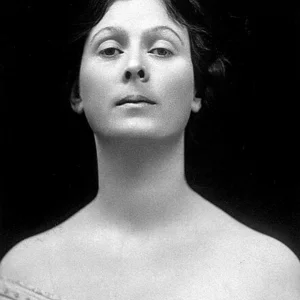

American dancer (1877-1927)
Isadora Duncan(1877 — 1927)
Isadora Duncan
Union soviétique, États-Unis
7 min read
Frequently asked questions
Key Facts
- Isadora Duncan (1877-1927) est considérée comme la pionnière de la danse moderne, rompant avec les codes stricts du ballet classique.
- Elle fonde ses premières écoles de danse en Europe au début du XXe siècle, notamment à Berlin (1904) et à Paris, pour diffuser sa conception de la danse libre.
- Inspirée par la Grèce antique, elle danse pieds nus, vêtue de tuniques légères, s'opposant au corset et aux pointes du ballet traditionnel.
- Elle s'installe en Union soviétique en 1921, invitée par le gouvernement bolchevique pour ouvrir une école de danse à Moscou, épousant le poète Sergueï Essénine.
- Elle meurt accidentellement à Nice en 1927, étranglée par son écharpe coincée dans les roues d'une automobile, laissant une œuvre artistique fondatrice.
Works & Achievements
Founding theoretical essay in which Isadora sets out her vision of a dance freed from academic conventions, rooted in nature and inner expression. A foundational text in the history of modern dance.
One of her most celebrated choreographies, inspired by Greek tragedy and danced to the music of Gluck. It perfectly illustrates her method of dramatic expression through free movement.
Patriotic solo created during the First World War, danced in a red tunic. Isadora allegorically embodies France as a martyr rising from its wounds, a sequence of immense emotional power.
Isadora was a pioneer in choreographing major symphonic works previously considered undanceable. This creation with the Munich orchestra was met with enthusiasm from European critics.
Isadora founded several schools to pass on her method to young students, the 'Isadorables'. These schools foreshadowed the contemporary dance pedagogies of the 20th century.
Autobiography published the year of her death, in which Isadora retraces her artistic and romantic journey with remarkable candor for the time. An invaluable document on the artistic life of the Belle Époque.
Anecdotes
Isadora Duncan always refused to wear the corset and pointe shoes imposed by classical dance. During her first performances in Paris in 1900, she performed barefoot on stage, which scandalized the bourgeois public but fascinated avant-garde artists such as Rodin.
In 1913, her two children, Deirdre and Patrick, drowned in the Seine after their automobile plunged into the river. The tragedy deeply shook Isadora, who attempted to overcome her grief by dedicating herself even more intensely to her art and her dance schools.
Isadora Duncan died in a manner both tragic and symbolic: in 1927 in Nice, her long red silk shawl became entangled in the spokes of the rear wheel of the open-top Amilcar she was riding in, strangling her instantly. The poet Jean Cocteau remarked: 'Admirable end for a woman who had always loved grand gestures.'
In 1921, Lenin invited her to come and open a dance school in Moscow. Isadora accepted enthusiastically, convinced that the Russian Revolution would liberate the arts. There she met the poet Sergei Yesenin, whom she married despite their seventeen-year age gap and their inability to understand each other without an interpreter.
During an American tour in 1922, Isadora was monitored by the FBI due to her Communist sympathies and her marriage to a Soviet citizen. On stage in Boston, she waved her red scarf and cried out 'I am red!', triggering a national scandal and threats of deportation.
Primary Sources
I have always believed that dance must come from within, that the movement of the body must be the direct expression of the soul. The corset and the pointe shoes are shackles to this truth.
My art is but an attempt to express in gestures and movements the truth of my being. I seek the primordial movement, the one that existed before man invented his conventions.
The dancer of the future will be the one whose body and soul are one, whose movements are a prayer. She will be the high priestess of a sublime religion.
I have never been able to understand why, in order to express joy, pain, or beauty, one should submit to codified rules invented by ballet masters of the 17th century.
Isadora Duncan dances and, watching her, I suddenly understand that outward form is nothing without the inner feeling that animates it. She taught me something essential about the art of acting.
Key Places
Isadora Duncan was born on May 26, 1877, in San Francisco. Her mother, a pianist, passed on to her from an early age a love of classical music that would guide all of her choreographic work.
Paris was the city where Isadora found fame, rubbing shoulders with Rodin, Debussy, and the artists of Art Nouveau. She spent most of her adult life there and lost her children there.
In 1903, Isadora and her family made a formative journey to Greece to study ancient architecture and sculpture. She even attempted to build a temple there dedicated to dance.
Invited by the Soviet government in 1921, Isadora opened a free dance school in Moscow. It was there that she met the poet Yesenin, whom she married.
It was in Nice, on September 14, 1927, that Isadora Duncan died, strangled by her scarf. The Promenade des Anglais remains associated with this tragic and symbolic fate.
Liens externes & ressources
Références
Œuvres
The Dance of the Future
1903
Iphigénie en Tauride (chorégraphie sur Gluck)
1904
La Marseillaise (solo)
1915
Symphonie n°7 de Beethoven (chorégraphie)
1904
École de danse d'Isadora Duncan (Grünewald puis Paris)
1904-1914
Ma Vie (My Life)
1927