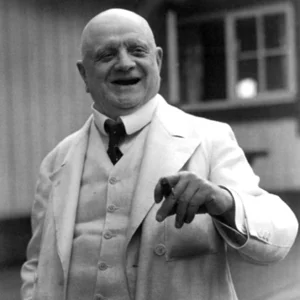

Finnish composer, a major figure of late Romanticism and musical nationalism. His work, marked by seven symphonies and the symphonic poem Finlandia, became a symbol of Finnish national identity in the face of Russian domination.
Jean Sibelius(1865 — 1957)
Jean Sibelius
Finlande, grand-duché de Finlande
6 min read
Frequently asked questions
Famous Quotes
« Pay no attention to what the critics say. No statue has ever been erected to a critic.»
Key Facts
- Born in 1865 in Hämeenlinna, in the Grand Duchy of Finland under Russian rule
- Composed Finlandia in 1899-1900, which became a Finnish patriotic anthem
- Premiered his Symphony No. 2 in 1902, one of his most frequently performed works
- Composed the Violin Concerto in D minor (1903-1905), the only concerto in his body of work
- Long creative silence after 1926 (the “silence of Ainola”) until his death in 1957
Works & Achievements
First major work inspired by the Kalevala; it revealed Sibelius as the musical voice of the Finnish nation.
Symphonic poem that became the unofficial anthem of Finnish resistance and national identity in the face of Russia.
Sibelius's only concerto, combining virtuosity with Nordic lyricism; a major piece of the violin repertoire.
A triumphant work often associated with Finnish patriotic feeling, among his most frequently performed symphonies.
A luminous symphony culminating in the “swan theme,” an emblem of his maturity.
His last completed symphony, in a single continuous movement, a peak of formal concentration.
His last great symphonic poem, evoking the mythical Finnish forest; it closes his creative career.
A piece drawn from the incidental music for Kuolema, which became one of his most popular works worldwide.
Anecdotes
As a young man, Sibelius dreamed of being a virtuoso violinist and auditioned for the Vienna Philharmonic Orchestra. Too nervous and having started too late, he failed: he then resolved to become a composer, which changed the history of Finnish music.
In 1899, under Russian censorship, the piece that would become Finlandia was performed under disguised titles such as “Impromptu” or “Hymn to the Homeland” to evade the imperial authorities' ban, so feared was its power to awaken national feeling.
Sibelius was passionately attached to Finnish nature: he claimed to have seen a flight of sixteen swans over his house, a vision that inspired the final theme of his Fifth Symphony, which he called “the swan hymn.”
After his Seventh Symphony (1924) and the tone poem Tapiola (1926), Sibelius practically stopped composing for more than thirty years, until his death. This “silence of Ainola” remains one of the great mysteries in the history of music; he is said to have burned the manuscript of an Eighth Symphony.
Sibelius was a cigar smoker and a great lover of fine food, which left him heavily in debt; as early as 1897 the Finnish State granted him an annual pension to allow him to compose freely, a rare recognition for an artist during his lifetime.
Primary Sources
Today at ten to eleven, I saw sixteen swans. One of the greatest experiences of my life! Lord, what beauty!
The finale, titled “Finland Awakens,” accompanies the patriotic tableau of the free Finnish press confronting oppression.
Music begins where the possibilities of language end. That is why I write music.
Key Places
Town in southern Finland where Sibelius was born in 1865 and spent his childhood.
The Finnish capital where Sibelius studied music and where many of his major works premiered, including Finlandia.
Villa built in 1904 on the shore of Lake Tuusula where Sibelius lived for half a century and died in 1957; today a museum.
The Austrian capital where Sibelius refined his composition skills (1890-1891) and failed the audition for the philharmonic orchestra.
City where Sibelius furthered his musical training in the early 1890s and became acquainted with the great Germanic tradition.
Typical Objects

Sibelius's instrument in his youth, which he practiced intensely while dreaming of a career as a virtuoso before devoting himself to composition.

Sheets of ruled paper on which Sibelius wrote out by hand his symphonies and symphonic poems for full orchestra.

Sibelius was a heavy cigar smoker, an expensive pleasure that contributed to his debts and is part of his legendary image.

A small metal instrument that gives the reference note, an everyday tool for the composer and the conductor to tune the music.

A collection of the Finnish national epic compiled by Elias Lönnrot, a major source of inspiration for *Kullervo*, the *Lemminkäinen Suite* and many other works by Sibelius.

Sibelius often conducted his own works in Finland and abroad; the baton was used to lead the orchestra during premieres.
School Curriculum
Vocabulary & Tags
Key Vocabulary
Daily Life
Morning
At Ainola, Sibelius often began his day late, after nights of work. He loved to walk in the forest and along the shore of Lake Tuusula, observing the nature that fed his musical inspiration.
Afternoon
The afternoon was devoted to composing in his silent study, where he demanded absolute quiet from his family. He worked slowly, tirelessly reworking his symphonies before deeming them worthy of being performed.
Evening
Evenings could be festive, with artist friends, fine wine and cigars, or, on the contrary, melancholy. Sibelius struggled with alcohol and self-doubt, but he also loved listening to the sounds of the Finnish night.
Food
A renowned gourmet, Sibelius enjoyed rich dishes, fine wines and champagne — expensive tastes that deepened his debts. Finnish and European cuisine sat side by side at his table at Ainola.
Clothing
He wore the well-kept attire of the European bourgeois of his time: dark suits, stiff collars and ties — the elegant image of a composer celebrated far beyond Finland.
Housing
His villa Ainola, built of wood in 1904 at Järvenpää, was a family home surrounded by forest and facing the lake, designed as a refuge favorable to creation far from the city.