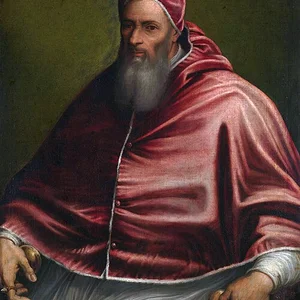

Julius III (Giovanni Maria Ciocchi Del Monte, 1487–1555) was the 221st pope of the Catholic Church from 1550 to 1555. He convened the resumption of the Council of Trent and was a patron of the arts, protector of Michelangelo and Palestrina.
Julius III(1487 — 1555)
Julius III
États pontificaux
8 min read
Frequently asked questions
Key Facts
- Born in 1487 in Rome as Giovanni Maria Ciocchi Del Monte
- Elected pope on 7 February 1550, taking the name Julius III
- Resumed the Council of Trent in 1551, which had been interrupted since 1547
- Appointed Palestrina choirmaster of St. Peter's Basilica in 1551
- Died on 23 March 1555 in Rome
Works & Achievements
Julius III convened the resumption of the council, which had been suspended since 1549, and presided over its second period, enabling the adoption of important decrees on the Eucharist, penance, and extreme unction — forming the heart of the Catholic Counter-Reformation.
Commissioned by Julius III and built by Vignola, Vasari, and Ammannati, this Mannerist suburban villa is one of the major architectural achievements of sixteenth-century Rome, today home to the National Etruscan Museum.
By appointing Palestrina as master of the Cappella Giulia and commissioning polyphonic Masses from him, Julius III laid the groundwork for a renewal of Catholic sacred music that would establish itself as the aesthetic model of the Counter-Reformation.
Julius III confirmed Michelangelo as chief architect of Saint Peter's Basilica, allowing him to continue without interference the design of the dome and the restructuring of the entire building site.
Although founded under Paul III, the Roman Inquisition tribunal was consolidated under Julius III, who gave it more clearly defined powers in the fight against Protestant heresy in Italy.
Anecdotes
During the conclave of 1549–1550, the election of Julius III took over two months and brought together 49 cardinals divided among French, Spanish, and Imperial factions. Giovanni Maria Ciocchi Del Monte was finally elected on February 7, 1550 after lengthy negotiations, largely because he was deemed acceptable to all parties.
In 1551, Julius III appointed young Innocenzo Ciocchi Del Monte — a teenager of humble background whom he had taken in at Bologna — as cardinal at around the age of 17. This extraordinary favor scandalized a portion of the College of Cardinals and drew considerable commentary from contemporaries, including the Venetian ambassador.
A great lover of sacred music, Julius III appointed Giovanni Pierluigi da Palestrina as master of the Cappella Giulia in 1551, commissioning polyphonic masses intended to showcase the splendor of the Roman liturgy. This decision helped launch the career of the composer who would become the central figure of Counter-Reformation music.
Julius III had the magnificent Villa Giulia built outside the walls of Rome, a masterpiece of Mannerist architecture designed by Vignola, Vasari, and Ammannati. The pope spent long days there, receiving artists and intellectuals in its gardens — much to the displeasure of certain cardinals who felt he paid too little attention to the affairs of the Church.
In 1551, Julius III reopened the Council of Trent, which had been suspended since 1549, but was forced to suspend it again as early as 1552 due to the political turmoil caused by the revolt of the German Protestant princes, allied with the French king Henry II against Emperor Charles V. The council would not resume definitively until the pontificate of Pius IV in 1562.
Primary Sources
Julius episcopus servus servorum Dei... Sacrosanctum oecumenicum et generale Concilium Tridentinum in Spiritu Sancto legitime congregatum... ad tractanda, definienda et terminanda ea omnia et singula quae ad fidei reformationem pertinent.
Il Pontefice mostra grande affecto per la musica et per le arti, et spende assai nella fabrica della sua villa et nella cappella. Palestrina è in grande favore appresso Sua Santità.
Papa Giulio è huomo di buona natura, liberale, amico delle lettere et delle arti, ma non molto studioso delle cose ecclesiastiche. Ama il riposo et i piaceri della villa più che le fatiche del governo.
Giulio III, pontefice di santa memoria, nel voler far la sua vigna fuor di porta del Popolo, si servì di Michelagnolo, del quale era amicissimo, e da lui fu indirizzato a Iacopo Barozzi da Vignola et a Giorgio Vasari.
Key Places
Official residence of Julius III and the seat of Catholic Church governance. It was here that he received ambassadors, cardinals, and artists, and oversaw the continuation of work on St. Peter's Basilica entrusted to Michelangelo.
A lavish suburban villa built by Julius III between 1551 and 1555, a masterpiece of Roman Mannerism designed by Vignola, Vasari, and Ammannati. Now home to the National Etruscan Museum, it stands as a testament to the pope's refined taste for the arts.
The meeting place of the Ecumenical Council of Trent, which Julius III reconvened in 1551 to continue the doctrinal and disciplinary reform of the Catholic Church in response to Protestantism.
A small Tuscan town claimed as the birthplace of Giovanni Maria Ciocchi Del Monte. The Del Monte family owned land there and maintained close ties to the town throughout the future pope's life.
A great center of papal liturgy where Julius III regularly heard the polyphonic compositions of Palestrina performed by the Cappella Giulia. Michelangelo was completing The Last Judgment there, commissioned by Paul III.