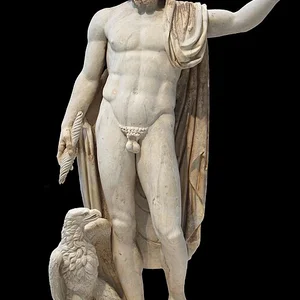

Jupiter is the supreme god of the Roman pantheon, master of the sky, lightning, and thunder. The Roman equivalent of Greek Zeus, he reigns over gods and men from Mount Olympus. He is the protector of Rome and the guarantor of cosmic order.
Jupiter
Jupiter
8 min read
Frequently asked questions
Key Facts
- Jupiter is the Roman equivalent of Greek Zeus, adopted during the Romanization of Greek myths (from the 3rd century BC onward)
- The Temple of Jupiter Capitolinus, on the Capitoline Hill in Rome, was founded according to tradition in 509 BC
- Jupiter forms the Capitoline Triad with Juno and Minerva, the central divine trio of Roman religion
- The ancient Olympic Games and many Roman festivals (Vinalia, Feriae Latinae) were dedicated to him
- His main attribute is the thunderbolt (the fulgur), symbol of his power over the heavens and mortals
Works & Achievements
The greatest temple in Rome, dedicated to the Capitoline Triad (Jupiter, Juno, Minerva). The center of Roman state religion and a symbol of the divine power granted to the city for nearly a thousand years.
Rome's founding epic, in which Jupiter plays a central role: he foretells Rome's eternal destiny and guides Aeneas to Italy. A landmark of Latin literature showcasing the sovereign god's authority.
A collection of 250 myths in which Jupiter is one of the most active characters. An essential source for understanding Greco-Roman mythology and the god's role in shaping and transforming the world.
Athletic and religious festivals established in honor of Capitoline Jupiter following the Capitoline Hill's resistance during the Gallic sack of Rome. A testament to Roman gratitude toward their divine protector.
A major philosophical treatise in which Cicero examines Roman conceptions of the gods, giving Jupiter a leading role in the discussion of divine providence and civic religion.
The Homeric epics establish Zeus — the Greek model for Jupiter — as king of the gods and the ultimate source of narrative authority throughout the mythological tradition that Rome inherited and adapted into Latin.
Anecdotes
According to Roman mythology, Jupiter was saved from his father Saturn by his mother Ops, who hid the infant in Crete and offered Saturn a swaddled stone in his place. Saturn, who devoured his children to prevent being overthrown, was thus deceived. Later, Jupiter forced his father to regurgitate his siblings, then dethroned him to rule over the world.
The Temple of Jupiter Optimus Maximus, built on the Capitoline Hill in Rome and dedicated in 509 BC, was the most sacred shrine in the city. Each year, newly elected Roman consuls sacrificed white bulls there to seek divine favor. It was the living heart of Roman civic religion.
During military triumphs, the victorious general ascended the Capitoline dressed in a gold-embroidered toga, carrying an ivory scepter topped with an eagle — the very attributes of Jupiter himself. This ritual served as a reminder that it was Jupiter who granted victory to Rome, and that the general was merely his temporary instrument.
Jupiter was the guardian of oaths and treaties. When the Romans concluded an alliance, the fetial priests invoked Jupiter Fidius and struck a pig with a flint stone, declaring: 'May Jupiter strike Rome as I strike this animal, should she break the treaty.' This solemn formula bound states together by divine word.
When a Roman emperor died, an eagle — Jupiter's sacred bird — was released above the funeral pyre. The Romans believed that the emperor's soul was carried up to the heavens by Jupiter's messenger, which justified the apotheosis, that is, the official deification of deceased emperors.
Primary Sources
Jupiter promises Venus the eternal empire of Rome: 'I set no limits on their power and no end to their time: I have given them empire without end.' He governs all things by his gaze and his will alone.
Jupiter, outraged by the corruption of mankind in the Iron Age, summons the gods in assembly and resolves to destroy the human race by flood: 'This race must be wiped out by extraordinary means — let the earth be submerged on all sides by my waters.'
The ancients wished Jupiter to be the king of all gods and all men, and they proclaimed him father, regarding him as the supreme ruler of the sky and the dispenser of light; hence his name Diespiter, the father of the day.
Romulus, after founding Rome, established the cult of Jupiter Feretrius on the Capitoline Hill and dedicated to him the spolia opima seized from King Acron. This was the first sanctuary erected in the nascent city, a testament to the divine protection granted to Rome.
As long as Jupiter presides over the affairs of men, Rome shall rule the nations. Horace calls upon him: 'Guardian of the Empire, you whom the gods have chosen to watch over Rome, do not let the wicked overturn the order you have founded.'
Key Places
The most sacred sanctuary in the Roman world, located on the Capitoline Hill. At the center of religious and political life, it hosted the consuls' sacrifices and the celebrations of military triumphs.
The mythical home of the Olympian gods, shared between Zeus/Jupiter and the other deities. This mountain, the highest in Greece, is the place from which Jupiter rules over the entire cosmos.
One of the oldest oracles in the Greek world, dedicated to Zeus/Jupiter. Priests interpreted the rustling of the leaves of a sacred oak tree to convey the divine will to mortals.
The mythical site of Jupiter's birth and hidden childhood, raised by the Curetes and nursed by the goat Amalthea to keep him safe from his devouring father Saturn.
A town in Latium home to a great oracular sanctuary linked to Jupiter. Thousands of votive offerings bear witness to the devotion of worshippers who came to seek the god's protection.
Typical Objects

Jupiter's primary weapon and symbol, forged by Vulcan. It represents the god's absolute power over the elements and his ability to punish mortals and impious gods.

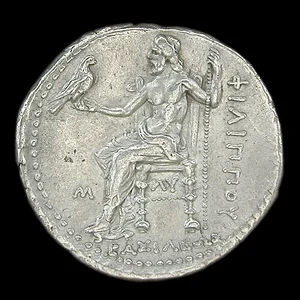
Jupiter's sacred animal and celestial messenger, the eagle symbolizes royalty and military power. It adorned the standards of Roman legions (aquila) as a permanent tribute to the god.

Jupiter's royal attribute, a symbol of his sovereign authority over gods and men. Triumphant generals carried this scepter during their victory processions in the god's honor.

The oak is Jupiter's sacred tree, associated with lightning and unyielding strength. The corona quercea was also awarded to Roman soldiers who had saved a fellow citizen's life.

A magical shield or breastplate that Jupiter sometimes shares with Minerva, striking terror into his enemies and protecting his allies. Its center is adorned with the head of the Gorgon Medusa.

A shallow cup used during sacrifices in Jupiter's honor. Priests would pour pure wine from it onto the altar to seal oaths and give thanks to the god for his blessings.
School Curriculum
Vocabulary & Tags
Key Vocabulary
Daily Life
Morning
At the break of day, Jupiter presides from Olympus over the fates of gods and men. He sometimes convenes the deities in solemn assembly to deliberate on the destiny of mortals, listening to the prayers rising from Roman temples alongside the first smoke of morning sacrifices.
Afternoon
Jupiter crosses the sky in his chariot, dispensing clouds, rain, and sunlight according to his will. He delivers judgments on human affairs, arbitrates disputes among the gods, and sends his eagle as an omen to generals and kings on campaign.
Evening
As night falls, Jupiter presides over the banquets of the gods on Olympus, surrounded by Juno and the Olympian deities. He receives the hymns of Roman priests completing their rites and ensures that the cosmic order is maintained until the next dawn.
Food
Jupiter and the Olympian gods subsist on nectar and ambrosia, the divine drink and food that confer immortality. On his altars, mortals offer him pure white bulls, unmixed wine, and sacred cakes (liba), whose fragrant smoke rises toward the heavens.
Clothing
Jupiter is dressed in a white tunic and a great cloak (paludamentum) of royal purple, a color reserved for emperors and gods. His abundant hair and majestic beard are crowned with a garland of oak leaves or a radiant nimbus.
Housing
Jupiter reigns from the summit of Olympus, a celestial palace above the clouds that only the gods can reach. In Rome, his earthly dwelling was the Capitoline Temple, its roof gleaming with gold and ivory, visible from across the city as a constant sign of his protective presence.
Historical Timeline
Period Vocabulary
Visual Style
Style gréco-romain classique et monumental : Jupiter trône entre colonnes de marbre blanc et ciel d'orage, brandissant la foudre dorée, dans une composition dramatique inspirée des grandes fresques et sculptures antiques.
Sound Ambience
L'univers sonore de Jupiter mêle la majesté des orages à la solennité des rituels romains : tonnerre, foudre, aigles en vol, chœurs sacerdotaux et feux sacrificiels sur fond de trompettes triomphales.
Liens externes & ressources
Références
Œuvres
Temple de Jupiter Optimus Maximus, Capitole de Rome
509 av. J.-C.
Virgile, Énéide
29-19 av. J.-C.
Ovide, Métamorphoses
8 ap. J.-C.
Jeux Capitolins (Ludi Capitolini)
Fondation légendaire 387 av. J.-C.
Cicéron, De natura deorum
45 av. J.-C.
Homère, Iliade et Odyssée
VIIIe s. av. J.-C.