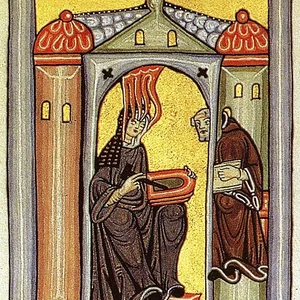
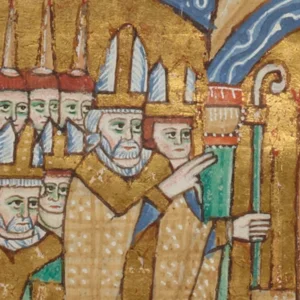
A German Benedictine recluse and mystic of the 12th century, Jutta of Sponheim founded a community of women at the monastery of Disibodenberg. She is best known as the spiritual teacher and educator of Hildegard von Bingen.
Jutta of Sponheim
Jutta of Sponheim
8 min read
Frequently asked questions
Key Facts
- Born around 1083 into the noble family of Sponheim, in the Rhineland
- Around 1112: settled as a recluse at the Benedictine monastery of Disibodenberg
- Founded and led a small community of women attached to the monastery
- Educated and mentored Hildegard von Bingen, the future great mystic and composer
- Died in 1136; her holiness was recognized locally shortly after her death
Works & Achievements
Jutta transformed her solitary recluse's cell into a structured community of Benedictine nuns, creating one of the earliest centers of organized female religious life in the Rhineland. This foundation stands as her principal achievement.
For more than twenty years, Jutta taught Hildegard reading, liturgical chant, Latin, and Benedictine spiritual life. This training became the foundation upon which Hildegard built her entire scientific, musical, and mystical body of work.
A biography of Jutta written by the monk Volmar after her death, drawn from the accounts of her contemporaries. This text remains the principal narrative source on her life, her ascetic practices, and her role as magistra.
Jutta faithfully observed and transmitted the Benedictine Rule within her community, adapting its precepts to the life of a recluse and teacher. This fidelity shaped the daily life of her community and of her most famous pupil.
Anecdotes
Around 1105, Jutta of Sponheim voluntarily chose to be walled up alive in a stone cell adjoining the monastery of Disibodenberg. This way of life, known as anchoritic enclosure, meant permanently renouncing the outside world: the only opening was a small window through which she received food and communicated with the faithful who came seeking spiritual guidance.
Jutta was entrusted with the education of the young Hildegard von Bingen, placed in her care around the age of eight by her noble family. She taught her the reading of the Psalms, liturgical chant, and the basics of Latin — a rare education for a girl at that time, yet one that would enable Hildegard to become one of the most celebrated intellectuals of the Middle Ages.
Despite her voluntary enclosure, Jutta's reputation for holiness attracted many noble young women eager to share her spiritual life. Her solitary cell gradually transformed into a genuine female community, of which she became the magistra. By the time of her death in 1136, she was leading an organized group of Benedictine nuns.
At her death, the nuns around her discovered on her body the marks of extreme asceticism: she had secretly worn a metal chain wrapped around her flesh and had always worn a hair shirt (cilice). These hidden penitential practices bore witness to the intensity of her devotion.
It was Volmar, the monk who served as Hildegard von Bingen's secretary, who wrote the Vita Juttae shortly after her death. He recounts that pilgrims came from afar to consult Jutta through the window of her cell for spiritual counsel, already regarding her during her lifetime as a holy woman.
Primary Sources
She chose to lead the life of a recluse, enclosed in a cell, renouncing the world according to the Rule of Saint Benedict, seeking God in silence and perpetual prayer, instructing those whom God entrusted to her.
Until my fifteenth year, I saw many things, and I told some of them to others. Jutta, a holy woman who instructed me in other matters, was astonished by this.
She was entrusted from childhood to Lady Jutta of Sponheim, of noble birth, who led an enclosed life at the monastery of Disibodenberg, by whom she was instructed in letters and sacred chant.
If anyone wishes to leave the world and come to monastic life, let him not be admitted easily, but let his spirit be examined with patience and his vocation be tested over time.
Key Places
The place where Jutta spent her entire life and died. It was at the entrance to this Benedictine monastery that she had herself enclosed and founded her female community, forming Hildegard von Bingen for more than twenty years.
The region where Jutta was born, into a family of the high Rhenish nobility. Her social standing earned her a thorough education before she entered religious life, and opened the doors of Disibodenberg monastery to her.
The seat of the bishopric under whose jurisdiction Disibodenberg fell. Bishop Otto of Bamberg officially blessed Jutta's enclosure, granting her the ecclesiastical legitimacy she needed.
The place where Hildegard founded her own monastery after Jutta's death. This establishment is the direct continuation of the formative work Jutta carried out at Disibodenberg — her most enduring spiritual legacy.
Typical Objects

A liturgical book containing the 150 Psalms, the foundation of all medieval monastic education. Jutta used it to teach Hildegard to read and to chant the divine offices in Latin.

A penitential garment woven from animal hair, worn directly against the skin to mortify the flesh. Found on Jutta's body after her death, it revealed the hidden intensity of her ascetic practice.

A metal ring worn secretly around the body as an instrument of voluntary mortification. Discovered only at Jutta's death, it bore witness to a devotion hidden even from the eyes of her own community.

A small opening cut into the wall of the cell, through which food and alms could be received and the faithful could seek counsel. Jutta's only physical link to the outside world for more than thirty years.

A prayer book containing the daily offices of the Liturgy of the Hours. Jutta structured her own day and that of her community around these prayers recited at fixed hours, from Matins to Compline.

A permanent light in the anchoress's darkened cell, a symbol of divine presence and ceaseless prayer. Essential for reading sacred texts during night vigils and the nocturnal offices.

Medieval writing tools used to record texts or teach the alphabet. Jutta most likely used them to introduce Hildegard to written Latin and the rudiments of grammar.
School Curriculum
Vocabulary & Tags
Key Vocabulary
Tags
Daily Life
Morning
Jutta rose before dawn for the office of Matins, reciting the Psalms in the darkness of her stone cell. After Lauds at daybreak, she devoted the first hours of the day to lectio divina — a slow, meditative reading of Scripture and the Church Fathers, alone by the light of a candle.
Afternoon
The afternoon was dedicated to teaching: Jutta instructed the young women in her care, including Hildegard, in the recitation of the Psalms, liturgical chant, and the basics of Latin. She also received the faithful at her cell window, who came seeking spiritual guidance, serving as a counselor and wise woman.
Evening
Vespers and Compline marked the end of the day. In the quiet of her cell at night, Jutta practiced her personal penitential exercises — the hair shirt, the chain — before allowing herself a brief rest on an austere bed, already waiting for the hour of Matins to begin the prayer cycle anew.
Food
Jutta's diet was that of a penitent recluse: frugal, meatless, and reduced to the bare essentials provided by the monastery through her cell window — dark bread, boiled vegetables, legumes, and water. Fast days, which were more numerous than the ordinary rule required, prompted her to reduce her portions still further as an act of penance.
Clothing
Jutta wore the black Benedictine habit (tunic, scapular, and cowl), a black veil over her head, and a white wimple covering her neck — garments worn day and night in monastic austerity. Beneath this plain habit, she secretly wore a hair shirt and a metal chain, discovered only after her death.
Housing
Jutta lived in an anchoress's cell attached to the church wall at Disibodenberg monastery, built especially for her at the time of her enclosure. This tiny room of cold stone had only a small window to the outside and another overlooking the church so she could follow the Divine Office. With the arrival of her pupils, the space was slightly enlarged to become a small priory.
Historical Timeline
Period Vocabulary
Visual Style
Le style visuel de Jutta évoque l'enluminure romane rhénane du XIIe siècle : austérité bénédictine, palette de terres chaudes et d'or parcheminé, cellule de pierre éclairée d'un seul rai de lumière divine filtrant par une étroite fenêtre.
Sound Ambience
L'univers sonore de Jutta est celui du silence monastique médiéval rhénan, rythmé par les cloches des heures canoniales et le chant grégorien, dans l'austérité recueillie d'une cellule de pierre ouverte sur la prière perpétuelle.