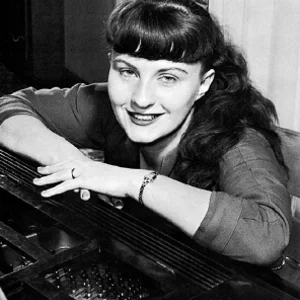

Jutta Hipp (1925-2003) was a German jazz pianist, one of the few female instrumentalists in post-war European jazz. After emigrating to the United States in 1955, she recorded for the prestigious Blue Note label before abruptly abandoning music to become a seamstress and painter.
Jutta Hipp(1925 — 2003)
Jutta Hipp
Allemagne
6 min read
Frequently asked questions
Key Facts
- Born on February 4, 1925, in **Leipzig** (Germany), she trained as a pianist amid the difficult circumstances of Nazi Germany, where jazz was frowned upon.
- She led her own trio in Germany in the early 1950s and made a name for herself on the European jazz scene.
- She emigrated to the United States in 1955, encouraged by the jazz critic **Leonard Feather**.
- She recorded for the **Blue Note** label, notably the live album *Jutta Hipp at the Hickory House* (1956) — a rare achievement for a woman at the time.
- She gave up professional music around 1958 to work as a seamstress in New York and devote herself to painting; she died on April 7, 2003, in Queens.
Works & Achievements
First recording for Blue Note, introducing American audiences to German jazz and Jutta Hipp's quintet.
Double live recording in a trio setting, a rare example of a woman leading her own group on Blue Note.
Studio album with saxophonist Zoot Sims, her final recording before she gave up music for good.
Sessions from the early part of her career in Europe, bearing witness to the rise of a West German jazz scene after the war.
A body of graphic work that remained largely private, extending her early artistic training and her eye for fellow musicians.
Anecdotes
As a teenager in Nazi Germany, Jutta Hipp grew up at a time when jazz was banned and labeled “degenerate music” by the regime. With a few friends, she secretly listened to American swing records, fascinated by this forbidden music. This clandestine passion would shape her entire life.
In 1954, the famous American jazz critic Leonard Feather heard her play in Germany and was won over by her talent. He helped her emigrate to the United States: in 1955, Jutta became one of the very few European women musicians to try her luck in the clubs of New York.
In April 1956, her concerts at the Hickory House, a Manhattan club, were recorded live by the prestigious Blue Note label. On the record, you can hear the atmosphere of the room, the clinking of glasses, and the applause, as if you were sitting at a table near the piano.
At the height of her career, after recording with the saxophonist Zoot Sims, Jutta Hipp abruptly gave up music around 1958. She vanished from the jazz world and became a seamstress in a New York garment workshop, a trade she would practice for decades.
Even after leaving the stage, Jutta never stopped being an artist. Trained in drawing during her youth in Leipzig, she painted and sketched portraits, especially of musicians, keeping to herself this talent that few people knew about.
Primary Sources
Critic Leonard Feather presents Jutta Hipp as a remarkable European pianist, the first musician from the Old World to record as a leader for Blue Note, and highlights the refinement of her playing, shaped by Lennie Tristano and Horace Silver.
The label's resident photographer captured Jutta Hipp at the piano during her 1956 New York recordings: these images document a rare female instrumentalist in the American jazz world of the time.
A primary sound document of her trio (with Peter Ind on double bass and Ed Thigpen on drums) captured live at the club, faithfully restoring the atmosphere of the 52nd Street clubs.
Preserved and studied after her rediscovery, her drawings and letters bear witness to her dual calling as an artist and to her voluntary withdrawal from the music scene, which she attributed to doubts about her own talent and a rejection of the milieu.
Key Places
Birthplace of Jutta Hipp, where she grew up during the war and studied drawing before turning to jazz.
After the war, she made her way in the West German jazz scene, leading her own band before leaving for America.
Manhattan club where her trio was recorded live by Blue Note in 1956, in the heart of the famous “Swing Street.”
Legendary studio of the Blue Note sound, where the album “Jutta Hipp with Zoot Sims” was recorded in July 1956.
She lived here quietly after leaving music, and died here in 2003, far from the spotlight.
Typical Objects

Her lifelong instrument, on which she improvised in clubs and in the studio. She developed a delicate touch inspired by cool jazz.

The 33 rpm record (LP) on which her 1956 recordings were released, immortalizing her playing for posterity.

A tool from her second life: after leaving jazz, she worked for decades as a seamstress in a New York workshop.

Trained in drawing in Leipzig, she sketched portraits, including those of musicians, and kept painting throughout her life.

Often photographed with a cigarette in hand at the piano, a typical image of the smoky atmosphere of 1950s jazz clubs.

Present at the Hickory House, it captured her trio live and the club's atmosphere during the sessions recorded by Blue Note.
School Curriculum
Vocabulary & Tags
Key Vocabulary
Daily Life
Morning
Like many jazz musicians who play late into the night, Jutta Hipp gets up late in the morning. Over a coffee and a cigarette, she often picks up a pencil to draw or sits down at the piano to work on a few chords.
Afternoon
Her afternoons are devoted to rehearsals, to listening to records to soak up the American style, and sometimes to studio sessions. In a foreign city, she also learns English and adapts to life in New York.
Evening
When evening comes, it's time for the stage: she plays several piano sets back to back in clubs like the Hickory House, performing standards and improvisations late into the night before a seated audience.
Food
Her diet is the modest one of an artist living on small fees: meals grabbed on the go in the clubs, plenty of coffee and cigarettes, far from any comfort. She still remembers the deprivations of postwar Germany.
Clothing
On stage, she takes care with her appearance, wearing elegant dresses as befitted the women musicians of the era. Off stage, her clothing is simple and understated, a reflection of her reserved nature.
Housing
She stays in small, inexpensive New York apartments. After leaving jazz behind, she settles permanently in a modest home in Queens, where she leads a quiet, retiring life.