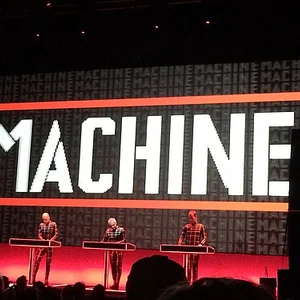

Kraftwerk is a German band founded in Düsseldorf in 1970 by Ralf Hütter and Florian Schneider. Pioneers of electronic music, they popularized the use of synthesizers, drum machines and robotic sounds, leaving a lasting influence on techno, synth-pop and hip-hop.
Kraftwerk
Kraftwerk
5 min read
Frequently asked questions
Key Facts
- Band founded in 1970 in Düsseldorf by Ralf Hütter and Florian Schneider
- The album Autobahn (1974) marked their international breakthrough
- Trans-Europe Express (1977) was a major influence on hip-hop and electro
- The Man-Machine (1978) explores man-machine and robotic imagery
- Computer World (1981) anticipated the computer and digital age
Works & Achievements
The band's first major success, this long landscape-like track laid the foundations of popular electronic music.
A concept album about radio waves and radioactivity, playing on the double meaning of the title.
A major work whose train rhythm deeply influenced techno and hip-hop.
The album that established the robot imagery and contains the classic “The Robots.”
A visionary album foreshadowing the computerized society and the flow of data.
A single dedicated to cycling, blending the breath of the riders with electronic pulses.
A digital reinterpretation of the classics, extending the band's sonic modernity.
Anecdotes
In 1974, Kraftwerk released *Autobahn*, a 22-minute track that imitates the sound of a car speeding down the German motorway. Against all odds, a shortened version became a radio hit all the way to the United States, proving that music made by machines could appeal to a wide audience.
On stage, the members of Kraftwerk sometimes had themselves replaced by robotic mannequins made in their likeness. Fascinated by the idea of the “man-machine,” they loved to blur the line between human and automaton, going so far as to present themselves as impassive robots, dressed identically.
The group set up its studio, named Kling Klang, in **Düsseldorf**, where they tinkered together with some of their own electronic instruments. **Ralf Hütter** and **Florian Schneider** built homemade drum machines and keyboards, because commercial equipment did not yet produce the sounds they imagined.
The track *Trans-Europe Express* (1977) was sampled directly in 1982 by **Afrika Bambaataa** for *Planet Rock*, a foundational hip-hop track. Without knowing it, these German musicians thus provided the rhythmic blueprint for an entire culture born on the streets of New York.
In 1983, Kraftwerk released *Tour de France*, a tribute to the cycling race in which the breathing of the riders and the clicking of the pedals become music. The members of the group were themselves passionate cyclists, to the point of bringing their bikes along on tour.
Primary Sources
The red-and-black Constructivist aesthetic and the rigid pose of the four members assert the group's identity: musicians turned into mechanical figures, neither quite human nor quite machine.
The sung refrain “Wir fahr'n fahr'n fahr'n auf der Autobahn” (We're driving, driving, driving on the motorway) is set against synthetic sounds imitating the engine and the traffic.
The lyrics evoke computers, databases and state records, anticipating a fully computerised society as early as the start of the 1980s.
The vocoded voice repeats “Ja tvoi sluga, ja tvoi rabotnik” (I'm your servant, I'm your worker), affirming the central theme of the human reduced to a machine.
Key Places
Industrial city in the Rhineland where Kraftwerk was founded in 1970. Its technological atmosphere fed the band's aesthetic.
The band's personal studio, the laboratory for all their creations. The musicians built some of their machines themselves there.
The West German motorways inspired the 1974 album *Autobahn*. There, the rumble of traffic becomes musical material.
This is where Kraftwerk's music was sampled and gave birth to electro hip-hop in the early 1980s.
A region of heavy industry and mines whose mechanical imagery permeates the band's universe.
Typical Objects

An electronic instrument that generates and shapes artificial sounds. Kraftwerk made it the heart of their music, replacing traditional guitars and drums.

A device that produces programmable electronic rhythms. It gave Kraftwerk its steady, mechanical pulse, a blueprint for the techno yet to come.

A device that turns the human voice into a robotic sound. It became the band's vocal signature and a fitting voice for their man-machine theme.

A life-size mechanical replica of the band members, used on stage. It literally embodied the idea that the musicians had become machines.

A device that records and automatically replays a series of notes. It allowed Kraftwerk to build precise, tireless repeating patterns.

A lightweight bicycle the band members rode with passion. It directly inspired the album *Tour de France* and its mechanical rhythm.
School Curriculum
Vocabulary & Tags
Key Vocabulary
Tags
Daily Life
Morning
The members of Kraftwerk lived to the rhythm of their studio. A morning might begin with a bike ride through Düsseldorf, followed by their arrival at Kling Klang to set the machines running.
Afternoon
Afternoons were spent adjusting synthesizers, sequencers, and drum machines. The work was meticulous: they would search for hours for just the right sound, almost like engineers in a laboratory.
Evening
In the evening, the group would refine their tracks or prepare their highly visual shows. On tour, the evenings were devoted to concerts where projections and lighting mattered as much as the music.
Food
Far from the excessive image of rock stars, the members of the group led a sober and disciplined life. Athletic and keen cyclists, they took as much care of their healthy lifestyle as of their music.
Clothing
On stage, Kraftwerk wore identical, polished outfits, often dark suits or jumpsuits with clean lines. This uniform reinforced the idea of a group without individuals, almost robotic.
Housing
Based in Düsseldorf, a modern industrial city, the musicians moved within an urban, technological environment. Their true home, however, remained the Kling Klang studio, the heart of their universe.