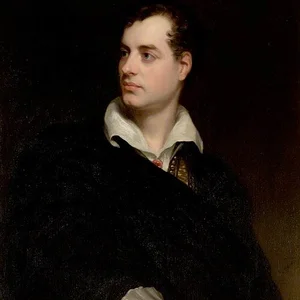

Lord Byron (1788-1824) was the most celebrated British poet of the Romantic era. A scandalous and politically engaged figure, he embodied the "Byronic hero": brooding, rebellious, and passionate. He died in Greece while fighting for Greek independence.
Lord Byron(1788 — 1824)
Lord Byron
royaume de Grande-Bretagne, Royaume-Uni de Grande-Bretagne et d'Irlande
8 min read
Frequently asked questions
Famous Quotes
« She walks in beauty, like the night / Of cloudless climes and starry skies.»
« The great object of life is sensation – to feel that we exist, even though in pain.»
Key Facts
- 1788: born in London; inherits the title of Baron Byron at age 10
- 1812: publication of the first two cantos of Childe Harold's Pilgrimage, an immediate success
- 1816: voluntary exile from England following scandals and the breakdown of his marriage
- 1819-1824: composition of Don Juan, his major satirical and epic masterwork
- 1824: death at Missolonghi (Greece) while supporting the Greek War of Independence
Works & Achievements
A long epic poem in four cantos following the travels of a disillusioned young aristocrat across Mediterranean Europe. Its publication in 1812 made Byron famous overnight.
A narrative poem featuring a dark and mysterious pirate, the archetypal Byronic hero. It sold 10,000 copies on the day of publication, making it one of the greatest publishing successes of the era.
An unfinished masterpiece in sixteen cantos, satirical and irreverent, reimagining the myth of the Spanish seducer. Considered the pinnacle of Byron's art for its rich irony and poetic brilliance.
A dramatic poem featuring a nobleman tormented by a secret crime, haunted by spirits among the Alpine peaks. A key work of dark Romanticism, it profoundly influenced Goethe and Gothic literature.
A dramatic poem reimagining Cain's murder of Abel through a philosophical and blasphemous lens. The work caused considerable scandal for its radical questioning of religion and free will.
A poem composed after Napoleon's abdication, blending admiration and disillusionment for the fallen conqueror. The text illustrates Byron's complex relationship with the figure of the great man and the nature of glory.
Anecdotes
Lord Byron kept a tame bear in his rooms at Cambridge, in response to the university's regulation banning dogs. He even threatened to present the animal as an official member of the college, earning him a reputation as an unrivaled provocateur.
Born with a club foot, Byron suffered deeply from this disability while developing an athletic physique through swimming. In 1810, he swam across the Hellespont strait — a feat he took great pride in and referenced in his poetry.
Byron was one of the most scandalous figures of the English Regency: his turbulent love affairs, including a relationship with his half-sister Augusta, caused such an uproar that he was forced to leave England for good in 1816, hounded by the condemnation of high society.
In 1816, during a rainy stay at the Villa Diodati near Geneva with Percy Shelley and Mary Godwin, Byron proposed a ghost story competition. That night directly inspired Mary Shelley's creation of Frankenstein and Polidori's The Vampyre — Polidori being Byron's personal physician.
Having traveled to Greece to support the Greek War of Independence against the Ottoman Empire, Byron funded a fleet at his own expense and attempted to organize troops. He died of fever at Missolonghi in 1824, aged 36, becoming a martyr of the Hellenic cause and a symbol of committed Romanticism.
Primary Sources
I have not loved the world, nor the world me, / But let us part fair foes; I do believe, / Though I have found them not, that there may be / Words which are things.
My domestic life has been quite miserable… But I do not complain — I have lived, and not in vain — I have seen magnificent things, and done a few good ones.
I want a hero: an uncommon want, / When every year and month sends forth a new one, / Till, after cloying the gazettes with cant, / The age discovers he is not the true one.
I rise at noon. I dine at seven. I work through the night until dawn. This is how poems are born — in silence and sleeplessness.
I came here not out of a taste for adventure, but because I believe the cause of the Greeks is that of all peoples who aspire to freedom.
Key Places
The ancestral home of the Byron family, a partially restored ruined medieval abbey. It was here that Byron grew up and developed his taste for gothic and melancholic atmospheres.
A villa rented by Byron on the shores of Lake Geneva in 1816 during his exile. It was here that the legendary night took place during which both Frankenstein and The Vampyre were conceived.
Byron lived in Venice from 1816 to 1819, leading a life of excess and intense writing. He composed the first cantos of Don Juan there and was captivated by the fading beauty of the lagoon city.
The coastal town where Byron landed in January 1824 to support the Greek War of Independence. He died there on 19 April of that same year, becoming a symbol of liberty and Romantic sacrifice.
Byron stayed in Athens during his Grand Tour and was deeply moved by the ruins of the Acropolis, then under Ottoman rule. He condemned the looting of the Parthenon marbles by Lord Elgin.
Typical Objects

Byron wrote his poems at night by candlelight, covering hundreds of pages in his rapid, slanted handwriting. The quill was the instrument of his meteoric fame.

Like any aristocrat of his time, Byron carried a sword and practiced fencing and pistol shooting. In Greece, he wore a military uniform and a gilded sword as a commander.

Byron owned a skull exhumed from the grounds of Newstead Abbey, which he used as a wine cup at provocative banquets, displaying his taste for the macabre and the transgressive.

During his Grand Tour of 1809–1811, Byron filled notebooks with notes and poetic sketches that became the raw material for Childe Harold. These notebooks reveal his fascination with ancient Greece.

Byron had himself painted in Albanian dress by Thomas Phillips in 1813, wearing a richly embroidered caftan and a turban. This orientalist portrait has become one of the most iconic images of Romanticism.

Byron took his pistols to Greece and practiced shooting daily. Dueling was an aristocratic ritual of the time, and Byron, despite his liberal views, saw it as a matter of honor.
School Curriculum
Vocabulary & Tags
Key Vocabulary
Tags
Daily Life
Morning
Byron rarely rose before noon, considering mornings unsuitable for creative work. He began his day with a cold bath — a habit he maintained even while traveling — followed by a light breakfast, as he lived in constant fear of gaining weight due to his club foot.
Afternoon
The afternoon was devoted to intensive physical activity: swimming (a passion of his), horseback riding, or fencing. In Italy, these hours were also spent on long gondola rides or galloping along the beach at the Lido in Venice, notebook always in pocket.
Evening
Byron dined late, around seven or eight o'clock, often in the company of his current mistress or fellow poets. He would then work until dawn, composing hundreds of lines of verse by candlelight, drinking red wine diluted with water and smoking cigars.
Food
Byron was obsessed with his figure and subjected himself to strict diets: dry biscuits, sparkling water, and boiled vegetables during his austere phases. But in his Venetian periods of excess, he indulged in lavish feasts of meats, oysters, and Italian wines, swinging between extreme restraint and outright indulgence.
Clothing
Byron wore the refined attire of the English aristocracy — black tailcoat with a white collar, embroidered waistcoat, top hat — but he also had a fondness for exotic costumes, most notably the Albanian dress in which he had himself painted. In Greece, he donned an ornate military uniform he had made at his own expense.
Housing
Byron lived successively in a series of grand but often crumbling residences: Newstead Abbey in England, the Palazzo Mocenigo on the Grand Canal in Venice, a villa in Ravenna, and finally a modest house in Missolonghi. He was surrounded by animals — dogs, cats, monkeys, foxes — turning every home into a menagerie.
Historical Timeline
Period Vocabulary
Visual Style
Le style visuel de Byron convoque l'esthétique romantique dans ce qu'elle a de plus sombre et de plus flamboyant : ruines gothiques, ciels d'orage et orientalisme exotique.
Sound Ambience
Une atmosphère mêlant l'intimité fiévreuse d'un poète nocturne, les sons de Venise romantique et les rumeurs guerrières de la Grèce en révolution.
Liens externes & ressources
Références
Œuvres
Childe Harold's Pilgrimage
1812-1818
Le Corsaire (The Corsair)
1814
Don Juan
1819-1824
Caïn (Cain: A Mystery)
1821
Ode à Napoléon Bonaparte
1814