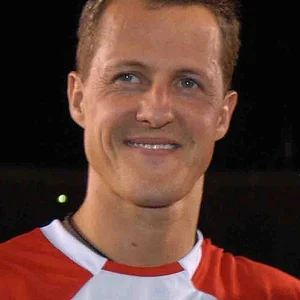

German Formula 1 racing driver, considered one of the greatest in the history of the sport. A seven-time world champion, he dominated the discipline, notably behind the wheel of Ferraris in the early 2000s.
Michael Schumacher(1969 — ?)
Michael Schumacher
Allemagne
6 min read
Frequently asked questions
Key Facts
- Born on 3 January 1969 in Hürth-Hermülheim (Germany)
- First F1 world champion title in 1994 with Benetton, second in 1995
- Five consecutive world titles with Ferrari from 2000 to 2004
- Record of seven Formula 1 world champion titles
- Victim of a serious skiing accident in December 2013 that ended his public life
Works & Achievements
Schumacher becomes the first German to win the F1 World Championship, opening a new era for German motorsport.
With engineers Ross Brawn and Rory Byrne, he transforms a declining team into a winning machine, ending a 21-year drought without a drivers' title.
A historic and unprecedented domination of Formula 1, which remains one of the longest streaks of consecutive titles in the sport.
An absolute record at the time, equalled only by Lewis Hamilton in 2020.
An unmatched win total for years, a testament to exceptional consistency at the highest level.
A foundation created by his family to support charitable projects and medical research, continuing his philanthropic commitment.
Anecdotes
In 1991, Michael Schumacher made his Formula 1 debut at the Belgian Grand Prix almost by chance: the regular driver for the Jordan team was in prison, and Schumacher was called in as a last-minute replacement. He impressed by qualifying 7th, and as early as the very next Grand Prix, the top team Benetton poached him.
When Schumacher joined Ferrari in 1996, the Italian team had not won a drivers' title since 1979. It took him five years to rebuild the team with his engineers before clinching the championship in 2000, sparking immense jubilation in Italy, where the Tifosi regarded him almost as a national hero.
Schumacher was famed for driving just as well in the rain as in the dry, which earned him the nickname “Regenkönig,” the “Rain King.” At the 1996 Spanish Grand Prix, on a soaking-wet track, he finished nearly 45 seconds ahead of the runner-up at the wheel of a Ferrari that was otherwise far from competitive that season.
His career was also marked by highly controversial moves. In 1994 and again in 1997, he caused collisions with his title rivals; in 1997, the stewards even disqualified him from the final championship standings for deliberately ramming Jacques Villeneuve.
In December 2013, a few months after retiring, Schumacher suffered a serious skiing accident in the French Alps and sustained a severe head injury. Since then, his family has strictly protected his privacy and has released almost no information about his condition.
Primary Sources
“I dedicate this title to the whole Ferrari team and to the tifosi who have waited so long. We worked as a single family to get here.”
“Michael was the victim of a skiing accident this morning in Méribel. He suffered a head injury and was taken to the hospital in Grenoble.”
“Even though I won't be able to finish the way I would have wished, from a sporting point of view I can say that I was happy to come back and that I enjoyed it.”
Key Places
Town in North Rhine-Westphalia where Michael Schumacher was born in 1969. He cut his teeth there on the karting track run by his parents.
Legendary track in the Belgian Ardennes where Schumacher made his F1 debut in 1991 and claimed his first victory in 1992. He would remain particularly attached to it.
Small town in Emilia-Romagna home to the headquarters of Scuderia Ferrari, where Schumacher worked from 1996 to 2006. The beating heart of his most glorious years.
Ski resort in the French Alps where his serious skiing accident occurred in December 2013. The tragedy shook the world of sport.
Town on the shores of Lake Geneva where the Schumacher family resides. It is here that he has lived, away from the public eye, since his accident.
Typical Objects

Full-face helmet in recognizable red and white colors, protecting the driver's head from impacts and heat. It became one of Schumacher's visual trademarks.

Formula 1 car of the Ferrari team, one of the most dominant in history, with which Schumacher won his seventh title. It embodies the technical peak of his career.

Full-body outfit made of fire-resistant fibers (Nomex) protecting the driver in case of fire. It displays the logos of the sponsors and the team.

Steering wheel packed with buttons and paddles allowing the driver to adjust the engine, gearbox and brakes mid-race. A true miniature onboard computer.

Cup awarded to the winner on the podium at the end of each race. Schumacher accumulated a record number of them over his 91 victories.

Instrument for measuring time to the hundredth of a second, essential for comparing performances in qualifying and during the race. Speed comes down to a few thousandths.
School Curriculum
Vocabulary & Tags
Key Vocabulary
Daily Life
Morning
During a race weekend, an F1 driver's day starts early with a physical preparation session and a technical meeting with the engineers. Schumacher, renowned for his discipline, would analyze the car's data and meticulously prepare every setting.
Afternoon
Afternoons were paced by free practice or qualifying on the track, where every tenth of a second counts. In the off-season, he would string together days of private testing to develop the following season's car.
Evening
In the evening, extended debriefings with the team to dissect performance and plan what came next. Away from the Grands Prix, Schumacher favored a low-key family life, far from the spotlight.
Food
Like all top-level drivers, he followed a controlled diet, rich in carbohydrates and proteins, to withstand the intense physical demands of racing. Hydration was crucial, as a driver can lose several liters of water during a Grand Prix.
Clothing
On the track, a fireproof suit, gloves, balaclava, and helmet in the team's colors. Off the track, he often wore understated attire branded with sponsors and the Ferrari or Mercedes name.
Housing
Schumacher splits his life between a residence in Switzerland, on the shore of Lake Geneva, and other properties. His considerable fortune affords him a luxurious lifestyle, but he has always maintained great discretion.
Historical Timeline
Period Vocabulary
Liens externes & ressources
Références
Œuvres
Premier titre de champion du monde (Benetton)
1994
Reconstruction de la Scuderia Ferrari
1996-2000
Cinq titres mondiaux consécutifs avec Ferrari
2000-2004
Record de 7 titres de champion du monde
2004
Record de 91 victoires en Grand Prix
1992-2012
Fondation Keep Fighting
2016