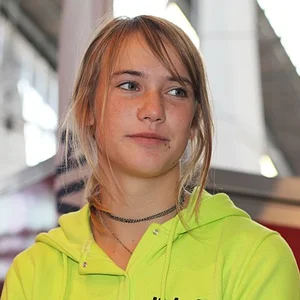

Dutch sailor born in 1995, Laura Dekker became in 2012 the youngest person to complete a solo circumnavigation by sailboat, at just 16 years old. Her 518-day voyage aboard her sailboat Guppy took her around the globe, departing from the Netherlands.
Laura Dekker(1995 — ?)
Laura Dekker
Royaume des Pays-Bas
7 min read
Frequently asked questions
Key Facts
- Born on September 20, 1995, in Papendrecht, the Netherlands
- Set off on her solo circumnavigation on August 21, 2010, from Den Osse
- Arrived in Sint Maarten on January 21, 2012, after 518 days at sea
- Became, at age 16, the youngest person to complete a solo circumnavigation by sailboat
- Her departure had been blocked by Dutch authorities in 2009, before a court granted her permission
Works & Achievements
Laura Dekker's founding achievement: 518 days at sea aboard the Guppy, covering approximately 27,000 nautical miles across the Atlantic, Pacific, and Indian Oceans. She became the youngest person ever to complete a solo circumnavigation.
A first-person account of her circumnavigation, covering the preparation, legal battles, adventures at sea, and her arrival. Translated into several languages, the book reached readers around the world.
A documentary film directed by Jillian Schlesinger, built from footage Laura shot herself during her voyage. Award-winning at several international festivals, it brought her story to a global audience.
An organization founded by Laura to encourage young people to discover sailing and develop their independence. The foundation funds projects that give teenagers — including those from disadvantaged backgrounds — the chance to take to the sea.
Anecdotes
Laura Dekker was born on January 20, 1995, in the port of Whangarei, New Zealand, aboard the sailboat where her family lived. Her father Dick Dekker, a passionate sailor, taught her to handle a boat from the age of 6, and she completed her first solo crossing at just 10 years old. Growing up on the water had given her a natural mastery of the sea well before she started middle school.
In 2009, when Laura, then 13, announced her plan to sail solo around the world, the Dutch child protection authorities (Raad voor de Kinderbescherming) went to court to stop her. For nearly a year, the young girl went through a grueling legal ordeal, but the courts ultimately granted her the right to depart in August 2010, after assessing her skills and psychological wellbeing.
During her 518 days at sea, Laura had to face storms, engine failures, and various breakdowns aboard her sailboat Guppy entirely on her own. She learned to fix everything herself, from the sails to the electronic instruments, developing a remarkable self-sufficiency. These daily technical challenges, faced without assistance thousands of miles from any port, proved just as formative as any traditional schooling.
On January 21, 2012, Laura Dekker arrived in the port of Philipsburg in Sint Maarten, in the Dutch Caribbean, welcomed by an enthusiastic crowd. Having set off from Den Helder on August 4, 2010, she completed her circumnavigation in 518 days, officially becoming the youngest sailor to have accomplished this feat solo, covering approximately 27,000 nautical miles.
Although her route was not ratified by the World Speed Sailing Record Council (which does not recognize youth records), her achievement was celebrated around the world. Her voyage had taken her across the Atlantic, through the Panama Canal, across the Pacific, the Indian Ocean, and around the Cape of Good Hope — waters that even experienced sailors dread.
Primary Sources
Laura Dekker recounts in her own words her solo circumnavigation, from the turbulent preparations and legal battles to her triumphant arrival in Sint Maarten, describing her fears, her joys, and the technical challenges she faced aboard the Guppy.
Throughout her voyage, Laura regularly posted updates on her website, describing her GPS position, the weather conditions she encountered, and her daily adventures — a uniquely real-time first-hand account.
The film draws on footage shot by Laura herself during her journey, offering a direct and unfiltered record of her life aboard and her state of mind across the oceans. It won several awards at international documentary film festivals.
On her arrival on 21 January 2012, Laura told the press: 'I never doubted that I would make it. This journey taught me that the only limits that truly matter are the ones you set for yourself.'
Key Places
Dutch port from which Laura Dekker set off on her round-the-world voyage on 4 August 2010. It is the town where she lived with her father before her departure.
Caribbean island where Laura arrived on 21 January 2012 to officially complete her round-the-world voyage, welcomed by a jubilant crowd and journalists from around the world.
A crucial stage of Laura's journey, this 80 km artificial waterway allowed her to pass from the Atlantic to the Pacific without having to round the treacherous Cape Horn.
The southernmost and most feared point of her African leg, located in a zone of fierce winds known as the "Roaring Forties." Rounding it was one of the most symbolic milestones of the entire voyage.
New Zealand port where Laura Dekker was born on 20 January 1995 aboard the family sailboat. She also made an emotional stopover there during her round-the-world voyage, returning to the place of her birth.
Typical Objects

The 11.7-metre sailboat that was Laura's home for 518 days at sea. She named it 'Guppy' after a small, colorful fish, and fitted it with all the instruments needed for a solo circumnavigation.

An essential piece of electronics for solo sailing, it steered the boat automatically by holding a set course, allowing Laura to sleep or carry out other tasks without having to man the helm at all times.

The emergency locator beacon was the most critical piece of safety equipment on board. In the event of a capsize or serious injury, it would automatically transmit Laura's position to rescue services via satellite.

A traditional navigator's tool, Laura used it to record her position, weather conditions, and observations every day. The log fed her real-time blog and served as the basis for her autobiography, published in 2012.

Laura combined paper nautical charts with digital GPS instruments to navigate accurately across the oceans. Mastering both old and modern tools is fundamental for any offshore sailor.

The Guppy was fitted with a full set of sails suited to different conditions: mainsail, genoa, spinnaker. Laura had to learn to repair them on her own when storms caused damage, sometimes in the dead of night in the middle of the ocean.
School Curriculum
Vocabulary & Tags
Key Vocabulary
Daily Life
Morning
Laura woke at dawn to check the navigation instruments and the weather reports transmitted by satellite. She consulted the autopilot, adjusted the sails according to wind direction and strength, and ate a frugal breakfast of cereal or freeze-dried food.
Afternoon
The afternoon was devoted to boat maintenance: checking the rigging, making minor repairs to the sails or instruments, and cleaning the deck. Laura took advantage of the daylight hours to film footage for her documentary, write in her logbook, and deepen her knowledge of navigation.
Evening
In the evening, Laura cooked a hot meal on the gas stove in the saloon and communicated by radio or satellite with her family back in the Netherlands. She then set an alarm every twenty minutes to monitor her course through the night and avoid any collision with a cargo ship.
Food
On board the Guppy, Laura lived mainly on non-perishable foods: canned goods, rice, pasta, and freeze-dried meals. She occasionally fished to supplement her diet, and stocked up on fresh fruit, vegetables, and bread during her stops in port.
Clothing
At sea, Laura wore a waterproof oilskin jacket and boots in bad weather, and light cotton clothing in fair tropical weather. She always put on an inflatable life jacket attached to the boat by a tether whenever she performed any maneuver on deck.
Housing
Her only home for 518 days was the Guppy, an 11.7-meter sailboat. She slept in the main berth, cooked in the saloon on a gas stove, and lived in a space of roughly 8 square meters — smaller than most middle-schoolers' bedrooms.
Historical Timeline
Period Vocabulary
Liens externes & ressources
Références
Œuvres
Tour du monde en solitaire à la voile
4 août 2010 — 21 janvier 2012
Globetrotter — 518 jours en mer (autobiographie)
2012
Laura Dekker Foundation
2014