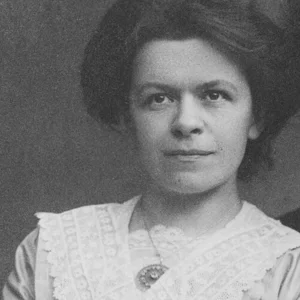

Serbian mathematician and physicist (1875–1948), the first woman admitted to the physics program at the Zurich Polytechnic. First wife of Albert Einstein, she collaborated on his *annus mirabilis* papers of 1905, though her exact contribution remains debated.
Mileva Marić(1875 — 1948)
Mileva Marić
Allemagne, Serbie, Royaume de Hongrie
8 min read
Frequently asked questions
Key Facts
- 1875: born on 19 December in Titel (Serbia), into a prosperous family that encouraged her education
- 1896: first woman admitted to the physics program at the Zurich Polytechnic (ETH), where she met Albert Einstein
- 1905: Einstein's *annus mirabilis* — her contribution to the landmark papers (special relativity, photoelectric effect, Brownian motion) remains historically debated
- 1903: married Albert Einstein; their correspondence bears witness to a close intellectual collaboration
- 1919: divorced Einstein, who transferred to her the full amount of the Nobel Prize (awarded in 1921); she raised their two sons alone in Zurich until her death in 1948
Works & Achievements
Mileva began a doctoral thesis at ETH Zurich on thermal conduction, under the supervision of Professor Heinrich Friedrich Weber. Her failures in the diploma examinations and her pregnancy brought the project to an end, denying her an academic career.
Einstein's four papers of 1905 — on special relativity, the photoelectric effect, Brownian motion, and E=mc² — revolutionized physics. The exact nature of Mileva's contribution to their development remains a subject of debate among historians of science.
The letters exchanged with Einstein, published in 1992 in *The Collected Papers of Albert Einstein*, provide indirect evidence of her involvement in the couple's scientific thinking and have become a primary source for the history of science.
Anecdotes
When Mileva Marić enrolled at the Zurich Polytechnic in 1896, she was the only woman among the physics students. To be admitted, she had obtained a special exemption, as universities in Central Europe almost never accepted women into scientific programs. Her presence, sometimes unwelcome by certain professors, never once dented her determination.
Before their marriage
Mileva and Albert Einstein exchanged an intense love correspondence. In a letter from March 1901
Einstein wrote:
How happy and proud I will be when the two of us together will have brought our work on relative motion to a victorious conclusion!" These letters, preserved and published in 1992, reignited the debate among historians about Mileva's actual role in developing the ideas that would go on to revolutionize physics.
In 1902, Mileva gave birth to a daughter named Lieserl, conceived out of wedlock. The child's existence was kept secret for decades. To this day, it remains unknown what became of Lieserl: was she given up for adoption, or did she die in infancy from scarlet fever? This chapter of Mileva's life remains one of the most poignant mysteries in the history of science.
At her divorce in 1919, Mileva secured a remarkable clause: if Einstein were to receive the Nobel Prize, she would receive the entire sum. Einstein was indeed awarded the prize in 1921, and Mileva received the money, which she invested in apartment buildings in Zurich to secure her sons' future. Some historians see in this a tacit acknowledgment of her intellectual contribution.
One of the most painful ordeals of Mileva's life was the illness of her younger son, Eduard, diagnosed with schizophrenia around 1930. She devoted her final years to caring for him, gradually selling off her assets to fund his treatment. She died in 1948 in relative isolation, leaving Eduard hospitalized at the Burghölzli clinic in Zurich.
Primary Sources
In a letter from March 1901, Einstein writes: 'How happy and proud I will be when the two of us together will have brought our work on the relative motion to a victorious conclusion!'
Mileva writes to her friend Helene: 'Albert has presented his work to the professor. I am very curious to know what he thinks of it and how he will receive it.'
The ETH archives record the admission of Mileva Marić to Section VI (mathematics and physics) for the academic year 1896–1897, the only woman in her cohort.
The ruling stipulates that should Albert Einstein be awarded the Nobel Prize, the entire sum shall be paid to Mileva Marić for the upkeep and future of their children.
Key Places
Mileva Marić's birthplace, in Vojvodina, then a province of Austria-Hungary. Her father, an ambitious civil servant, encouraged her from childhood to pursue scientific studies that were unusual for a girl.
It was here that Mileva enrolled in the physics program in 1896, the only woman in her cohort. She met Einstein there and attended lectures by leading scientists such as Heinrich Friedrich Weber.
The apartment where Mileva and Einstein lived after their marriage in 1903. It was in this modest home — now the Einstein Museum — that the great ideas of the *annus mirabilis* of 1905 were intellectually conceived.
Mileva returned here permanently with her sons after their separation in 1914. She spent her final decades there, managing her rental properties and caring for her son Eduard, who was hospitalized at the Burghölzli psychiatric clinic.
The city where Mileva completed part of her secondary education. Her family was well established there, and her father campaigned to give her access to higher education that was ordinarily reserved for men.
Typical Objects

Mileva took meticulous notes during her studies at ETH Zurich. These notebooks filled with equations and diagrams bear witness to a rigorous training in thermodynamics and electrodynamics.

The correspondence between Mileva and Einstein, as well as with her friend Helene Savić, is the primary documentary source on her life and scientific thinking. These letters, published in 1992, revealed her intellectual contribution to the world.

ETH students worked from the major treatises of the era. Mileva had a command of scientific German and drew on these works for her research in statistical thermodynamics.

ETH Zurich had laboratories equipped with galvanometers, electrometers, and precision electrical measuring devices. Mileva conducted practical experiments there as part of her scientific training.

Mileva played the piano, a practice cultivated in her middle-class family. Music was a passion she shared with Einstein, who played the violin, and it set the tone for their evenings together in Bern.

An indispensable tool for physicists in the early twentieth century before calculators, the slide rule allowed for quick computation of complex multiplications and divisions. Mileva mastered it like any science student of her era.
School Curriculum
Vocabulary & Tags
Key Vocabulary
Tags
Daily Life
Morning
Mileva rose early to review her notes before class. At ETH Zurich, she attended theoretical physics lectures from 8 o'clock in the morning, notebook in hand, attentive to every demonstration. She would reread the previous day's summaries in anticipation of her professors' questions.
Afternoon
Afternoons were devoted to practical work in the laboratory or to study sessions with her classmates, Einstein among them. She worked in the rooms of the university library, surrounded by treatises in German, or discussed equations in the cafés near ETH.
Evening
In the evenings, Mileva and Einstein would often meet to read scientific articles together or to make music — she at the piano, he on the violin. After the birth of her sons, evenings became more domestic, shared between caring for the children and corresponding with her family in Serbia.
Food
Mileva's diet in Zurich was that of a modest student: bread, cheese, soups, and simple dishes from Swiss-German cuisine. At home, she also prepared traditional Serbian dishes, especially during the holidays, a reminder of her Balkan roots.
Clothing
Mileva wore the dark, understated outfits typical of intellectual bourgeoisie women of the Belle Époque: high-necked dresses, tightly buttoned bodices, and long black or dark grey skirts. Her appearance was functional and unpretentious, well suited to the academic environment.
Housing
During her studies, Mileva lived in boarding houses with private families in Zurich, as most foreign students did. After her marriage, the couple occupied small, modest apartments in Bern, including the famous lodgings at Kramgasse 49. The furnishings were simple, dominated by books and sheet music.
Historical Timeline
Period Vocabulary
Visual Style
Style réaliste de la Belle Époque mêlant sobriété académique et rigueur scientifique : tons sépia et bleus froids, évoquant les photographies d'archives universitaires de Zurich du tournant du XXe siècle.
Sound Ambience
L'ambiance sonore évoque le Zurich universitaire du début du XXe siècle : laboratoires de physique, cafés d'étudiants où les idées fusent, et appartements bourgeois où résonnent les conversations scientifiques et la musique de chambre.
Liens externes & ressources
Références
Œuvres
Mémoire sur la conduction thermique (thèse inachevée)
1900-1901
Contribution aux articles de l'annus mirabilis (rôle débattu)
1905
Correspondance scientifique avec Einstein (publiée dans les Collected Papers)
1897-1903