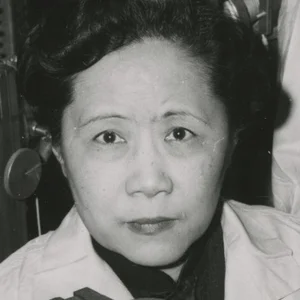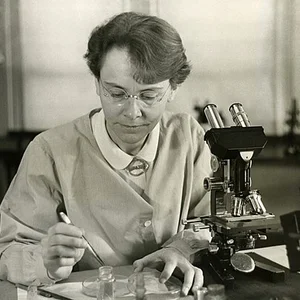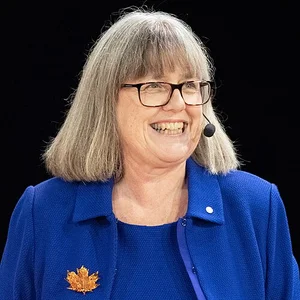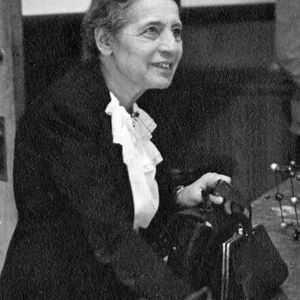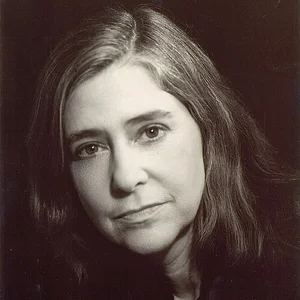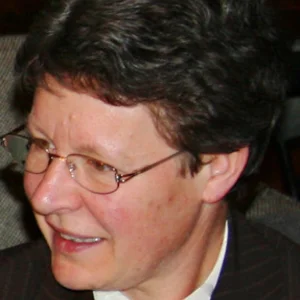

British astrophysicist born in 1943, Jocelyn Bell discovered pulsars in 1967 — neutron stars emitting regular radio signals — during her doctoral thesis. Her thesis supervisor received the Nobel Prize for this discovery, sparking a lasting controversy over the recognition of women in science.
Jocelyn Bell Burnell(1943 — ?)
Jocelyn Bell
Royaume-Uni
8 min read
Frequently asked questions
Key Facts
- 1967: discovery of pulsars during her PhD at the University of Cambridge
- 1974: the Nobel Prize in Physics was awarded to her supervisor Antony Hewish, not to her — worldwide controversy
- 2018: received the Special Breakthrough Prize ($3 million), which she donated entirely to fund scholarships
- President of the Royal Astronomical Society (2008–2010) and of the Institute of Physics (2008–2010)
- Became an iconic figure in the fight for equity in science
Works & Achievements
Founding article co-signed with Hewish and three colleagues, announcing the discovery of pulsars. It is considered one of the most important publications in 20th-century astrophysics.
First detection of a pulsar, an ultra-dense astrophysical object spinning at high speed. This discovery opened up an entire field of astronomy and confirmed the existence of neutron stars.
A series of contributions for the general public, in which Bell Burnell explains the nature of pulsars and the story of their discovery, making science accessible to all.
As president, she played a major role in promoting astronomy in the United Kingdom and championed the place of women in science.
A global award recognising her entire career. She donated the full £2.3 million to a scholarship fund for under-represented students in physics.
At the helm of the leading British physics institution, she drove inclusion and diversity policies that became a benchmark in the global scientific community.
Anecdotes
In 1967, while she was still a doctoral student at Cambridge, Jocelyn Bell detected a strange, regular radio signal in her data: a pulse every 1.337 seconds, of astonishing precision. Intrigued, she initially nicknamed the signal 'LGM-1' (Little Green Men), as some colleagues joked about a possible extraterrestrial origin. This signal turned out to be the first pulsar ever observed.
Jocelyn Bell had herself helped build the Mullard Radio Telescope near Cambridge, planting poles and laying cables across several hectares. This physical labour, unusual for a researcher of her time, allowed her to master the instrument with which she would make her historic discovery.
In 1974, the Nobel Prize in Physics was awarded to Antony Hewish and Martin Ryle for the discovery of pulsars — but not to Jocelyn Bell, who had nonetheless made the decisive discovery. This exclusion caused an outcry in the scientific community. Fred Hoyle, a renowned astronomer, publicly denounced the injustice. Bell herself chose not to harbour bitterness and continued her career with equanimity.
In 2018, Jocelyn Bell Burnell received the Breakthrough Prize in Fundamental Physics, accompanied by a reward of £2.3 million. Rather than keeping the money, she donated the entire sum to a fund aimed at helping students from underrepresented minorities pursue physics studies in the United Kingdom, stating that diversity in science is essential to progress.
During her lectures, Jocelyn Bell Burnell likes to recall that while analysing the kilometres of data printed on paper by her telescope, she would spot anomalies by hand among thousands of traces. It was this meticulous attention — which many would have dismissed as 'noise' — that allowed her to identify the first pulsar. She thus embodies the virtues of perseverance and scientific rigour.
Primary Sources
A large radio telescope operating at a frequency of 81.5 MHz has recently been brought into operation... we wish to report the detection of a signal which appears to be pulsed, with a period of 1.3373 s.
I took myself off to the Observatory one midsummer's day in 1967 to get some more experience with the equipment, and there I noticed a piece of 'scruff' on the chart. I thought it didn't look quite like man-made interference.
I decided to use the prize money to fund PhD studentships for people from under-represented groups wanting to become physics researchers. We need all the talent we can get.
I feel I've done very well out of not getting a Nobel prize. If I had got a Nobel prize, I think I would have been a very different person. The attention and credit I've received since have been extraordinary.
Key Places
Site of the discovery of pulsars in 1967. Jocelyn Bell built the radio telescope there and analysed the data that changed astrophysics.
University where Jocelyn Bell earned her physics degree in 1965, becoming the first woman to join the institution's physics team.
Institution where Bell completed her doctorate under Antony Hewish and made her historic discovery of pulsars.
Jocelyn Bell Burnell's birthplace, where she grew up in a family that encouraged her to pursue scientific studies despite the conventions of the time.
University where Bell taught and led research from the 1990s onwards, while also championing access to science for all.
Typical Objects

A radio antenna composed of 2048 dipoles spread across four hectares, which Bell herself helped build. It was with this instrument that she detected pulsars in 1967.

The telescope's data was printed on rolls of graph paper. Bell manually analysed dozens of metres of chart traces per day to spot anomalies.

Essential tools for marking and measuring pulses on the data rolls. It was by annotating these traces that Bell isolated the signal from the first pulsar.

The transceiver tuned to this frequency allowed distant radio-emitting objects in the universe to be listened to, making the detection of pulsars possible.

The regularity of the pulsar signal — 1.3373 seconds — was measured with clockwork precision. A reliable timepiece was essential to confirm the astrophysical nature of the signal.

The symbolic garment of physical science researchers in the 1960s. Bell wore it during work in the control room and analysis suite at the Mullard Observatory.
School Curriculum
Vocabulary & Tags
Key Vocabulary
Tags
Daily Life
Morning
Jocelyn Bell rises early and walks or cycles to the Mullard Radio Astronomy Observatory, located a few kilometres from Cambridge. She begins her day by collecting the rolls of data printed overnight by the radio telescope, carefully unrolling them across a large analysis table.
Afternoon
The afternoon is devoted to painstaking analysis of the charts: Bell goes through dozens of metres of printouts, pencil in hand, searching for anomalies or unusual signals. She regularly discusses the previous night's results with her PhD supervisor Antony Hewish and fellow doctoral students.
Evening
In the evenings, Bell writes up her research notes and sometimes carries out additional night-time observations. During the years of her discovery, she often spends her evenings cross-referencing suspicious data with other observations to rule out false leads, such as man-made interference.
Food
Typical diet of British students in the 1960s: meals taken in the Cambridge university canteen, sandwiches and tea during long analysis sessions. Hot tea is an indispensable companion during cold nights in the prefabricated buildings of the observatory.
Clothing
Bell wears the standard white laboratory coat when working in the control room, and warm, practical clothing (wool jumper, trousers, boots) for outdoor work on the telescope site. Her attire is functional and understated, typical of British women researchers of the era.
Housing
During her doctorate, Jocelyn Bell lives in a Cambridge university hall of residence, in a simple and functional room. Student accommodation of the time is modest: a desk, shelves lined with scientific textbooks, a bed, and few extras.
Historical Timeline
Period Vocabulary
Visual Style
Style réaliste et documentaire inspiré des photographies scientifiques britanniques des années 1960 : nuit étoilée sur les champs du Cambridge, lumière chaude des laboratoires préfabriqués, rouleaux de papier millimétré et cadrans analogiques.
Sound Ambience
L'ambiance sonore du Mullard Radio Astronomy Observatory dans les années 1960 : craquements des récepteurs radio, bourdonnement des appareils électroniques, vent sur les champs et le roulement régulier des rouleaux de données imprimées.
Liens externes & ressources
Références
Œuvres
Observation of a Rapidly Pulsating Radio Source (Nature, 1968)
1968
Découverte du premier pulsar PSR B1919+21
1967
Cosmic Search — articles de vulgarisation scientifique
1977–1980
Présidence de la Royal Astronomical Society
2002–2004
Breakthrough Prize en physique fondamentale
2018
Présidence de l'Institute of Physics
2014–2016