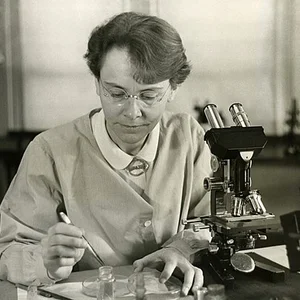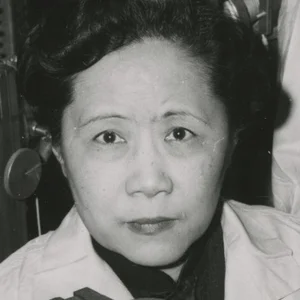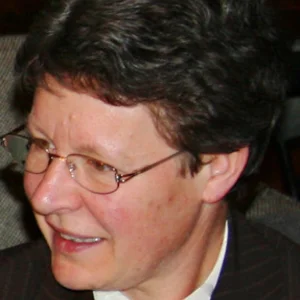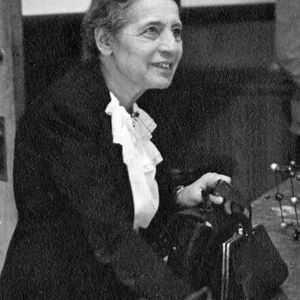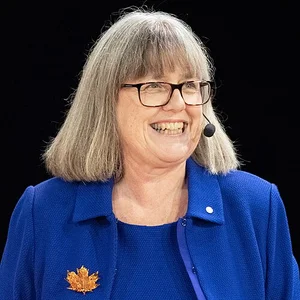

Donna Strickland is a Canadian physicist and pioneer in the field of ultra-intense lasers. In 1985, she co-developed with Gérard Mourou the technique of chirped pulse amplification (CPA), revolutionizing laser physics. In 2018, she received the Nobel Prize in Physics, becoming only the third woman ever to receive this distinction.
Donna Strickland(1959 — ?)
Donna Strickland
Canada
7 min read
Frequently asked questions
Key Facts
- Born in 1959 in Guelph, Ontario, Canada
- In 1985, co-invented the chirped pulse amplification (CPA) technique with Gérard Mourou
- Earned her doctorate from the University of Rochester in 1989
- Became a professor at the University of Waterloo, where she leads a laser physics laboratory
- In 2018, received the Nobel Prize in Physics alongside Gérard Mourou and Arthur Ashkin
Works & Achievements
Revolutionary technique invented with Gérard Mourou enabling the production of ultrashort laser pulses of unprecedented intensity. It forms the basis of LASIK surgery, cancer treatment, and numerous industrial applications.
Scientific publication stemming from Strickland's doctoral thesis, co-authored with Mourou, which lays the theoretical and experimental foundations of CPA. One of the most cited papers in laser physics.
Strickland contributes to the rise of lasers capable of producing pulses on the order of a femtosecond (10⁻¹⁵ second), opening the way to ultrafast chemistry and precision medical imaging.
The highest honor in physics, awarded to Strickland for her foundational role in the development of CPA. She is the first woman to receive this prize in 55 years.
At the University of Waterloo, Strickland leads research on ultrashort lasers applied to biological tissue surgery, particularly for the treatment of the retina and cornea.
Anecdotes
In 2018, Donna Strickland became the third woman in history to receive the Nobel Prize in Physics, 55 years after Maria Goeppert Mayer. When the news was announced to her by phone, she jokingly replied that she first had to check it wasn't a prank. Her spontaneous, laid-back reaction made headlines around the world.
Before the Nobel announcement, a Wikipedia contributor had attempted to create a dedicated page for Donna Strickland, but the request was rejected by moderators who deemed the researcher not sufficiently 'notable'. A few months later, following the Nobel Prize award, the page was hastily created, highlighting how women scientists are often underrepresented in reference sources.
The revolutionary chirped pulse amplification (CPA) technique that Donna Strickland developed with Gérard Mourou in the 1980s gave rise to laser eye surgery (LASIK), performed on millions of people every year. Strickland herself only discovered this medical application of her work years after its publication.
When Donna Strickland joined the University of Waterloo after her doctorate, she held the position of associate professor rather than full professor — a fact that surprised many observers once the Nobel was awarded. She admitted she had never applied for a higher-ranking position, preferring to focus on her research without worrying about academic hierarchies.
Donna Strickland shares the 2018 Nobel Prize with her doctoral supervisor Gérard Mourou, an exceptionally rare occurrence in the history of science. The landmark paper describing their discovery, published in 1985, was drawn directly from Strickland's doctoral thesis — proof that a student's work can change the course of physics worldwide.
Primary Sources
We have demonstrated the compression of amplified chirped optical pulses. Amplification of the pulse was achieved by means of a grating pair expander, a Nd:glass amplifier chain, and a grating pair compressor.
The field of ultrafast science has been transformed by the development of sources that generate ultrashort, high-intensity laser pulses. This was made possible by the technique of chirped pulse amplification.
I thought it was really exciting that we were able to use these short pulses to do interesting things in science. I never really thought it would lead somewhere like this.
The developed system enables the amplification of light pulses without damaging the amplifying material, by temporally stretching the pulse before amplification and then recompressing it.
Key Places
Donna Strickland's hometown, where she grew up and developed her interest in science. This university city in southern Ontario is known for its university and scientific vitality.
University where Strickland completed her undergraduate studies in engineering physics (1977–1981), laying the foundations of her training in optics and applied physics.
Optics laboratory (The Institute of Optics) where Strickland completed her doctorate under the supervision of Gérard Mourou and developed the CPA technique between 1983 and 1989.
Canadian university where Donna Strickland has been a professor since 1997 and conducts her research on ultrafast lasers. It is here that she learned of the Nobel Prize award in 2018.
City where the Nobel Prize award ceremony is held every year in December. It is here that Donna Strickland received her Nobel medal and diploma in December 2018.
Typical Objects

A key component of the CPA technique, the diffraction grating stretches and then recompresses light pulses. Strickland uses it to separate the wavelengths of a laser, making amplification possible without destroying the material.

Type of laser used in Strickland and Mourou's experiments to amplify ultrashort pulses. This synthetic crystal is at the heart of the high-power laser systems developed in the 1980s.

Essential measuring instruments in Strickland's laboratory for characterizing the duration and shape of laser pulses. They allow verification that temporal compression is being carried out correctly.

Mandatory safety equipment in laser physics laboratories, where intense beams can cause irreversible eye injuries. Symbols of the daily life of an experimental physicist.

The publication of the landmark paper on CPA is the central object of Strickland's career. This document of a few pages transformed laser physics and paved the way for medical and industrial applications worldwide.

A heavy table suspended on an air cushion used in laser laboratories to prevent the slightest vibrations from disturbing beam alignment. An everyday tool for the researcher in her precision experiments.
School Curriculum
Vocabulary & Tags
Key Vocabulary
Tags
Daily Life
Morning
Donna Strickland starts her day early, often checking the latest preprints on arXiv before heading to the university. She has a coffee while reviewing the results of experiments conducted the previous day by her students. Mornings are dedicated to group meetings and scientific discussions with her doctoral students.
Afternoon
In the afternoon, she spends long hours in the laboratory, supervising optical alignments and data acquisitions. She attends physics seminars or teaches her undergraduate and graduate courses. Reviewing articles submitted to scientific journals also takes up a significant part of her time.
Evening
In the evening, Donna Strickland enjoys unwinding by cooking for her family and engaging in sports activities. She regularly reads popular science books and novels. She is known for her sense of humor and conviviality at team dinners and international conferences.
Food
Typically North American diet — balanced and practical, suited to the pace of an active researcher. She enjoys shared family meals and informal lunches with colleagues in the university cafeteria. Little formalism at the table, with the emphasis on conviviality.
Clothing
Donna Strickland dresses simply and functionally: plain sweater or shirt, comfortable trousers, a lab coat when working with lasers. She places no particular importance on appearance, something she acknowledges with humor in interviews. At official ceremonies, she wears elegant but understated outfits.
Housing
She lives with her family in a residential suburban house near Waterloo, Ontario. The setting is typical of Canadian university towns: a detached house with a garden, in a quiet and leafy neighborhood. Her home is a few kilometers from campus, which she sometimes reaches by bicycle.
Historical Timeline
Period Vocabulary
Visual Style
Esthétique de laboratoire universitaire nord-américain : blanc immaculé, équipements optiques métalliques, faisceaux laser colorés, tableaux couverts d'équations et lumière naturelle du campus ontarien.
Sound Ambience
L'univers sonore de Donna Strickland est celui d'un laboratoire de physique expérimentale : bourdonnement des systèmes de refroidissement, cliquetis des montures optiques, bips des instruments de mesure et murmures des échanges entre chercheurs.
Liens externes & ressources
Références
Œuvres
Amplification par dérive de fréquence (Chirped Pulse Amplification — CPA)
1985
Article fondateur : 'Compression of amplified chirped optical pulses' (Optics Communications)
1985
Développement des lasers à impulsions femtosecondes
1989-2000
Prix Nobel de physique
2018
Recherches sur les lasers à fibre pour applications biomédicales
2000-présent