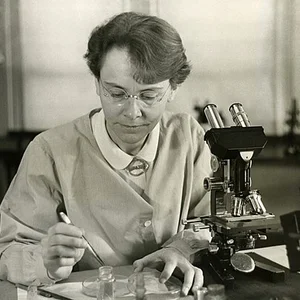

Barbara McClintock is a pioneering American geneticist who discovered transposable elements, known as "jumping genes," in maize as early as the 1940s. Long overlooked by the scientific community, she received the Nobel Prize in Physiology or Medicine in 1983, the only woman to have received it unshared in that discipline.
Barbara McClintock(1902 — 1992)
Barbara McClintock
Japon
7 min read
Frequently asked questions
Famous Quotes
« If you know you are right, you don't care what others think.»
Key Facts
- Born in 1902 in Hartford, Connecticut; earned her doctorate in botany from Cornell in 1927
- Discovered transposable elements ("jumping genes") in maize in the 1940s–1950s
- Her work was ignored or dismissed for more than 20 years by the scientific community
- Scientific vindication came in the 1970s as the rise of molecular biology confirmed her discoveries
- Nobel Prize in Physiology or Medicine in 1983, at age 81, for her body of work on genetic transposition
Works & Achievements
Landmark paper experimentally demonstrating that the exchange of genetic material between homologous chromosomes corresponds to an observable physical exchange — a cornerstone of modern genetics.
Discovery that certain DNA segments (Activator and Dissociation) can change position within the genome, regulating gene expression — a revolution ignored for decades.
Major publication laying out the mechanism of genetic transposition, now regarded as one of the most important papers in the history of genetics.
Conference paper in which McClintock presented her theory of gene regulation by mobile elements — met with skepticism by the audience.
Fieldwork in Colombia, Peru, and Guatemala tracing the evolution and diversification of cultivated maize from its wild ancestors, combining genetics and archaeobotany.
Nobel lecture in which McClintock presented her vision of the genome as a dynamic system capable of reorganizing itself in response to environmental challenges, anticipating contemporary epigenetics.
Anecdotes
In the 1940s, Barbara McClintock observed that certain maize kernels changed color in unexpected ways from one generation to the next. She deduced that segments of DNA were moving from one location to another on the chromosome — an idea so revolutionary that the scientific community deemed it incomprehensible for decades.
McClintock worked alone in her maize fields at Cold Spring Harbor for years, with no permanent position or institutional recognition. She continued her research with rigor and passion, refusing to give up despite widespread indifference: 'If you know you are right, you don't need others to know it.'
When she received the Nobel Prize in Physiology or Medicine in 1983, at the age of 81, it was one of the rare occasions a woman received it alone, without sharing the award. She simply stated that she was relieved her work was finally understood, but that she had never doubted her conclusions.
McClintock had an exceptional visual memory and could individually recognize each of the maize plants in her experiments, noting the slightest morphological variations with the naked eye before any microscopic analysis. Her colleagues nicknamed her 'the woman who talked to the corn.'
Declining a position at the University of Missouri because she sensed she would never receive tenure there as a woman, she chose instead to join the Carnegie Institution at Cold Spring Harbor in 1942, where she worked until her death — a bold choice that allowed her to conduct her research in complete intellectual freedom.
Primary Sources
Certain loci in maize are mutable; the mutations arise at a high rate and are reversible. The mutability is controlled by specific genetic elements that can change position in the chromosome complement.
The Ds locus is capable of transposition to new positions in the chromosome complement. This transposition is controlled by the Ac element and results in chromosome breakage and new patterns of gene expression.
The behavior of the transposable elements suggests that the genome is not static but dynamic, capable of reorganizing itself in response to internal and external signals.
Nothing prepared me for the period of sudden attention I received after the Nobel Prize announcement. It was a disconcerting experience. I had not sought recognition — only understanding.
Key Places
The place where McClintock completed her undergraduate studies and doctorate, and where she made her first fundamental discoveries about maize chromosomes.
The institution where McClintock worked from 1942 until her death in 1992; it is here that she discovered and documented transposable elements in her experimental maize fields.
A position she held briefly (1936–1941) before leaving, sensing she would never receive tenure there as a woman scientist.
Barbara McClintock's birthplace in 1902, born into an American middle-class family that valued education and independence.
The German institution where McClintock stayed in 1933 on a Guggenheim fellowship, before leaving Germany due to the rise of National Socialism.
Typical Objects

The central tool of McClintock's work, which she used to observe stained maize chromosomes and identify chromosomal rearrangements invisible to the naked eye.

The biological material for all her experiments: she grew hundreds of maize plants and analyzed the pigmentation variations of kernels to deduce genetic movements.

McClintock meticulously recorded every observation in detailed notebooks, tracing the genealogy and phenotype of each plant — essential archives of her scientific approach.

Chemical products used to stain maize chromosomes and make them visible under the microscope, allowing McClintock to identify breaks and transpositions.

Supports for microscopic preparations on which McClintock spread and fixed maize cells for detailed observation.

Simple field botanist equipment: stakes, strings, and numbered labels allowing McClintock to identify each of her plants in the experimental fields at Cold Spring Harbor.
School Curriculum
Vocabulary & Tags
Key Vocabulary
Daily Life
Morning
McClintock rises early and begins her day in her corn fields at Cold Spring Harbor, methodically inspecting each plant, noting variations in kernel color and attaching numbered labels. She often works several hours outdoors before returning to the laboratory.
Afternoon
The afternoon is devoted to the microscope: she prepares stained maize chromosome sections, observes them for hours with intense concentration, and fills her notebooks with detailed diagrams and annotations. She works alone, taking few breaks.
Evening
In the evening, McClintock re-reads her notes, compares data across multiple plant generations and reflects on the theoretical implications of her observations. An avid reader, she also takes an interest in philosophy and Eastern sciences; she lives simply and frugally.
Food
McClintock led a sober and unpretentious life; her meals were simple and functional, often eaten quickly between work sessions. She attached little importance to gastronomy and neither smoked nor drank, preserving her health into very old age.
Clothing
Pragmatic and little concerned with conventions, she typically wore sturdy cotton trousers, plaid shirts and solid shoes suited to fieldwork in the fields. In the laboratory, she would slip a white coat over her gardening clothes.
Housing
She lived in modest accommodation provided by the Carnegie Institution at Cold Spring Harbor, close to her fields and laboratory. Her living environment was functional and uncluttered, a reflection of a personality entirely devoted to scientific work.
Historical Timeline
Period Vocabulary
Visual Style
Réalisme scientifique américain du milieu du XXe siècle : chercheuse solitaire dans les champs de maïs dorés, laboratoire en bois avec microscope laiton et cahiers manuscrits couverts de schémas chromosomiques.
Sound Ambience
Ambiance sonore des champs expérimentaux et du laboratoire de Cold Spring Harbor : bruissement des plants de maïs, insectes d'été, silence studieux d'une chercheuse solitaire au microscope.
Liens externes & ressources
Références
Œuvres
Preuve cytologique du crossing-over (avec Harriet Creighton)
1931
Découverte des éléments transposables Ac/Ds dans le maïs
1948-1950
The origin and behavior of mutable loci in maize (PNAS)
1950
Chromosome organization and genic expression (Cold Spring Harbor Symposia)
1951
Études sur le génome du maïs en Amérique du Sud (projet NSF)
1957-1981
Discours Nobel : 'The Significance of Responses of the Genome to Challenge'
1983