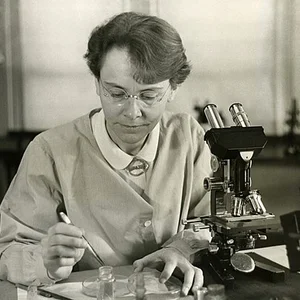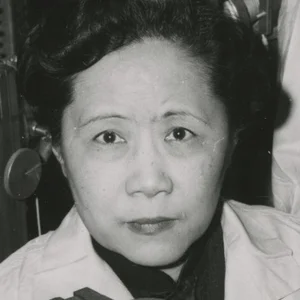

Chien-Shiung Wu was a Chinese-American experimental physicist, nicknamed "the First Lady of Physics." Her 1956 experiment disproved the law of conservation of parity, upending particle physics. Unjustly passed over for the Nobel Prize awarded to Lee and Yang for that discovery, she remains one of the most important figures in twentieth-century physics.
Chien-Shiung Wu(1912 — 1997)
Chien-Shiung Wu
États-Unis, Taïwan, république de Chine
8 min read
Frequently asked questions
Famous Quotes
« "It is sad that only a tiny fraction of half of humanity contributes to the understanding of the great visible and invisible world that surrounds us."»
Key Facts
- 1912: Born in Liuhe, near Shanghai, into a family that encouraged girls' education
- 1944: Joins the Manhattan Project at Columbia University to help develop the atomic bomb
- 1956: Her cobalt-60 experiment disproves the law of conservation of parity, confirming the theory of Lee and Yang
- 1957: Lee and Yang receive the Nobel Prize in Physics for the theory Wu had experimentally proven — she is excluded
- 1975: First woman elected president of the American Physical Society
Works & Achievements
Landmark experiment proving that parity symmetry is not conserved in weak interactions, confirming Lee and Yang's theory. Considered one of the most important physics experiments of the 20th century.
Wu experimentally demonstrated the vector-axial structure of weak currents, validating the unified theory of Feynman, Gell-Mann, Marshak and Sudarshan on beta decay.
Series of pioneering publications establishing Wu as the world's foremost experimentalist in beta nuclear physics, with measurements of unmatched precision for the era.
Identification of xenon-135 poisoning as the cause of the Hanford reactor shutdown, enabling the resumption of plutonium production for the American nuclear program.
Definitive scientific treatise on beta decay, used by generations of nuclear physicists. Wu synthesizes decades of experimental and theoretical research within it.
Late in her career, Wu applied her nuclear physics techniques to the study of hemoglobin and sickle cell anemia, illustrating the fruitfulness of exchanges between physics and medical biology.
Anecdotes
In 1956, theoretical physicists Tsung-Dao Lee and Chen-Ning Yang proposed that parity symmetry might be violated in weak interactions, but no one had yet proven it experimentally. Chien-Shiung Wu took up the challenge and designed an extremely delicate experiment involving cobalt-60 cooled to temperatures near absolute zero. Her results, published in early 1957, confirmed the violation of parity and upended fundamental physics.
Lee and Yang received the Nobel Prize in Physics in 1957 for their theory on parity violation, but Chien-Shiung Wu, who had provided the decisive experimental proof, was excluded from the Nobel. This omission sparked lasting controversy in the scientific community and became one of the most cited examples of gender bias in the awarding of scientific prizes.
During World War II, Chien-Shiung Wu was recruited as part of the Manhattan Project. She worked at Columbia University on uranium enrichment through gaseous diffusion and helped solve a critical problem: the Hanford reactor was mysteriously shutting down; she identified that xenon-135, a fission product, was the cause, making it possible to correct the process.
Born in a small town near Shanghai, Chien-Shiung Wu was encouraged from childhood by her father, a progressive schoolteacher, to pursue scientific studies at a time when this was exceedingly rare for a girl in China. She left her country in 1936 to pursue a doctorate at Berkeley, expecting to return quickly, but did not go back to China until decades later, after the death of her parents.
In 1975, Chien-Shiung Wu became the first woman to serve as president of the American Physical Society. In her inaugural address, she directly challenged her male colleagues on the underrepresentation of women in science, declaring that the obstacles were not intellectual but social and institutional.
Primary Sources
If parity is not conserved in beta decay, one should observe a forward-backward asymmetry in the distribution of the beta particles with respect to the direction of the nuclear spin. The present experiment was designed to measure this asymmetry.
I have been working very hard on the beta-decay experiments and the results seem to be consistently pointing in one direction. I believe we are close to a definitive answer on the question of parity.
The experimental confirmation was provided by C.S. Wu and her collaborators at the National Bureau of Standards, whose courageous and skillful experiment on oriented Co60 gave clear and definite evidence for parity nonconservation.
I wonder whether the tiny, almost imperceptible [discouragement] which some individual scientists may have unwittingly encountered in their early formative years has been multiplied many times over in the academic world.
Key Places
Chien-Shiung Wu's hometown, where her father ran a progressive co-educational school. This family environment, supportive of women's education, was a defining factor in her scientific vocation.
Wu earned her doctorate here in 1940 under the supervision of Ernest Lawrence. It was there that she received advanced training in experimental physics and met her future husband, physicist Luke Yuan.
The institution where Wu spent most of her career, from 1944 until her retirement. It was in its laboratories that she conducted the parity violation experiment and her work on beta decay.
The site where the parity violation experiment was physically carried out in 1956–1957, in collaboration with the bureau's cryogenics teams, whose equipment Wu needed to reach the required temperatures.
Manhattan Project nuclear facility where Wu contributed remotely to solving the xenon poisoning problem that was crippling the first plutonium production reactor.
Typical Objects

Central instrument in Wu's experiments on beta decay, it measures emitted particles with extreme precision. Wu was renowned for her meticulous care in adjusting and calibrating her detectors.

Radioactive isotope used in the landmark 1956–1957 experiment. Wu cooled cobalt-60 atoms to 0.01 Kelvin to align their nuclear spins and observe the asymmetry of beta emission.

Device used to reach temperatures close to absolute zero, essential to the parity experiment. Its technical mastery was considered an experimental tour de force for the era.

Instrument measuring the energy of electrons emitted during beta decay. Wu used this device to confirm the shape of the energy spectrum predicted by Fermi's theory.

Symbol of her role as a teacher and lecturer. Wu taught at Columbia for more than thirty years and was known for the rigor and clarity of her nuclear physics courses.

Wu frequently wore this traditional garment, thereby affirming her Chinese cultural identity throughout her American career, including at international conferences.
School Curriculum
Vocabulary & Tags
Key Vocabulary
Tags
Daily Life
Morning
Wu arrived very early at the Columbia laboratory, often before her colleagues and students. She devoted the first hours to reading the results of overnight experiments, annotating graphs and planning the day's technical adjustments. Her morning coffee was often forgotten, growing cold on her desk.
Afternoon
The afternoon was dedicated to experimental work proper: calibrating detectors, preparing radioactive sources, and meticulously recording measurements. Wu personally supervised each step and did not hesitate to redo herself the delicate calibrations her assistants considered satisfactory but which she deemed insufficiently precise.
Evening
Evenings were divided between writing scientific papers at home, preparing her courses, and discussions with her husband, physicist Luke Yuan. Wu also regularly hosted colleagues and students for dinner in their New York apartment, where conversations blended physics and Chinese culture.
Food
Wu maintained a diet rooted in Chinese culinary tradition, often preparing Cantonese and Shanghainese dishes at home despite her demanding schedule. She was known for her hospitality and generous table at academic gatherings, where she served Chinese specialties to her American colleagues.
Clothing
Wu frequently wore the cheongsam, a fitted traditional Chinese dress, including in professional settings and at scientific conferences. This deliberate sartorial choice expressed her pride in her cultural heritage. For laboratory work, she would put on a regulation white lab coat over it.
Housing
Wu and her husband Luke Yuan lived in a comfortable apartment in Manhattan, close to Columbia University. The apartment was simply furnished but adorned with Chinese art objects and shelves overflowing with scientific journals and physics books. It was a cherished intellectual gathering place for students and researchers passing through New York.
Historical Timeline
Period Vocabulary
Visual Style
Esthétique des laboratoires universitaires américains des années 1950-1960, mêlant instruments scientifiques en bakélite, tableaux noirs d'équations et la présence distinctive de Wu en cheongsam parmi les appareils cryogéniques.
Sound Ambience
Ambiance d'un laboratoire de physique nucléaire des années 1950-1960 : bourdonnement des instruments, cliquetis des détecteurs et calme studieux des salles de séminaires universitaires.
Liens externes & ressources
Références
Œuvres
Expérience sur la violation de la parité (expérience Wu)
1956-1957
Confirmation de la théorie V-A de Fermi
1963
Travaux sur la désintégration bêta (thèse et articles)
1940-1950
Contribution au Projet Manhattan – résolution du problème du xénon
1944
Beta Decay (ouvrage de référence)
1965
Recherches sur l'anémie falciforme
1970-1980