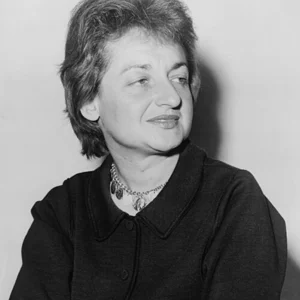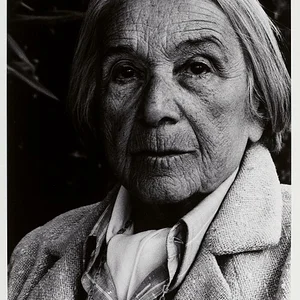

French writer of Russian origin (1900-1999), Nathalie Sarraute is a major figure of the French Nouveau Roman. She revolutionized the novel form by exploring movements of consciousness and the 'sub-conversations' that animate human relationships.
Frequently asked questions
Famous Quotes
« There are in us very subtle, very fleeting states of consciousness, movements of extreme delicacy that can only be captured by the novel.»
« I seek to grasp these movements that exist in everyone and that no one dares to acknowledge.»
Key Facts
- 1939: Publication of her first work 'Tropisms', a collection of psychological snapshots that prefigured the Nouveau Roman
- 1956: Publication of 'The Age of Suspicion', a founding theoretical essay defining her novelistic poetics
- 1959: Publication of 'The Planetarium', a major novel exploring the micro-dramas of conjugal life
- 1983: Awarded the Prix Goncourt for 'Childhood', a fragmented and poetic autobiography
- Active participation in the Nouveau Roman movement alongside Robbe-Grillet, Butor and Pinget
Works & Achievements
Sarraute's first collection, composed of short prose texts exploring the minute psychological movements that stir people without their awareness. This founding book lays the groundwork for her entire future work.
A novel prefaced by Sartre under the term 'anti-novel', it deconstructs the conventions of the traditional novel by following a narrator who obsessively observes a father and his daughter without ever penetrating their mystery.
A collection of theoretical essays considered the manifesto of the Nouveau Roman. Sarraute analyses the crisis of the novelistic character and argues for a literature that probes the depths of consciousness.
A novel staging the critical reception of a fictional book of the same name, exposing the mechanisms of literary judgement and literary fashion. International Literature Prize in 1964.
A novel exploring the process of literary creation from the inside, through the consciousness of a writer at work. A deeply reflexive work on language and the act of writing.
An autobiographical account in which Sarraute dialogues with an inner voice to reconstruct her childhood memories. A masterpiece of memorial lucidity, unanimously praised by critics.
A radio play that illustrates with striking economy of means how a tone of voice or a single word can trigger a profound crisis in a friendship. Regularly performed and studied in secondary schools.
Anecdotes
Nathalie Sarraute was born Natacha Tcherniak in Ivanovo-Voznesensk, Russia, in 1900. After her parents' divorce, she traveled back and forth between Paris and Saint Petersburg before settling permanently in France at the age of eight. This childhood shared between two cultures gave her a particular sensitivity to languages and to the silences between people.
Trained as a lawyer, Sarraute was admitted to the Paris Bar in 1925 but quickly abandoned the profession to devote herself to writing. She began drafting the texts that would become Tropisms as early as 1932, but the book was not published until 1939, to near-universal indifference, in a print run of only a few hundred copies.
During the Occupation, Sarraute was forced into hiding because of her Jewish origins. She lived under a false identity in the Paris region, and it was during this period of enforced isolation that she continued writing Portrait of a Man Unknown, which Jean-Paul Sartre would preface in 1948, coining for her the term "anti-novel".
In 1983, Nathalie Sarraute published Childhood, an autobiographical work in which she engages in dialogue with an inner voice that questions her own memories. This formal device perfectly illustrates her method: she refuses to deliver a smooth memoir narrative, preferring instead to stage the uncertainty and complexity of consciousness.
Primary Sources
There was something between them, indefinable, fragile and taut, like an invisible thread that the slightest gesture might break.
Today's reader has become wary. He knows he must be careful not to believe too quickly in the characters, the settings, the situations the novelist offers him.
— So, are you really going to do this? Evoke your childhood memories... — Why not? — You know it's always a little risky. Those words that seemed to capture so well what you wanted to convey, when you look at them closely... sometimes they slip away.
— That's good, that is... — What? — What you said. That's good, that is. — Oh really. And it shocked you? — No. But it's the tone... a certain tone...
The Golden Fruits... have you read The Golden Fruits? — No, not yet... — Well, read it. It's remarkable. Truly remarkable.
Key Places
Nathalie Sarraute spent most of her adult life in the 16th arrondissement of Paris. It was there that she wrote, received friends, and lived her life as a writer.
Sarraute completed her legal studies there in the 1920s before being admitted to the bar. This place marks her rigorous intellectual formation prior to her transition to writing.
The emblematic publishing house of the Nouveau Roman published several of her works. Its director Jérôme Lindon was a central figure in promoting the group and Sarraute in particular.
Nathalie Sarraute's birthplace, now known as Ivanovo, approximately 300 km from Moscow. Although she left it very young, her Russian origins profoundly shaped her literary sensibility.
Sarraute owned a country house in Cherisy where she regularly retreated to write away from the bustle of Paris. This rural refuge nourished the writing of several of her works.
Typical Objects

Sarraute wrote her texts on a typewriter, the central tool of her work as a writer throughout the twentieth century. She would tirelessly rework her sentences to capture the minute movements of consciousness.
📷 Domaine public · Wikimedia Commons ↗
Before moving to the typewriter, Sarraute would record her observations on people and their interactions in notebooks. These brief notes formed the raw material for her tropisms.

Trained as a lawyer, Sarraute kept legal texts in her library that bore witness to her dual intellectual path. Her sense of argumentation and conceptual precision nourished her analytical writing.
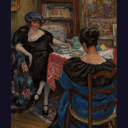
As heir to a Russo-European culture, tea accompanied her long working sessions and literary conversations in her Parisian apartment. The drawing room gathered around a cup of tea is moreover a recurring setting in her works.
📷 Domaine public · Wikimedia Commons ↗
Sarraute closely followed French literary life through major publications such as Les Temps modernes and La Nouvelle Revue Française. These publications were at the heart of the aesthetic debates in which she actively participated.

The telephone appears as a symbol in several of her works and plays, representing the banal conversation behind which lie sub-conversations laden with psychological intensity.
📷 CC BY-SA 3.0 · Wikimedia Commons ↗School Curriculum
Vocabulary & Tags
Key Vocabulary
Daily Life
Morning
Sarraute began her mornings early, settling at her desk before domestic and social life could impose itself. She devoted the morning hours to writing, believing that creative concentration was at its peak in the morning. Those close to her speak of her rigorous discipline and her resistance to distractions.
Afternoon
Afternoons were often devoted to reading, revising her texts, and literary correspondence. She sometimes received writer friends or journalists, and took part in debates within Parisian intellectual life. Her outings took her to lectures, public readings, or gatherings at Les Éditions de Minuit.
Evening
Sarraute's evenings were often studious or spent at intimate dinners with friends from the Parisian literary and artistic scene. She enjoyed in-depth conversations, which directly nourished her thinking on the 'tropisms' and sub-conversations she observed in human interactions.
Food
Sarraute led a sober life without particular excesses, typical of the Parisian intellectual bourgeoisie of the twentieth century. She appreciated simple meals shared with family or friends, valuing the quality of conversation over that of the table. Her Russo-European heritage may have been reflected in a certain dietary restraint.
Clothing
Nathalie Sarraute dressed with the discreet and classic elegance of the Parisian intellectual upper-middle class. She wore understated outfits, often in neutral tones, without ostentation or excessive flair. Photographs frequently show her in a tailored suit or simple dress, hair neatly arranged, embodying the image of the serious woman of letters.
Housing
Sarraute lived in a bourgeois apartment in the 16th arrondissement of Paris, surrounded by books and manuscripts. She also had a country house in Cherisy in Eure-et-Loir, a retreat where she enjoyed writing in peace. These two spaces symbolise the dual movement of her work: the observation of Parisian social milieu and the inner withdrawal necessary for creation.
Historical Timeline
Period Vocabulary
Visual Style
L'univers visuel de Sarraute s'inspire des intérieurs bourgeois parisiens du milieu du XXe siècle, avec une esthétique sobre et introspective qui évoque la littérature moderniste et les couvertures épurées des Éditions de Minuit.
Sound Ambience
L'univers sonore de Sarraute mêle le calme studieux d'un appartement bourgeois parisien au bruit feutré de la ville, avec au premier plan le cliquetis de la machine à écrire et les conversations à mi-voix qui cachent toujours une autre conversation.
Liens externes & ressources
Références
Œuvres
Tropismes
1939
Portrait d'un inconnu
1948
L'Ère du soupçon
1956
Les Fruits d'or
1963
Entre la vie et la mort
1968
Pour un oui ou pour un non
1982