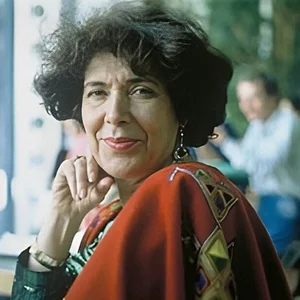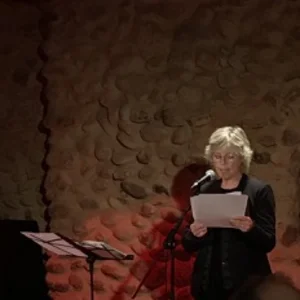

A Quebec poet and writer born in 1958, Hélène Dorion is a leading figure in contemporary French-Canadian poetry. Her work, marked by introspection and meditation on nature and identity, explores themes of belonging and freedom.
Frequently asked questions
Famous Quotes
« Poetry is a way of inhabiting the world differently.»
« Writing is learning to live with silences.»
Key Facts
- Born on April 21, 1958 in Quebec City, Canada
- Publication of major collections including "Mes forêts", studied in the 2025 baccalauréat
- Founder and editor of the literary journal "Moebius" (1978)
- Recipient of numerous Quebec and Canadian literary awards and distinctions
- Work translated into several languages, with international recognition
Works & Achievements
Hélène Dorion's first poetry collection, which immediately raises the central questions of her work: time, silence, the space between beings and things.
A meditative collection exploring the duality of matter and breath, of earthly heaviness and the lightness of the poetic spirit.
A major work by Dorion, which questions the relationship to landscape, to the memory of places, and to the construction of identity through lived geography.
A collection acclaimed by critics for its gentleness and depth, centered on the fragility of living things and the beauty of ordinary things.
A masterwork of maturity, this collection devoted to the forest as inner and outer space was shortlisted for the Prix Médicis étranger and brought Dorion to the attention of the broader international public.
Anecdotes
Hélène Dorion began writing poetry at a very young age, during adolescence, searching for words to express what ordinary language could not convey. She has shared that the Quebec landscape — its forests, snow, and the raking light of winter — was her first great "book", even before she opened the collections of great poets.
In 2021, her collection 'Mes forêts' caused a resounding surprise in the French-speaking literary world: shortlisted for the Prix Médicis étranger in France, it introduced contemporary Quebec poetry to a very wide European audience who had not yet discovered her work. The poet described this international recognition as "a bridge thrown across the Atlantic".
Hélène Dorion collaborated for many years with the Quebec poetry publisher Le Noroît, helping to establish it as a cornerstone of French-Canadian poetry. She also took part in writing residencies and gatherings between poets of different languages, convinced that poetry is a universal language that transcends borders.
Fascinated by the dialogue between the arts, Hélène Dorion has repeatedly brought her writing into dialogue with visual and musical works. Some of her texts have been set to music or paired with painting exhibitions, reflecting her belief that poetry "touches everything that resists ordinary speech".
In interviews, Hélène Dorion often explains that her writing process is bound up with solitary walks in nature, particularly in the forest. She considers that walking slowly and observing — a leaf, a lake, the light between the trees — is inseparable from the act of writing, as if words are born from the silence inhabited by the world.
Primary Sources
"I am made of forests / that never cease to grow / in me, around me, before me."
"Places inhabit us before we inhabit them. It takes time to understand what the landscape says about us."
"What is fragile is not what breaks, but what trembles and endures, what clings to life in spite of everything."
"Between two silences, a word — and that is where poetry resides, in that space one dares not fill."
"We are at once the matter and the wind that lifts it, the clay and the breath that gives it form."
Key Places
Hélène Dorion's hometown, whose St. Lawrence River landscapes and harsh winters profoundly shaped her poetic imagination.
The city where much of Quebec's literary life is concentrated; Hélène Dorion forged ties there with publishing houses and Francophone poetry circles.
Quebec's boreal and Laurentian forests are the founding backdrop of Dorion's work; they appear as spaces of meditation, silence, and revelation throughout her collections.
France is an essential interlocutor of Quebec literature; the selection of 'Mes forêts' for the Prix Médicis étranger anchored Dorion in the Parisian literary landscape.
Liens externes & ressources
Références
Œuvres
L'intervalle prolongé
1983
D'argile et de souffle
2002
Ravir : les lieux
2005
Mondes fragiles, choses frêles
2006
Mes forêts
2021