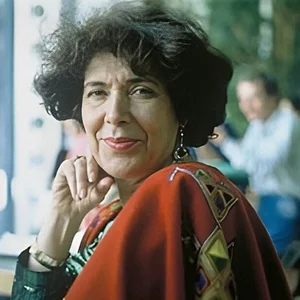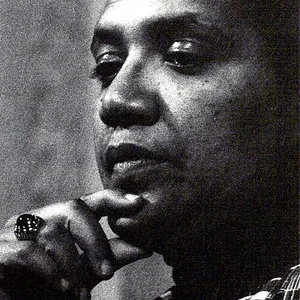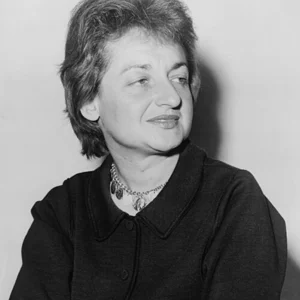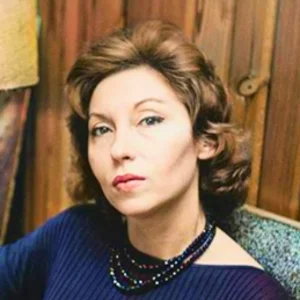

Clarice Lispector, born in Ukraine and raised in Brazil, is one of the greatest Portuguese-language writers of the 20th century. Her work, deeply introspective, renews Brazilian prose through a unique poetic and philosophical style.
Clarice Lispector(1920 — 1977)
Clarice Lispector
Brésil, république socialiste soviétique d'Ukraine
8 min read
Frequently asked questions
Famous Quotes
« Escrever é uma maldição que salva. — Writing is a curse that saves.»
« A maior luta de um ser humano é a de ser ele mesmo.»
Key Facts
- Born in 1920 in Tchetchelnik, Ukraine, into a Jewish family that emigrated to Brazil in 1922
- Publication of her first novel Near to the Wild Heart in 1943, hailed as a stylistic revolution in Brazil
- Diplomatic life: follows her diplomat husband across Europe and the United States from 1944 to 1959
- Publication of The Passion According to G.H. in 1964, considered her masterpiece
- Died in 1977 in Rio de Janeiro, leaving behind a major body of work translated worldwide
Works & Achievements
Clarice's first novel, written at age 23. Revolutionary in Brazilian literature for its use of stream of consciousness and radical introspection, it received the Graça Aranha Prize and immediately established a voice without equal.
A mature novel written during her diplomatic years. It explores the flight and identity reconstruction of a man, and stands as a key work of Brazilian modernism.
Clarice's masterpiece, often compared to the great mystical texts. A woman alone confronting a cockroach triggers a vertiginous meditation on existence, God, and disgust. Translated worldwide, it is one of the pinnacles of twentieth-century literature.
A short story collection considered one of the most important in Brazilian literature. Ordinary women experience silent inner epiphanies that upend their relationship to reality.
An experimental text between novel and prose poetry, pushing narrative fragmentation to its limit. Clarice explores the pure instant and painting as an act of writing.
Her last novel, published a few weeks before her death. It tells the story of Macabéa, a young migrant from northeastern Brazil in Rio, with no future and no beauty. Clarice examines the writer's responsibility in the face of social invisibility, in a narrative that is at once funny and heartbreaking.
For six years, Clarice published a weekly chronicle in this major Brazilian daily newspaper. These brief, intimate, and luminous pieces allowed her to reach a wide audience while freely experimenting with short form.
Anecdotes
Clarice Lispector was born on December 10, 1920, in Ukraine, into a Jewish family fleeing the pogroms. Her parents set sail for Brazil when she was only two months old. She grew up in Recife, in northeastern Brazil, learning Portuguese as an adopted mother tongue — a circumstance that shaped her unique, almost alien relationship with language.
At only 23, she published her first novel 'Perto do Coração Selvagem' in 1943, on the very same day she married diplomat Maury Gurgel Valente. Brazilian critics were astonished: this stream of inner consciousness, deemed revolutionary, earned the young unknown the Graça Aranha Prize and immediate comparisons to Virginia Woolf and James Joyce.
In December 1966, Clarice fell asleep in her Rio de Janeiro apartment with a lit cigarette. The resulting fire severely burned her right hand — her writing hand. She spent weeks in hospital, narrowly avoided amputation, and would suffer lasting after-effects for the rest of her life, yet continued to write despite the pain.
Clarice Lispector died on December 9, 1977, just one day before her 57th birthday, from ovarian cancer. Her final novel, 'A Hora da Estrela', had been published just a few weeks earlier. As if she had waited to deliver her literary testament before departing, this coincidence between her life and her work deeply moved her readers and reinforced the legend of this extraordinary writer.
Primary Sources
O pai estava sentado à mesa, lendo. Era um homem tranquilo que às vezes suspirava e levantava os olhos do livro. Joana brincava no chão, entre cadeiras.
Writing is a way of having courage. One must always be afraid to write, but one must do it anyway.
Perdi algo que me era essencial e que já não me é mais. Não me é necessário. Eu me tornei desnecessária para mim mesma.
Tudo no mundo começou com um sim. Uma molécula disse sim a outra molécula e nasceu a vida.
I don't write to be read. I write because I can't help it. It's like breathing.
Key Places
City in northeastern Brazil where Clarice grew up from 1922 to 1934. The heat, the intense light, and the northeastern popular culture permeated her literary imagination, particularly in 'A Hora da Estrela' whose heroine comes from the Northeast.
Cultural capital where Clarice spent most of her adult life, wrote her major works, and died. Her apartment in Leme, in the Copacabana neighborhood, was the scene of the 1966 fire.
Village in Ukraine where Clarice was born on December 10, 1920, into an Ashkenazi Jewish family. She retained no conscious memory of it, but this European origin marked her identity and her relationship to exile.
City where Clarice lived between 1952 and 1959 following her diplomat husband. This gilded but lonely exile inspired her to write 'A Maçã no Escuro' and deepen her introspective style, far from Brazil.
The Lispector couple's first diplomatic posting (1946–1949). Clarice discovered Europe there, moved in literary circles, and continued writing despite linguistic and cultural isolation.
Typical Objects

Clarice used her portable typewriter to compose her novels and journalistic columns, often at night. The object symbolizes her writing discipline despite the lasting effects of the burn on her right hand.

A heavy smoker, the cigarette is inseparable from Clarice's image at work. It was precisely a forgotten lit cigarette that caused the 1966 fire that nearly cost her her hand.
📷 Domaine public · Wikimedia Commons ↗
Clarice jotted down her observations on daily life, her dreams and intuitions in notebooks. These fragments would then feed into her novels and her columns in the Jornal do Brasil.

Passionate about painting, Clarice took up oil painting after the 1966 fire. The practice became for her both a therapy and an extension of writing — another language for exploring the invisible.

Photographs of Clarice often show her dressed in a sober and elegant style, reflecting a woman who cared for her appearance without ostentation. Her outfits captured the tension between her discretion and her magnetic presence.

Clarice was compared early on to the British writer for her use of stream of consciousness. She read and drew inspiration from Woolf, recognizing in that introspective literature something fundamentally close to her own approach.
School Curriculum
Vocabulary & Tags
Key Vocabulary
Tags
Daily Life
Morning
Clarice woke up late, often after having written part of the night. The morning was devoted to reading the newspapers, strong Brazilian coffee, and correspondence with her sisters and editors. She never started the day without a cigarette.
Afternoon
In the afternoon, she sometimes received writer friends or journalists. During her years of collaboration with the Jornal do Brasil (1967-1973), she worked on her weekly chronicles. She also painted in oils after the 1966 fire, as therapy and an extension of writing.
Evening
The evening was her main writing time. In her apartment in Leme (Copacabana), facing the sea, she would sit at her typewriter late into the night, often until dawn. She smoked heavily and worked in near-total solitude.
Food
Clarice ate simply, in the Brazilian way: rice, black beans, grilled meat. She cared little about gastronomy but appreciated shared meals with her close family. Strong black coffee was an absolute constant of her days.
Clothing
Photographs show her usually dressed soberly: simple dresses, often dark or neutral, sometimes a white blouse. She took care of her appearance with elegance but without extravagance, reflecting a serious woman of letters who was nonetheless aware of her public image.
Housing
She lived in bourgeois apartments in Rio de Janeiro, first in various neighborhoods and then permanently in Leme, near Copacabana. These interiors filled with books, plants, and personal objects form the backdrop of her late work. The apartment was both a refuge and a gilded cage.
Historical Timeline
Period Vocabulary
Visual Style
Modernisme brésilien des années 1950-70 : lumière chaude de Rio, intérieurs intimes et contrastes expressionnistes évoquant le monde intérieur de Clarice.
Sound Ambience
Appartement tropical de Rio des années 1960-70 : mer lointaine, typewriter, radio bossa nova et chaleur humide.
Liens externes & ressources
Références
Œuvres
Perto do Coração Selvagem
1943
A Maçã no Escuro
1961
A Paixão Segundo G.H.
1964
Laços de Família
1960
Água Viva
1973
A Hora da Estrela
1977
Chroniques du Jornal do Brasil
1967–1973