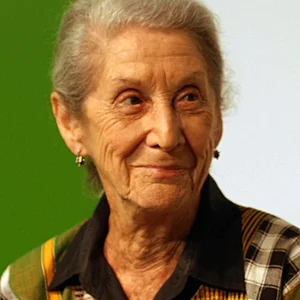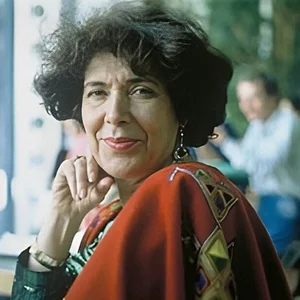

Assia Djebar, whose real name was Fatima-Zohra Imalayen, was an Algerian novelist and filmmaker who wrote in French. A pioneer of North African women's literature, she gave voice to Algerian women through a body of work blending memory, History, and feminism. In 2005, she became the first North African woman elected to the Académie française.
Assia Djebar(1936 — 2015)
Assia Djebar
France, Algérie
8 min read
Frequently asked questions
Famous Quotes
« The French language is my war booty.»
« Writing is also dying a little, and living more.»
Key Facts
- 1936: Born in Cherchell, in colonial Algeria
- 1957: Publication of her first novel La Soif, at age 21, under the pen name Assia Djebar
- 1979–1985: Directed two films about Algerian women, including La Nouba des femmes du Mont Chenoua (Critics' Prize, Venice 1979)
- 2005: First North African woman elected to the Académie française (seat 5)
- 2015: Died in Paris, leaving behind a landmark body of work on colonial and feminine memory
Works & Achievements
First novel published at age 21, under a pseudonym, while she was studying in Paris. The story of a bourgeois young Algerian woman in search of identity, it launched an exceptional literary career.
A novel that gives voice to Algerian women involved in the war of independence. It is one of the first works of fiction to portray the role of women in anti-colonial resistance.
A collection of short stories inspired by the oral testimonies of Algerian women and by Delacroix's painting. This book marks her return to literature after ten years of silence and lays the foundations of her feminism.
The first volume of the Algerian Quartet, a masterpiece that interweaves the French conquest of Algiers in 1830 with the author's autobiography. This novel established Djebar as one of the great voices of world literature.
The second volume of the Quartet, a variation on the myth of Scheherazade transposed into contemporary Algeria. It examines the sisterhood between women and the transmission of the female voice.
A documentary film awarded at the Venice Biennale, giving voice to rural Berber women. This cinematic work extends her literary project of restoring erased voices.
An autobiographical novel and literary testament, recounting her childhood and her relationship with the French language inherited from the colonizer. Djebar explores with poignant lucidity the question of fractured identity.
Anecdotes
Assia Djebar was the first Algerian woman to be admitted to the École normale supérieure de Sèvres in 1955, an exceptional achievement for a young woman from Cherchell. She studied history there, but a nationalist student strike forced her to interrupt her studies — she used the time to write her first novel, 'La Soif' (The Thirst), published in 1957.
To write 'Women of Algiers in Their Apartment' (1980), Assia Djebar spent many hours recording Algerian women recounting their daily lives, their suffering, and their hopes in Algerian Arabic and Berber dialects. She thus transformed a living oral tradition into written French literature, creating a bridge between two cultural worlds.
Assia Djebar directed two documentary films about Algeria, including 'La Nouba des femmes du Mont Chenoua' (1978), which won the International Critics' Prize at the Venice Biennale. It was the first time an Algerian female director had received such international recognition.
Elected to the Académie française in 2005, Assia Djebar became the first Maghrebi woman and the first non-European francophone writer to take a seat under the Coupole. In her acceptance speech, she paid tribute to the Algerian women whose voice she had championed throughout her life.
Assia Djebar lived for a long time between several languages: she wrote in French, sometimes thought in Algerian Arabic and Berber, and read in English. She described this situation as a 'stepmother tongue' — French inherited from colonization — which she transformed into an instrument of resistance and liberation for the women of her country.
Primary Sources
I was twenty years old, I was thirsty, thirsty for myself, thirsty for the other, thirsty for the world. And I wrote because writing was the only way to belong to myself.
A little Arab girl goes, every morning, accompanied by her father, to the French school in the village. A satchel on her back, she walks forward into the new light, while a few crouching fellahs turn to look at her.
I am the daughter of two languages and two memories. I do not choose between them: they both constitute me, in their very conflict, in their very love.
Writing in the French language means, for me, always exposing myself to a foreign light, with the risk of seeing my own shadow lengthen, distorted, on the other's ground.
I belong to the tribe of the voiceless, and yet it is my voice that resounds in this language I have made my own, that I have turned inside out like a glove.
Key Places
Assia Djebar's birthplace, an ancient Roman city on the Algerian coast. This historically layered site, at the crossroads of civilizations, deeply nourished her imagination of the in-between cultures.
A prestigious Parisian institution where Djebar became the first Algerian woman admitted in 1955. This place embodies both academic excellence and the contradiction of an Algerian woman shaped by the culture of her colonizer.
The city where she taught history at the university after independence (1962). The Algiers Casbah, with its secluded women and labyrinthine alleyways, lies at the heart of her literary and cinematic work.
A Kabyle mountain range that lends its name to her 1978 documentary film. This Berber site, rooted in historical resistance, symbolizes the memory of rural Algerian women whose voices she sought to amplify.
The university where Djebar taught Francophone literature from 2001 until her death. Her American exile allowed her to escape the violence of Algeria's Black Decade while continuing to write and teach.
The institution where she was elected in 2005 to seat no. 5. Taking her place under the Coupole represented a major symbolic recognition for a postcolonial Algerian writer working in French.
Typical Objects

Assia Djebar used a tape recorder to collect oral testimonies from Algerian women. These recordings nourished her writing and allowed her to restore the living language of ordinary women.
Before the digital era, Djebar typed her manuscripts on a typewriter. She rewrote her texts tirelessly, considering each sentence a precise architecture between two languages.
📷 Domaine public · Wikimedia Commons ↗
This traditional Algerian white veil appears often in her works as an ambivalent symbol — both a protection for women and an assignation to invisibility. It is central in 'Women of Algiers in Their Apartment'.
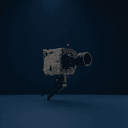
During her documentary films of the 1970s, Djebar handled the camera to give a face and a voice to rural Algerian women, extending her literary work through the image.
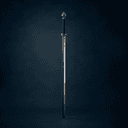
Presented at her induction into the Académie française in 2006, this engraved sword symbolizes her entry into France's most prestigious literary institution, the crowning of a lifetime of struggle through words.
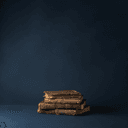
A historian by training, Djebar drew on French colonial archives to write her novels. She turned these official texts against themselves, giving voice to the Algerian voices they had erased.
School Curriculum
Vocabulary & Tags
Key Vocabulary
Daily Life
Morning
Assia Djebar rose early and devoted the first hours of the morning to writing, a time of absolute concentration before her academic obligations. She systematically reread the previous day's pages, reworking them word by word in what she called her 'struggle with the French language'.
Afternoon
Her afternoons were often occupied with university teaching — in Algiers during the 1960s, then in New York from the 2000s onward. She also received students and colleagues, or visited archives for her historical research that fed into her novels.
Evening
Evenings were devoted to reading, listening to Algerian Andalusian music, and intellectual exchanges. During her stays in Algiers, she took part in women's gatherings where she recorded oral testimonies for her future works.
Food
Her diet reflected her Mediterranean roots: couscous, tagines, sun-grown vegetables, olive oil, mint tea. In France and the United States, she adapted her habits while retaining a nostalgia for the Algerian flavors tied to childhood and family.
Clothing
Assia Djebar favored a sober and elegant style, halfway between Western modernity and certain elements of Algerian tradition. She often wore dresses or suits in warm colors — ochre, burgundy, navy blue — without a veil, asserting through her clothing her freedom as a secular and emancipated woman.
Housing
She lived in a succession of urban apartments: in Paris in the Latin Quarter, in Algiers in intellectual neighborhoods, then in New York near the university. Her living spaces were invariably overrun with books, manuscripts, and a tape recorder for her oral collection work.
Historical Timeline
Period Vocabulary
Visual Style
Un style visuel qui oscille entre la chaleur ocre de l'Algérie méditerranéenne et la rigueur froide des institutions françaises, traversé par les motifs orientalistes revisités et la lumière tamisée des intérieurs féminins.
Sound Ambience
Un univers sonore mêlant la Méditerranée algérienne, les voix féminines enregistrées et le silence studieux des bibliothèques parisiennes, reflet de la double vie culturelle d'Assia Djebar.
Liens externes & ressources
Références
Œuvres
Les Enfants du nouveau monde
1962
Les Femmes d'Alger dans leur appartement
1980
L'Amour, la fantasia
1985
Ombre sultane
1987
Nulle part dans la maison de mon père
2007