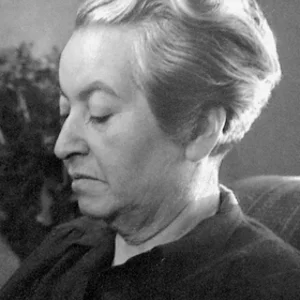

Gabriela Mistral, born Lucila Godoy Alcayaga, was a Chilean poet and diplomat. The first Latin American to receive the Nobel Prize in Literature in 1945, she devoted her work to themes of maternal love, childhood, and Latin American identity.
Gabriela Mistral(1889 — 1957)
Gabriela Mistral
Chili
7 min read
Frequently asked questions
Famous Quotes
« We are guilty of many errors and many faults, but our worst crime is abandoning the children.»
« What the soul does for the body is what the artist does for his people.»
Key Facts
- Born in 1889 in Vicuña, Chile, into a modest family; became a schoolteacher in her teenage years
- Published *Desolación* in 1922, her first major collection, marked by grief and spirituality
- Received the Nobel Prize in Literature in 1945, the first woman and first Latin American to receive this distinction
- Represented Chile as honorary consul in several countries (Spain, Portugal, Brazil, United States)
- Died in 1957 in New York; Chile declared three days of national mourning
Works & Achievements
Three sonnets inspired by the death of a childhood love. These poems earned her national recognition at the Floral Games of Santiago.
First major collection published in New York, blending romantic grief, religious faith, and love of nature and childhood. It established her reputation on an international scale.
Collection of lullabies, rounds, and poems for children, translated into many languages and considered a landmark of children's literature in Spanish.
Poetry collection marked by spirituality and grief, whose royalties were donated to orphaned children of the Spanish Civil War, reflecting her humanist commitment.
Last collection published during her lifetime, imbued with deep melancholy and an intense spiritual quest, considered one of her most accomplished works.
Long epic poem published after her death, in which she imagines a journey through Chile in the company of an indigenous child, celebrating the nature and identity of her country.
Anecdotes
Gabriela Mistral was born in 1889 in the Elqui Valley, in northern Chile, under the name Lucila Godoy Alcayaga. She adopted her pseudonym as a tribute to two poets she admired: the Italian Gabriele D'Annunzio and the Provençal Frédéric Mistral. This pen name became far more famous than her birth name.
At the age of fifteen, Gabriela Mistral began teaching in rural Chilean schools without having obtained an official diploma, as the authorities denied her access to the teacher training college on account of her ideas being deemed too unconventional. She finally obtained her teaching certificate in 1910, after a special examination, and went on to become one of the most respected educators in Latin America.
In 1922, the Mexican government invited Gabriela Mistral to take part in the reform of its educational system alongside José Vasconcelos. She traveled across the country to open rural libraries and improve access to education for indigenous populations, leaving a lasting mark on Mexican cultural policy.
In 1945, Gabriela Mistral received the Nobel Prize in Literature, becoming the first person from Latin America to receive this distinction. At the ceremony in Stockholm, she declared that she was accepting the prize on behalf of all of Latin America and especially its indigenous peoples. This worldwide recognition earned her the status of cultural ambassador for her continent.
Gabriela Mistral spent a large part of her life as honorary consul of Chile in various cities around the world (Madrid, Lisbon, Los Angeles, New York, Naples). This atypical diplomatic role allowed her to travel, write, and advocate for the rights of women and children on an international scale, while remaining deeply connected to her South American roots.
Primary Sources
Yo no tengo soledad / es mi desolación a nadie dada / y mi carne es un rosal encendido / y soy un viento que nadie ha atajado.
I am the direct representative of the poetry of Spanish America and I receive this award in my capacity as representative of the Hispanic race and the Spanish language.
Meciendo / El mar sus millares de olas, / meciendo al divino viento, / yo mező a mi niño.
La maestra es el más sagrado de los oficios humanos, porque en ella la humanidad deposita lo que tiene de más precioso: sus hijos y su futuro.
Key Places
Gabriela Mistral's birthplace, set in an arid and luminous Andean valley that deeply inspired her poetry. She is commemorated there by a museum dedicated to her memory.
It was here that she worked on the reform of the Mexican educational system from 1922 onward, opening rural libraries and collaborating with minister José Vasconcelos.
A city where she resided for several years as consul and where her adoptive son Juan Miguel tragically died in 1943, an event that inspired some of her darkest poems.
The city where she received the Nobel Prize in Literature in December 1945, becoming the first voice from Latin America to be honored with this world distinction.
She spent her final years here and died in 1957. It was also in New York that her first collection Desolación was published in 1922 by the Instituto de las Españas.
Typical Objects

Gabriela Mistral wrote her poems by hand in notebooks, often at night, after her days of teaching. The quill was for her the primary tool of her dual vocation: educator and poet.

As a schoolteacher in the rural areas of Chile, she used and designed educational materials for children in the countryside. She advocated for an education adapted to local realities.

Gabriela Mistral often wore the rebozo, a shawl typical of Latin American women, a symbol of her attachment to the indigenous popular cultures she celebrated in her writings.

As honorary consul of Chile in several countries, she traveled throughout her life with this official document, which allowed her to carry Latin American culture and literature across the world.

Deeply spiritual, Gabriela Mistral regularly read the Bible and texts of Christian mysticism. This faith nourished her poetic work, particularly the themes of death, love, and compassion.

Presented in Stockholm in December 1945, this medal represented in her eyes not personal glory, but the recognition of all Hispanic-American literature.
School Curriculum
Vocabulary & Tags
Key Vocabulary
Tags
Daily Life
Morning
Gabriela Mistral rose early, accustomed since childhood to rural rhythms. She began her day with a prayer or spiritual reading, often the Bible, before preparing her lessons or correcting her students' work in the first peaceful hours of the morning.
Afternoon
Her afternoons were devoted to teaching, writing pedagogical reports, or, later in her diplomatic career, to official correspondence and consular meetings. She also used this time to read and annotate works of philosophy or literature.
Evening
In the evenings, Gabriela Mistral wrote. It was often at night that she composed her poems, in the quiet, by the light of a lamp. She maintained an abundant correspondence with writers, politicians, and friends across the world.
Food
Her diet was simple and frugal, shaped by the modest habits of the Chilean countryside: dried vegetables, beans, corn, bread, local fruits. Throughout her life, she kept sober eating habits, indifferent to the culinary refinements of the diplomatic circles she moved in.
Clothing
Gabriela Mistral dressed in a sober and practical manner, favoring loose-fitting dresses in dark or neutral tones. She often wore a shawl or rebozo, an accessory she kept throughout her life as a symbolic link to the women of Latin America. She conspicuously avoided any sign of vanity.
Housing
She lived in modest lodgings throughout her life, even during her diplomatic years. In the consular houses where she resided — in Mexico, Brazil, Italy, or the United States — she always created a simple corner for writing and praying, surrounded by books, plants, and a few objects recalling her Chilean origins.
Historical Timeline
Period Vocabulary
Visual Style
Un style visuel ancré dans l'Amérique latine du début du XXe siècle : terres arides, portraits austères, typographie Art Déco des années 1920, mêlant la sobriété des salles de classe rurales à la solennité des cérémonies diplomatiques.
Sound Ambience
L'univers sonore de Gabriela Mistral est celui des vallées andines chiliennes : vents secs, voix d'enfants dans les écoles rurales, cloches d'église et murmures de la nature austère qui nourrit sa poésie.
Liens externes & ressources
Références
Œuvres
Sonetos de la muerte
1914
Desolación
1922
Poema de Chile
1967 (posthume)