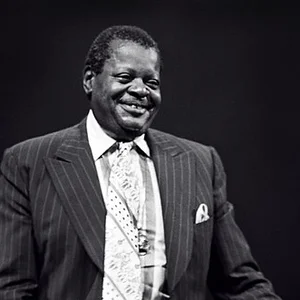

Canadian jazz pianist and composer (1925-2007), regarded as one of the greatest virtuosos of jazz piano. Renowned for his dazzling technique, his swing, and his feel for the blues, he recorded more than 200 albums.
Oscar Peterson(1925 — 2007)
Oscar Peterson
Canada
5 min read
Frequently asked questions
Famous Quotes
« It's the group sound that's important, even when you're playing a solo.»
Key Facts
- Born on August 15, 1925, in Montreal (Quebec, Canada) into a family of West Indian origin
- Discovered by impresario Norman Granz, he caused a sensation at Carnegie Hall in 1949
- In the 1950s he formed a celebrated trio with guitarist Herb Ellis and double bassist Ray Brown
- Composed the 'Canadiana Suite' in 1964, a tribute to his native country
- Died on December 23, 2007, in Mississauga (Ontario), showered with awards and honorary doctorates
Works & Achievements
A composition that became an anthem of the American civil rights movement; its solemn melody made a lasting impression far beyond the world of jazz.
A suite in several movements evoking a journey from east to west across Canada; it was nominated for a Grammy Award.
One of his trio's most popular albums, blending standards and blues in an elegant swing.
A trio album (with Ed Thigpen on drums) featuring the famous “You Look Good to Me.”
A series of recordings made in Germany for the MPS label, renowned for their warm, intimate sound.
An autobiography in which he retraces his journey, from Montreal to stages around the world.
Anecdotes
When Oscar was seven, tuberculosis forced him to spend long months in the hospital. Too weak to blow into his trumpet, he turned for good to the piano — the instrument that would make his fame.
As a teenager, Oscar heard a record by pianist Art Tatum for the first time, played for him by his father. Tatum's dizzying playing impressed him so much that he thought himself incapable of matching it and, discouraged, did not dare touch the piano for weeks.
In 1949, American producer Norman Granz heard Peterson on the radio from a taxi in Montreal. Astonished, he had himself driven to the musician, then invited him to play at Carnegie Hall in New York: that concert launched his international career.
The great Duke Ellington so admired his technique that he nicknamed him “the Maharaja of the keyboard.” Peterson could string together cascades of notes at a breathtaking speed while keeping an irresistible swing.
In 1962, Peterson composed “Hymn to Freedom.” Having become a rallying song of the American civil rights movement, the melody echoed through marches and churches, alongside the struggle of Martin Luther King.
Primary Sources
the Maharaja of the keyboard
It's the group sound that's important, even when you're playing a solo.
In it, Peterson recounts his childhood in Little Burgundy and the decisive influence of his father, a railway sleeping-car porter and self-taught musician, who required his children to practice the piano every day.
Key Places
A working-class neighborhood and the heart of Montreal's Black community, where Oscar Peterson was born in 1925.
It was on this prestigious stage that he made a resounding debut in 1949 with Jazz at the Philharmonic, launching his international career.
Peterson served as its chancellor from 1991 to 1994, a mark of the institutional recognition of his cultural contribution.
Here, for the MPS label, he made the famous series of intimate recordings “Exclusively for My Friends” in the 1960s.
A suburb of Toronto where the pianist spent his final years and died in 2007.
Typical Objects

Peterson was especially fond of Bösendorfer and Steinway concert pianos, whose powerful keyboard suited his playing of exceptional velocity.

The highest honor in the American music industry: Peterson won eight of them, plus a lifetime achievement award.

Promoted to Companion in 1984, he received his country's highest civilian honor for his contribution to music.

The medium for the more than 200 albums Peterson recorded; vinyl carried his playing to every continent.

Sheets of music on which he wrote down his compositions, such as the “Canadiana Suite” or “Hymn to Freedom”.

An elegant evening outfit worn during concerts, in keeping with the polished look of jazz musicians in the great concert halls.
School Curriculum
Vocabulary & Tags
Key Vocabulary
Daily Life
Morning
On tour as if at home, Peterson often began his day with long hours of scales and exercises at the piano, true to his rigorous classical training. This discipline of technical practice remained a lifelong habit.
Afternoon
Afternoons were devoted to rehearsals with his trio, sound checks in the venues, and the many journeys between one concert city and the next.
Evening
Evening brought the time for concerts, in jazz clubs or great concert halls. The nights sometimes stretched on with impromptu “jam sessions” late into the night with other musicians.
Food
The life of a touring artist meant hotel and restaurant meals as the tours unfolded. A man of imposing stature, Peterson enjoyed good food.
Clothing
On stage, he wore the elegant dark suit or the tuxedo customary among the jazzmen of his era. His thick-framed glasses were also part of his familiar silhouette.
Housing
Born in a modest home in Montreal's Little Burgundy neighborhood, he later settled in the Toronto area, in Mississauga, where he lived out his final years.