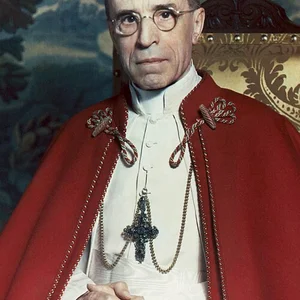

260th pope of the Catholic Church (1939–1958), Pius XII led the Church through the Second World War and the Cold War. His attitude toward the Holocaust remains controversial to this day.
Pius XII(1876 — 1958)
Pius XII
Italie, royaume d'Italie
8 min read
Frequently asked questions
Famous Quotes
« Peace is the work of justice.»
« Nothing is lost with peace. Everything can be lost with war.»
Key Facts
- 1939: elected pope under the name Pius XII, a few months before the outbreak of the Second World War
- 1943: absence of an explicit public condemnation of the Holocaust, a source of persistent historical controversy
- 1948: condemnation of communism and excommunication of Catholics who joined the Communist Party
- 1950: proclamation of the dogma of the Assumption of the Virgin Mary
- 1958: death at Castel Gandolfo, leaving a deeply disputed legacy
Works & Achievements
The first encyclical of his pontificate, condemning totalitarianism and the abandonment of Christian values without directly naming Nazism. It laid the moral foundations for his pastoral action during wartime.
A landmark text for the Catholic biblical renewal, encouraging scholars to draw on the original languages and modern historical methods. It paved the way for the reforms that flourished at the Second Vatican Council.
A development of the doctrine of the Church as the Mystical Body of Christ, this encyclical deepened ecclesiological theology and remains a major reference in twentieth-century Catholic thought.
The solemn proclamation of the dogma of the Assumption of the Virgin Mary, and the only exercise of pontifical infallibility *ex cathedra* in recent history. This act represented the high point of Pius XII's Marian devotion.
A warning against modernist theological tendencies, this encyclical reflects Pius XII's concern to preserve Catholic orthodoxy in the face of new philosophies and existentialism.
Anecdotes
Before becoming pope, Eugenio Pacelli had personally negotiated the Reichskonkordat of 1933 as Vatican Secretary of State, a treaty between the Holy See and Nazi Germany guaranteeing the rights of the Catholic Church in Germany. This agreement was criticized by some historians for lending international legitimacy to Hitler's regime, even though Pacelli hoped it would provide protection for German Catholics.
On October 16, 1943, the SS arrested more than 1,200 Jews in Rome, just a few kilometers from the Vatican. Pius XII issued no official public protest, although Roman monasteries and convents had hidden thousands of Jews during the Nazi occupation. This silence remains one of the most debated topics in contemporary historiography.
Pius XII used Vatican Radio as a diplomatic and pastoral tool throughout the Second World War. His Christmas address of 1942 referred to the victims of racial persecution without explicitly naming the Jews or the Nazis — a deliberate choice of words that disappointed the Allies and fueled decades of controversy about his true intentions.
In 1950, Pius XII solemnly proclaimed the dogma of the Assumption of the Virgin Mary, declaring that Mary had been taken up body and soul into heaven. This was the first — and so far only — exercise of papal infallibility since the proclamation of the Immaculate Conception in 1854, marking the pinnacle of his Marian devotion.
In March 2020, Pope Francis opened the Vatican's secret archives relating to the pontificate of Pius XII, allowing historians to consult millions of documents. Far from closing the debate, these archives revealed the complexity of the dilemmas Pius XII faced, without providing a definitive answer about his deepest motivations in the face of the Holocaust.
Primary Sources
Those who exercise political authority must recognize that such authority is not absolute and unlimited; it is subject to the natural and divine law that precedes it and to which it must conform.
We wish to express a word of sympathy and comfort to the hundreds of thousands of people who, through no personal fault of their own, sometimes solely on account of their nationality or their membership in a particular group, are condemned to death or to a slow decline.
We leave it to local pastors to judge whether and to what degree the danger of reprisals and other circumstances arising from the length and psychology of the war counsel restraint — despite the reasons that argue in favor of speaking out openly.
We proclaim, declare, and define as a divinely revealed dogma that the Immaculate Mother of God, the ever-Virgin Mary, having completed the course of her earthly life, was assumed body and soul into heavenly glory.
Certain thinkers depart from the truths defined by the Church and, through ambiguous expressions and rash assertions, threaten to undermine the very foundations of the Catholic faith.
Key Places
The official residence and seat of papal power where Pius XII governed the Church for twenty years. He refused to leave the Vatican throughout the German occupation of Rome, making his presence a symbol of moral resistance.
The papal summer residence in the Castelli Romani, on the shores of Lake Albano. Pius XII stayed there regularly and died there on October 9, 1958; the estate served as a refuge for many refugees during the war.
The German capital where Pacelli served as apostolic nuncio in the 1920s, developing an intimate knowledge of German politics and culture that profoundly shaped his papal decisions.
The heart of papal ceremonies where Pius XII officiated for two decades. It was from its balcony that he addressed the Roman crowds on June 4, 1944, following the liberation of Rome by Allied forces.
Typical Objects

A triple-crowned headdress worn during solemn ceremonies, symbolizing the spiritual and temporal authority of the sovereign pontiff. Pius XII wore it at his coronation and during major liturgies, embodying the majesty of the pontifical office.

A ring bearing an image of Saint Peter fishing, used to authenticate the pope's official documents. Struck with a hammer upon the pontiff's death to prevent forgery, it is recast anew for each incoming pope.

Pius XII was one of the first popes to make extensive use of Vatican Radio, addressing Catholics around the world in several languages. His radio broadcasts were eagerly awaited, especially during the Second World War.

A liturgical prayer book that Pius XII recited conscientiously every day. A man of deep piety, he devoted several hours each day to prayer and spiritual meditation.

The distinctive garment of the sovereign pontiff since Pius V. Pius XII, of an ascetic slenderness, wore this cassock with the white mozzetta and a gold pectoral cross, lending his silhouette an almost mystical quality.

Confidential correspondence exchanged between the Vatican and its nuncios around the world. Pius XII reviewed them each morning; they formed the lifeblood of papal intelligence in a Europe torn apart by war.
School Curriculum
Vocabulary & Tags
Key Vocabulary
Daily Life
Morning
Pius XII rose before dawn and devoted several hours to personal prayer and the recitation of the Divine Office. He celebrated Mass in his private chapel, alone or with a small circle, before receiving his first collaborators and reviewing the diplomatic dispatches that had arrived overnight.
Afternoon
The afternoon was dedicated to official audiences — cardinals, ambassadors, bishops from around the world, and sometimes ordinary faithful — as well as working meetings with the Secretariat of State. A demanding writer, he personally drafted much of his encyclicals and speeches in several languages.
Evening
In the evening, Pius XII retired to his apartments to read, study, and pray. Ascetic in his habits, he slept little and ate sparingly, devoting part of his nights to theological reflection and correspondence with nuncios and bishops around the world.
Food
Pius XII's diet was frugal and almost spartan. He was content with simple, light meals, refusing the lavishness of the pontifical table. His legendary thinness was the visible reflection of his austere habits and ascetic way of life.
Clothing
The pope wore the white cassock characteristic of the sovereign pontiff, together with the white mozzetta and a gold pectoral cross. For major ceremonies, he donned the full pontifical liturgical vestments, including the tiara, gloves, and a gold-embroidered cope.
Housing
Pius XII resided in the pontifical apartments of the Apostolic Palace in Vatican City, overlooking St. Peter's Square. Spacious yet soberly furnished in keeping with his austere tastes, these apartments included his personal library, his private chapel, and his study, where he often worked alone late into the night.
Historical Timeline
Period Vocabulary
Visual Style
Un style visuel austère en noir et blanc, à mi-chemin entre la photographie diplomatique officielle et le néoréalisme italien, soulignant la tension entre la splendeur pontificale et la tragédie de l'Europe en guerre.
Sound Ambience
Un paysage sonore solennel mêlant le chant grégorien des basiliques romaines, les grésillements de la radio vaticane diffusant la voix du pape à travers une Europe en guerre, et le silence pesant d'un monde confronté à la tragédie.