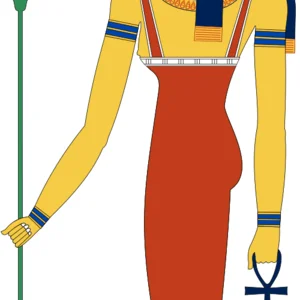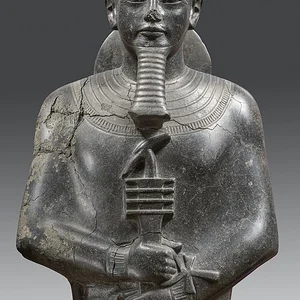

Ptah is one of the oldest and most important gods of ancient Egypt, a creator god and patron of craftsmen and architects. Venerated at Memphis since the Old Kingdom, he embodies creation through thought and speech. His triad with Sekhmet and Nefertum forms the heart of the Memphite cult.
Ptah
Ptah
10 min read
Frequently asked questions
Key Facts
- Venerated at Memphis since the Old Kingdom (c. 2700 BCE), one of the oldest Egyptian deities
- Creator god through the 'Word': he creates the world through thought and speech, a concept that anticipates later philosophical traditions
- Patron of the Hemu-netjer (craftsmen), sculptors, and architects; protector of human works
- His living incarnation is the Apis bull, venerated at Memphis and buried in the Serapeum of Saqqara
- His main temple, 'Hut-ka-Ptah' (House of the Soul of Ptah), is thought to have given rise to the word 'Aiguptos', the origin of the name 'Egypt'
Works & Achievements
A foundational cosmogonic text describing how Ptah created the world through the thought of his heart and the speech of his tongue. Preserved in the British Museum, it represents one of the oldest known philosophical traditions in the world.
One of the largest cult complexes in ancient Egypt, whose name may have given Egypt its name altogether. Largely destroyed today, it is attested by foundations, colossal statues of Ramesses II, and the descriptions of Herodotus.
An underground necropolis for the Apis bulls cut into the rock at Saqqara, a direct funerary extension of the cult of Ptah. Rediscovered by Auguste Mariette in 1851, it contained granite sarcophagi weighing up to 70 tonnes.
A body of liturgical texts sung or recited during Memphite rituals, preserved on papyri and in temple inscriptions. These hymns celebrate Ptah as universal creator, lord of time, and protector of craftsmen.
Thousands of funerary statuettes depicting the trinity Ptah-Sokar-Osiris, placed in tombs to ensure the rebirth of the deceased. Their large-scale production at Memphis stands as a testament to the god's universal popularity.
A chapel built by Thutmose III within the precinct of the Temple of Amun at Karnak, reflecting Ptah's national influence beyond Memphis. Remarkably well preserved, it remains visible today with its original statues intact.
Anecdotes
The word 'Egypt' itself may derive from the name of Ptah's great temple in Memphis: Hwt-Ka-Ptah, meaning 'the dwelling of the ka of Ptah.' The Greeks gradually transformed this name into 'Aigyptos,' which the Latins rendered as 'Aegyptus.' An entire country may thus owe its name to a sanctuary dedicated to this creator god.
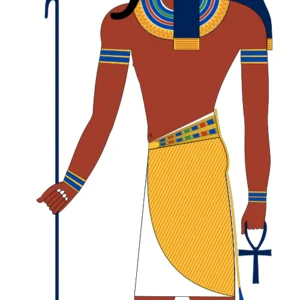
Unlike most Egyptian gods depicted in motion or in animal form, Ptah is always shown standing upright, wrapped tightly in a shroud like a mummy, his shaved head covered by a blue skullcap. Only his hands emerge from the wrappings, holding a composite scepter that combines the djed pillar, the was scepter, and the ankh — symbols of stability, power, and life united in a single object.
The Memphite Theology, engraved on the Shabaka Stone around 710 BCE from a much older text, presents a cosmogony of striking modernity: Ptah is said to have created the world through thought (his heart) and speech (his tongue). Greek philosophers, and later the authors of the prologue to the Gospel of John, would develop similar ideas centuries later with the concept of the Logos.
Imhotep, the architectural genius who built the first step pyramid for Pharaoh Djoser around 2650 BCE, was considered the son of Ptah. After his death, he was deified and venerated as the god of medicine and wisdom — the Egyptians' way of honoring one of history's greatest craftsmen by connecting him directly to their divine patron.
In Memphis, priests kept a living bull named Apis within the precinct of Ptah's temple, regarded as the earthly manifestation of the god. This sacred bull was chosen according to strict criteria — specific markings on its coat — then housed in a palace and tended by dedicated priests. Upon its death, it was mummified and buried in the Serapeum of Saqqara with full royal honors.
Primary Sources
Ptah the Great is the heart and tongue of the gods. […] He it is who made the gods come into being, who created the cities, who founded the nomes, who set the gods in their sanctuaries. […] Thus all things were created: divine speech and every work of the hands.
O Atum-Khepri, you rose up as a hill, you shone forth as the Aten. Ptah-Tatenen raised you above the gods. […] You spat out Shu, you expelled Tefnut.
Hail to you, Ptah-Tatenen, great god whose form is hidden! You are the lord of years, the master of eternity. The gods issue from your mouth, humankind comes forth from your eyes.
My father Ptah has granted me victory; he has laid all foreign lands beneath my feet. I have come forth from you, O master of craftsmen, and my monument shall endure as long as the sky.
At Memphis, the Egyptians have a magnificent temple dedicated to Hephaestus [Ptah]. Before this temple stands the statue of this god rendered in a strange form, resembling the Pataici that the Phoenicians place on the prows of their triremes.
Key Places
The religious capital of ancient Egypt and home to the great temple of Ptah, whose name 'Hwt-Ka-Ptah' most likely gave Egypt its name. A site of pharaonic coronations and the center of the Apis bull cult, it was one of the most visited sanctuaries in the ancient world.
The royal necropolis of Memphis where mummified Apis bulls were interred in massive granite sarcophagi. This rock-cut pilgrimage site directly linked the living cult of Ptah to its funerary and regenerative dimensions.
The village of the craftsmen responsible for carving and decorating the royal tombs in the Valley of the Kings. Ptah was their most venerated patron deity, and many chapels, stelae, and votive offerings were dedicated to him by workers who placed themselves under his daily protection.
Within the great temple of Ramesses II, a small side chapel is dedicated entirely to Ptah. At the equinoxes, sunlight penetrates deep into the sanctuary and illuminates the statue of Ptah — a symbol of luminous creation at the heart of darkness.
A chapel dedicated to Ptah within the great temple complex of Amun at Karnak, testifying to his national influence beyond Memphis. It still preserves several statues of Ptah and his consort Sekhmet in remarkably good condition.
Typical Objects

Ptah holds a unique scepter combining three symbols: the djed pillar (stability), the was scepter (divine power), and the ankh (life). This attribute embodies his three essential functions as creator, sovereign, and giver of life.

Ptah wears a close-fitting headdress in lapis lazuli blue, the color of the night sky and primordial creation. It visually sets him apart from all other Egyptian gods and symbolizes his connection to the cosmos.

Ptah's body is wrapped entirely in a pristine white shroud like a mummy, his feet together and arms held straight at his sides. This form evokes mummification, concentrated power, and the potential of creation held in readiness to be released.

The Apis was the sacred bull living in the temple of Memphis, identifiable by specific markings, and regarded as the earthly manifestation of Ptah. Upon its death, it was solemnly mummified and buried in the Serapeum at Saqqara.

A broad pectoral collar of gold and precious stones (lapis lazuli, carnelian, turquoise) worn by Ptah in his official representations. It symbolizes divine wealth and radiance, and was reproduced in craftsmen's workshops as a votive offering.

Ptah is always depicted standing on a pedestal painted green (the color of regeneration), sometimes inscribed with protective formulas. This base, present in all his statuettes, represents the stable foundation upon which creation rests.

Craftsmen, sculptors, and architects would place small statuettes of Ptah in their workshops and on building sites to ensure his protection. These ex-votos, made of blue faience or painted wood, have been found in large numbers at Deir el-Medina.
School Curriculum
Vocabulary & Tags
Key Vocabulary
Tags
Daily Life
Morning
At sunrise, the priests of Ptah solemnly opened the doors of the naos — the sacred chamber housing the divine statue — while reciting awakening prayers. They ritually washed the statue, dressed it in fresh linen, and presented offerings of bread, beer, roasted meats, and incense, performing the god's daily 'awakening' according to an unchanging protocol passed down from generation to generation.
Afternoon
The middle of the day was devoted to the activities of the royal workshops under Ptah's patronage: sculptors, foundry workers, carpenters, and jewelers worked in the temple annexes, crafting pieces destined for sanctuaries and royal tombs. Communal prayers punctuated the manual work, with each artisan invoking Ptah to guide his hand and sharpen his eye for measurement and proportion.
Evening
At sunset, a second 'closing' ceremony symbolically sealed the naos: the priest erased his own footprints in the sacred sand as he backed away, then locked the doors and applied clay seals. Throughout the city of Memphis, artisan families lit small oil lamps before their household statuettes of Ptah, giving thanks for the day's work.
Food
The food offerings presented to Ptah included ritual-shaped breads (among them the conical loaf known as 'Ptah's bread'), barley beer, roasted geese, dried Nile fish, figs, dates, and pomegranates. After the ceremony, these offerings were returned as food through the 'reversion of offerings' to the priests and temple workers, forming a significant part of their daily sustenance.
Clothing
The cult statue of Ptah was dressed each morning in a shroud of immaculate white linen, a symbol of creative purity. His high priests wore white linen robes with a single shoulder strap (a long shendyt kilt), a leopard skin for major ceremonies, and a distinctive cylindrical headdress. The artisans who worshipped him wore the simple linen work loincloth (short shendyt), but changed into clean clothing for prayers.
Housing
Ptah's sacred precinct in Memphis (Hwt-Ka-Ptah) was a vast enclosure of mud brick surrounded by a colossal enclosure wall, housing the main temple, storehouses, workshops, the stables of the Apis bull, sacred pools, and the priests' quarters. The divine statue occupied the innermost and darkest chamber of the sanctuary, a space regarded as the very womb of the world — the meeting point between the visible and the invisible.
Historical Timeline
Period Vocabulary
Visual Style
Représentation canonique égyptienne : Ptah momiforme en bleu lapis-lazuli ou noir profond, sur fond de pierre ocre et de hiéroglyphes dorés, dans le style plat et frontal des reliefs du Nouvel Empire.
Sound Ambience
Ambiance sonore du temple de Ptah à Memphis à l'aube : prières graves des prêtres, ciseaux sur la pierre, sistre rythmique et souffle chaud du désert portant l'écho du Nil.
Liens externes & ressources
Références
Œuvres
La Théologie Memphite (Cosmogonie de Ptah)
v. 2700 av. J.-C. (gravée sur la Pierre de Shabaka vers 710 av. J.-C.)
Grand temple de Ptah à Memphis (Hwt-Ka-Ptah)
v. 3100 av. J.-C. — agrandi jusqu'au Ier s. av. J.-C.
Sérapéum de Saqqarah
v. 1400 av. J.-C. — IVe s. ap. J.-C.
Hymnes à Ptah (corpus liturgique)
Nouvel Empire, v. 1550–1069 av. J.-C.
Statuaire de Ptah-Sokar-Osiris
Moyen Empire — époque ptolémaïque (v. 2000–30 av. J.-C.)
Chapelle de Ptah à Karnak (Thoutmosis III)
v. 1450 av. J.-C.