
Last emperor of the Western Roman Empire, Romulus Augustulus reigned in 475–476 AD, placed on the throne by his father Orestes. Deposed at around age 15 by the Germanic chieftain Odoacer, his abdication marks the conventional end of the Western Roman Empire.
Romulus Augustulus(462 — ?)
Romulus Augustulus
Empire romain d'Occident
8 min read
Frequently asked questions
Key Facts
- Proclaimed Emperor of the West on October 31, 475 by his father Orestes, a general of the Roman army
- His nickname 'Augustulus' ('little Augustus') underscores the irony of his role as a mere figurehead
- Deposed on September 4, 476 by Odoacer, chieftain of the Heruli, who refused to name a successor
- Exiled to Campania (Castellum Lucullanum) rather than executed, and even granted a pension
- 476 is recognized by historians as the symbolic date for the fall of the Western Roman Empire
Works & Achievements
A landmark act in world history: by handing over his insignia to Odoacer, Romulus Augustulus symbolically brought the Western Roman Empire to an end. This event is recognized by historians as the closing of Antiquity and the opening of the Middle Ages.
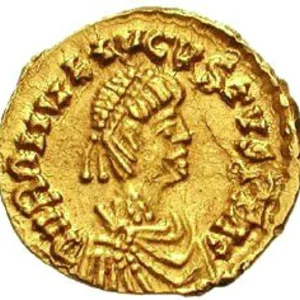
Rare solidi and siliquae struck during his ten-month reign, now held in several European museums. They are the only direct material evidence of this fleeting reign, and are prized by scholars of late Roman numismatics.
Cassiodorus, secretary to Theodoric, mentions in his official correspondence a 'Romulus' at the Castellum Lucullanum receiving a pension. These texts prove that the former emperor survived at least thirty years after his deposition — a fact that is often overlooked.
Anecdotes
Romulus Augustulus bears, with a tragic irony of History, the names of both the legendary founder of Rome (Romulus) and its first emperor (Augustus). The last ruler of a thousand-year empire, he embodies in a single person the alpha and omega of Roman civilization — from its founding myth to its final fall.
His father Orestes had been the personal secretary of Attila, the fearsome Hunnic warlord. After the death of the 'Scourge of God', he changed sides, entered Roman service, rose through the ranks to become a general, then overthrew Emperor Julius Nepos to place his own 14-year-old son on the throne.
When the Germanic chieftain Odoacer deposed Romulus in September 476, he was struck by the boy emperor's youth. Rather than execute him, he spared his life and sent him into comfortable exile at the Castellum Lucullanum, a magnificent fortress overlooking the Bay of Naples, with an annual pension of 6,000 gold solidi.
The reign of Romulus Augustulus lasted only ten months, from October 475 to September 476. It was so brief and his authority so hollow — his father Orestes held the real power — that Constantinople refused to recognize him officially. Technically, Julius Nepos, in exile in Dalmatia, remained the only legitimate emperor in the eyes of the East.
Odoacer sent back to Constantinople the imperial insignia of the West — the diadem, the purple cloak — declaring that the Empire no longer needed two emperors. This symbolic gesture officially sealed the end of the Western Roman Empire, the date historians use to mark the close of Antiquity.
Primary Sources
Odoacer rex Gothorum Romam obtinuit. Orestem vero Placentiae interfecit. Romulum autem, cui a parvitate Augustulus inditum est cognomentum, regno privatum in Lucullano Campaniae castello exsilii poena damnavit.
A letter attesting that a certain Romulus was still residing at the Castellum Lucullanum around 507–511, receiving a pension from the Ostrogothic kings who succeeded Odoacer — proof that the former emperor survived for several decades.
The Romans had been accustomed to electing a king from among the barbarian nations present in Italy, and handing him all the imperial insignia that the western emperor had customarily worn.
Romulum, qui et Augustulus dictus est, regno privavit et Lucullanum Campaniae castrum exilio deportavit.
Key Places
Capital of the Western Roman Empire since 402, Ravenna was the seat of Romulus Augustulus's reign and the site of his forced abdication on September 4, 476. Protected by its surrounding marshes, the city was chosen for how easily it could be defended against invasion.
A fortress built on the ruins of Lucullus's villa overlooking the Bay of Naples, this was the gilded place of exile where Romulus was sent after his deposition. He lived there for many years, still receiving a pension under the Ostrogothic rule of Theodoric.
The symbolic birthplace of the Empire, Rome had not been the political capital for a century, yet it remained the spiritual heart of the Roman world. Its repeated sackings in the 5th century had foreshadowed the final collapse, of which Romulus Augustulus was the last crowned witness.
Capital of the Eastern Roman Empire, Constantinople refused to recognize Romulus Augustulus as a legitimate emperor. It was to its ruler Zeno that Odoacer sent the imperial regalia in 476, asking to be recognized as administrator of Italy.
A city in the Po Valley where Orestes, father of Romulus Augustulus, was captured and executed by Odoacer's troops in August 476. His death left Romulus without his only protector and hastened the abdication just a few weeks later.
Typical Objects

A band of gold and precious stones symbolizing supreme power, worn by Romulus at his proclamation in Ravenna. Its surrender to Odoacer and subsequent dispatch to Constantinople symbolically sealed the end of the Western Roman Empire.

The imperial military standard bearing the Christian Chi-Rho monogram, inherited from Constantine. A symbol of Roman army command, it embodied an authority that Romulus Augustulus, a child-king, was never truly able to exercise.

A cloak of Tyrian purple reserved for Roman emperors, the quintessential symbol of Augustan rank. Returned along with the other imperial insignia to Odoacer in 476, it represented the imperial dignity that Romulus was forced to relinquish at the age of fifteen.

An emblem of imperial command adorned with an eagle, Rome's emblematic bird. Listed among the regalia sent to Constantinople by Odoacer, its absence from Italy signified that there was no longer an emperor in the West.

A gold coin minted during his ten-month reign, bearing his portrait. These rare coins are today the direct archaeological evidence of his fleeting rule, highly sought after by numismatists and museums alike.

A compilation of imperial laws codified in 438 under Theodosius II, which remained the law of the land under Romulus Augustulus. This body of Roman law survived the fall of the Empire and directly influenced the barbarian law codes of the successor kingdoms.
School Curriculum
Vocabulary & Tags
Key Vocabulary
Tags
Daily Life
Morning
Romulus Augustulus began his day with Christian religious rites — the Empire having officially adopted Christianity since Constantine. A fifteen-year-old boy-king, he was dressed by cubicularii (chamberlains) in the imperial palace at Ravenna, adorned with the heavy ceremonial purple robes and golden diadem.
Afternoon
His afternoons were filled with formal audiences orchestrated entirely by his father Orestes, with Romulus playing a purely figurehead role. He received senators, ambassadors, and generals, reciting learned ceremonial phrases while Orestes made the real political decisions behind the scenes.
Evening
Evenings at the late imperial court blended formal banquets with high dignitaries, readings from classical or religious texts, and perhaps equestrian exercises suited to his young age. The fragility of his position stood in stark contrast to the pomp of performances designed to mask the empire's imminent collapse.
Food
The imperial table of the fifth century combined Roman culinary traditions — garum, legumes, white bread, Italian wines — with the Germanic influences of the foederati. Roasted meats, Adriatic fish, fruits, cheeses, and spiced mulled wines made up the formal meals, served on silver tableware.
Clothing
Romulus wore the trabea — the purple cloak reserved for emperors — and a diadem set with gemstones and pearls. His gold-embroidered silk garments reflected the Byzantine splendor adopted by the Ravennate court. In exile at the Castellum Lucullanum, he would have worn simpler clothes, reflecting his fallen status.
Housing
The imperial palace at Ravenna — of which remains still survive — was a monumental residence adorned with mosaics and marble, heated by hypocaust, and surrounded by gardens. After his deposition, the Castellum Lucullanum — the former villa of Lucullus converted into a fortress on a Neapolitan promontory — became his gilded place of exile.
Historical Timeline
Period Vocabulary
Visual Style
Style paléochrétien et byzantin de Ravenne : mosaïques dorées, portraits frontaux hiératiques, pourpre impériale — la splendeur figée d'un jeune visage grave sous le diadème, crépuscule d'un empire millénaire.
Sound Ambience
L'ambiance sonore de la cour impériale de Ravenne en déclin : latin tardif mêlé d'accents germaniques, armures des gardes fédérés, chants liturgiques et rumeur sourde d'une capitale qui sent son monde s'effondrer.
Liens externes & ressources
Références
Œuvres
Abdication et remise des insignes impériaux
4 septembre 476
Monnaies à l'effigie de Romulus Augustule
475-476
Lettres de Cassiodore attestant sa survie (Variae)
vers 507-511