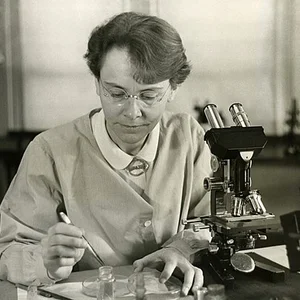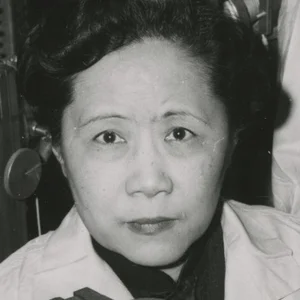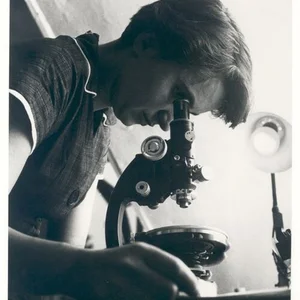

British molecular biologist (1920–1958), Rosalind Franklin made essential contributions to our understanding of DNA structure through her X-ray crystallography work. She is best known for Photo 51, a landmark image that revealed the double helix structure of DNA.
Frequently asked questions
Key Facts
- 1941–1947: Advanced studies in physical chemistry and research in coal crystallography
- 1951–1952: Production of the famous Photo 51, showing the structure of DNA by X-ray diffraction at King's College London
- 1953: Her critical data contributed to Watson, Crick, and Wilkins's elucidation of the double helix structure of DNA
- 1955: Pioneering work on the structure of viruses and RNA
- 1958: Death at age 37 from cancer, before official recognition of her foundational role
Works & Achievements
An X-ray diffraction image revealing the double helix structure of DNA. This crucial photograph provided visual proof of DNA's molecular geometry and was instrumental in the model proposed by Watson, Crick, and Wilkins.
A series of experiments using X-ray crystallography to analyze the structure of deoxyribonucleic acid. This work revealed the dimensions and configuration of the DNA molecule with unprecedented precision.
Crystallographic studies of the structure of the tobacco mosaic virus. Franklin determined that this virus had a helical structure, contributing to the understanding of viral architecture.
Franklin published several major scientific papers detailing her discoveries on the structures of DNA and proteins. These publications laid the scientific foundations for future generations of molecular biologists.
Franklin refined and applied X-ray crystallography methods to the study of biological molecules. Her technical innovations enabled a resolution of complex molecular structures that had never before been achieved.
Anecdotes
Rosalind Franklin captured the famous 'Photo 51' in 1952, an X-ray diffraction image that clearly revealed the double helix structure of DNA. The photograph was so sharp and detailed that Watson and Crick used it as key evidence for their DNA model, even though Franklin was not initially credited for this decisive contribution.
At the age of 31, Rosalind Franklin was diagnosed with cancer in 1956, most likely caused by her prolonged exposure to X-rays during her scientific experiments. She continued working on her research despite her illness and died on April 16, 1958 — four years before Watson, Crick, and Wilkins received the Nobel Prize for their work on DNA.
Franklin was known as an independent woman with a deep passion for research: she was fluent in several languages (French, German, and Hebrew) and had to leave France in 1940 to escape the Nazi occupation before continuing her scientific studies in Britain. Her determined yet sometimes reserved personality earned her a reputation as a scientist who held herself and her colleagues to exacting standards.
Although her crucial role in discovering the structure of DNA was long overlooked, Rosalind Franklin also conducted pioneering research into the structure of viruses and RNA. Her early work on the chemistry of coal contributed to the British war effort during the Second World War.
The laboratory where Franklin carried out her DNA experiments was located at King's College London, a prestigious scientific environment where she nonetheless had to contend with prejudice as a woman in science. Despite these obstacles, her experimental data was so precise and rigorous that it revolutionized molecular biology for generations to come.
Primary Sources
The X-ray diffraction patterns of sodium thymonucleate fibres have been studied quantitatively, and the results suggest a possible structure for this important protein complex. The very regular structure and the uniformity of the pattern suggest a regular, ordered arrangement of the atoms in the fibre.
Evidence has been presented for a helical structure of the deoxyribonucleic acid molecule based on X-ray diffraction data. The angle of the helix and the number of residues per turn have been determined from the observed diffraction patterns.
I have obtained very good X-ray diffraction photographs showing a highly regular structure. The crystallographic data strongly suggest a helical configuration of the DNA molecule.
The structure of deoxyribonucleic acid displays remarkable characteristics that can only be explained by a regular, ordered arrangement of its constituent molecules.
Key Places
Rosalind Franklin's birthplace in 1920. She grew up in a prosperous Jewish family and received an excellent education before going on to pursue her university studies.
The institution where Rosalind Franklin conducted her X-ray crystallography research between 1951 and 1953. It was here that she produced the famous Photo 51, a crucial piece of evidence for the double helix structure of DNA.
The institution where Franklin worked from 1953 to 1958 on viruses and nucleic acids. There she continued her groundbreaking crystallography research with greater scientific freedom.
Where Rosalind Franklin completed a formative fellowship in 1947–1948 at the Laboratoire Central de Chimie Physique. She refined her X-ray crystallography techniques during her time there.
The prestigious institution where Franklin's discoveries about DNA were recognised and built upon. Watson, Crick, and Wilkins — who went on to receive the Nobel Prize — worked nearby at Cambridge.
Typical Objects

Scientific instrument used by Rosalind Franklin to analyze the crystalline structure of biological molecules. This device was essential to her groundbreaking research in X-ray crystallography.

Iconic X-ray diffraction image revealing the double helix structure of DNA. This photograph, taken by Franklin in 1952, became one of the most important scientific images of the 20th century.

Carefully prepared biological samples that Franklin crystallized for her experiments. These microscopic crystals were processed and oriented in advance to produce usable diffraction patterns.

Scientific observation instrument representative of cutting-edge technology in the mid-20th century. This equipment allowed researchers like Franklin to explore molecular structures at an unprecedented scale.

Personal document in which Franklin recorded her observations, calculations, and experimental results. These notebooks formed the written record of her rigorous work in crystallography.

Educational and research tool used by 20th-century scientists to visualize molecular structures in three dimensions. Franklin used these models to interpret her crystallography results.

Medium used to capture X-ray diffraction images during experiments. These specialized plates were essential to documenting Franklin's discoveries.

Standard work attire for researchers in the mid-20th century, symbolizing the professional setting in which Franklin conducted her groundbreaking scientific experiments.
School Curriculum
Vocabulary & Tags
Key Vocabulary
Tags
Mouvement
Daily Life
Morning
Rosalind Franklin rises early, around 7 a.m., in her London apartment. She has a light breakfast before getting ready to head to King's College London, where she works in the crystallography laboratory. The commute by public transport gives her time to read scientific journals and mentally prepare for her workday.
Afternoon
The afternoon is devoted to X-ray crystallography experiments — meticulous, demanding work requiring concentration and precision. She examines radiographic images, takes detailed notes in her laboratory notebook, and exchanges ideas with colleagues. Between 5 and 6 p.m., she usually leaves the lab, though scientific work continues to occupy her mind.
Evening
Rosalind Franklin generally dines alone or occasionally with fellow scientists. In the evenings, she reads scientific literature, corresponds with other researchers, or attends academic seminars. She has a deep passion for music and theatre, important outlets that help balance the intensity of her research.
Food
Her diet is typical of the British middle class in the 1940s–1950s: a light breakfast (eggs, toast, tea), a light lunch at the lab or near King's College (a sandwich, tea), and a more substantial dinner of meat or fish, vegetables, and starchy foods. Although Jewish, she does not strictly follow kosher dietary rules, reflecting her independent spirit.
Clothing
Rosalind Franklin dresses professionally and modestly: tailored suits or laboratory coats, practical closed-toe shoes. She rarely wears makeup or conspicuous jewellery, favouring functionality and understated elegance. Her appearance reflects her scientific seriousness and her refusal to conform to the conventional feminine norms of the era.
Housing
She lives in a small London apartment near King's College — modestly furnished but tidy and welcoming. Her home reflects her intellectual tastes, with shelves of scientific works and literature. It is a private space where she retreats to escape the social and professional tensions, away from the sexist discrimination she faces in the scientific world.
Historical Timeline
Period Vocabulary
Visual Style
Un style graphique mêlant rigueur scientifique et esthétique rétro des années 1940-50, dominé par les tons neutres et les motifs géométriques cristallins, évoquant l'univers de la cristallographie aux rayons X et de la recherche en biologie moléculaire.
Sound Ambience
Une ambiance sonore immersive du laboratoire scientifique britannique des années 1950, caractérisée par les bruits subtils des équipements cristallographiques, les sons précis de la recherche moléculaire et l'atmosphère concentrée d'une découverte scientifique majeure.
Liens externes & ressources
Références
Œuvres
Photographie 51
1952
Études de cristallographie aux rayons X de l'ADN
1951-1952
Recherches sur le virus de la mosaïque du tabac (TMV)
1955-1958
Publications scientifiques sur la structure moléculaire
1951-1958
Développement de techniques de cristallographie avancées
1947-1958